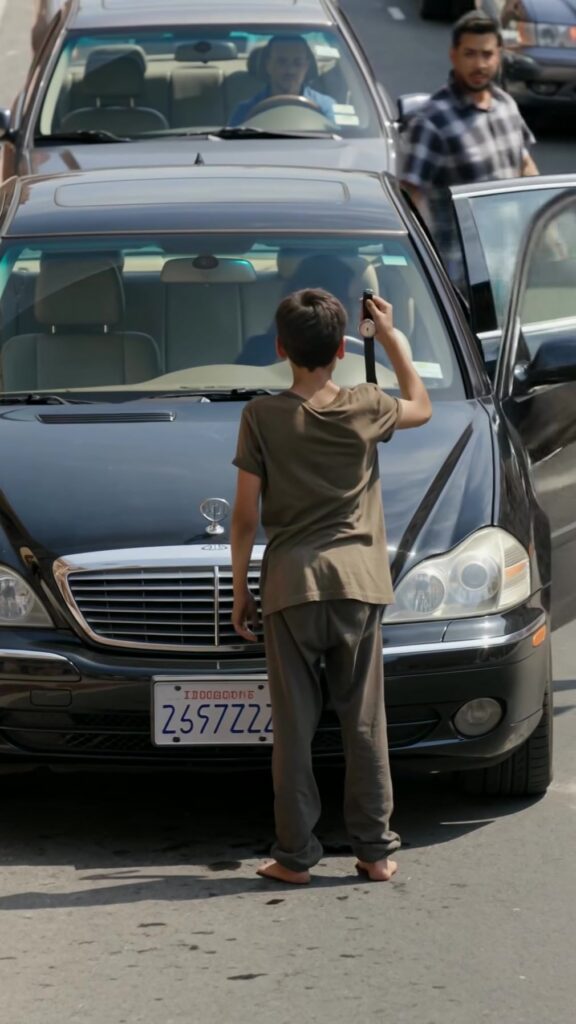
Everyone thought he was just another street kid, the kind the city learned to see without looking. He lingered where the sidewalk narrowed at the bridge, where the glass towers threw long, clean shadows over the grime. His hair was cut by a friend’s clippers and his hoodie had a broken zipper held together with a safety pin. He sat with his back against a pillar and watched traffic pour through the afternoon like a river that never noticed the stones it polished.
The intersection below the bridge was a famous throat in the city’s body—five lanes, two turning arrows, a crosswalk that counted down with a shrill impatience. Horns lived there. So did tempers. People stepped off curbs without lifting their eyes from glowing screens, trusting signals more than judgment. Cars surged when lights turned, and pedestrians flinched when drivers tested the limits of yellow.
The boy watched it all with a stillness that looked like surrender. He didn’t ask for money. He didn’t dance for pity. He didn’t harass anyone, which almost made him easier to ignore. A few commuters assumed he was high. A few tourists took pictures of the skyline and accidentally caught him in the frame like a blemish to be cropped out later.
His name was Eli, though no one called him that anymore. Names weren’t worth much on the street. The only things worth carrying were what you could keep in your pocket, what you could hide inside your shirt, what couldn’t be stolen by a quick hand.
He had one thing, flat and cold, tucked into the waistband of his jeans: a battered leather wallet with a cracked emblem pressed into the front. It looked like any other discarded wallet someone might have lost in a bar, except Eli held it like it might bite.
At four twelve, the light changed. A stream of cars accelerated through the intersection. Eli stood up, slow at first, like he was stretching after a long sleep. A woman in a crisp blazer glanced at him and kept walking, her heels tapping a warning. A man with earbuds stepped around him as if stepping around a puddle.
Eli didn’t wait for the walk sign. He didn’t wait for permission. He stepped off the curb and into the first lane of traffic as if the asphalt belonged to him.
Brake lights burst red. Tires screamed. A delivery van swerved and missed him by a breath. Someone shouted. Someone laughed, because fear sometimes turns into laughter when there’s nothing else to do.
Then, from the far lane, a black luxury sedan surged forward—sleek, polished, the kind of car that made the city’s reflections look better than they were. It was too fast. It did not expect a boy to be standing in its path.
Eli raised his hands, not in surrender but in choice. He struck the hood with both palms, hard enough that the sound cracked through the intersection like a snapped branch. The sedan skidded to a halt. For a moment, everything held—engine growling, people frozen mid-step, traffic lights blinking their indifference overhead.
Phones lifted like a flock of dark birds. People turned. Faces emerged from behind windshield glass. A chorus of “Oh my God” moved down the sidewalk.
The driver’s door opened with a soft, expensive click.
She stepped out like she owned the air.
She was tall, dressed in a charcoal coat that hung from her shoulders like a cape. Her hair was pinned back, her makeup precise in the way of someone who didn’t sweat. On her wrist a watch caught the light and threw it back with a sharp glitter. She looked around the intersection as though the entire city was inconveniencing her, then focused on Eli with a stare that had ended arguments in boardrooms and silenced rooms full of men.
“Are you out of your mind?” she snapped, voice carrying. “Do you know how much damage—” She cut her eyes to the hood, then to him. “Move. Now.”
Eli didn’t flinch. He stood in front of her car, chest rising and falling, and slid his hand beneath his hoodie. A few bystanders made a small noise and stepped back. Someone’s phone camera zoomed.
He pulled out the wallet.
It was nothing dramatic—no weapon, no knife, no gun. Just a piece of worn leather that looked like it had been carried for years, dropped, stepped on, rescued, and dropped again. He held it up between two fingers, not shaking, not pleading.
“You dropped this,” he said.
The woman’s annoyance sharpened into something colder. “I didn’t drop anything.”
Eli took a step closer. He didn’t cross the boundary of her personal space, but he didn’t retreat either. He flipped the wallet open with a careful thumb.
Inside, behind a clear sleeve yellowed with age, was an ID card that did not belong in any modern wallet. It wasn’t plastic and bright like the ones the city issued now. It was paper-laminated, the edges worn, the photograph faded but still recognizable: a younger version of her, softer around the eyes, standing in front of a building that had been torn down a decade ago. Beneath the picture, a name printed in old ink.
Her name—before she’d changed it.
Eli watched the moment her face changed, because he’d replayed it in his mind a hundred times. First came confusion, a blink as her eyes translated what they were seeing. Then a twitch in her jaw. Then a kind of emptiness that poured into her expression as if a floor had dropped out beneath her.
Her voice shifted when she spoke again. It lost its sharpness. It became smaller. “Where did you get that?”
Behind her, someone honked impatiently. Another driver shouted. But the sound seemed far away now, muffled by whatever had just opened inside her.
“From the river,” Eli said. “Under the old bridge, where the city dumps what it doesn’t want to remember.”
The woman’s eyes flicked to his hands, to the wallet, to his face. Panic wasn’t loud; it was precise. Her gaze measured exits, witnesses, angles. She glanced at the phones raised around them, at the strangers recording.
“Give it to me,” she said, and the command tried to return, but it came out cracked.
Eli didn’t move. “You said you didn’t drop anything.”
Her nostrils flared. She took one step forward, then stopped as if stepping closer would make the thing in his hands real.
“How much?” she asked, but it wasn’t the question of a mugging. It was the question of someone buying back a piece of their own skin.
Eli’s fingers tightened on the wallet. “It’s not money.”
“Then what—” She stopped herself. Her eyes searched his face again, and something in her expression broke apart, rearranging. “Who are you?”
Eli swallowed. The air smelled of hot brakes and exhaust and summer dust. His mouth was dry, but the words had been waiting in him, heavy as stones.
“You used to come to the shelter,” he said. “Before you stopped.”
Her eyes narrowed, trying to place him. The city had a thousand hungry faces; it was easy to forget them when your life became clean.
Eli’s voice stayed even. “You wore a cheap coat back then. You brought oranges in a bag and pretended you didn’t know how to peel them. You told people you were doing community service, but you weren’t. You were looking for someone.”
Her breath hitched. Her hands, immaculate, hovered at her sides with nowhere to go. “No.”
“You asked about a kid,” Eli went on. “A boy taken from a hospital. A boy with a birthmark like a comma behind his left ear.”
The woman’s hand went to her own ear without thinking. The gesture was small, unconscious, and it was all Eli needed to see. The crowd shifted, sensing the temperature change even if they didn’t understand it. The phones remained lifted, hungry.
“You were never meant to find me,” Eli said. “And I was never meant to find you.”
Her face went pale in a way makeup couldn’t disguise. “Stop,” she whispered. The word was a plea this time, not an order. “Don’t say it here.”
Eli held the wallet higher so the cameras caught the old emblem, the dated stamp, the name like a ghost. “You built your whole life on forgetting,” he said. “But you forgot something you shouldn’t have.”
Her eyes darted again to the witnesses. She took another step toward him, slower now, as if approaching a frightened animal. “Please,” she said, and the sound of it made a few bystanders frown, because it didn’t match the woman they’d seen step out of the car.
Eli’s throat tightened. He wasn’t here to humiliate her. He wasn’t here for applause. He had walked into traffic because he had run out of quieter ways to be heard. Letters had been returned unopened. Calls had been filtered through assistants. Every path toward her had been paved with locked doors.
“You left me,” he said, and for the first time his voice trembled, betraying the boy inside the street kid. “You signed papers. You erased a name. And then you pretended it was charity whenever you looked down from your office window and saw people like me.”
She closed her eyes for a second, as if bracing against impact. When she opened them, they were wet, and that seemed to frighten her more than anything. “I didn’t have a choice,” she said, and it sounded like something she’d rehearsed in the dark. “You don’t understand what they would have done. You don’t understand—”
“I understand enough,” Eli said. “I understand the river keeps what people throw away. I understand streets raise children when parents don’t. I understand how it feels to be a problem someone solved on paper.”
He held the wallet out, not offering it, just displaying it—proof that the past had teeth.
“I’m not here to blackmail you,” he said. “I’m here because I want you to look at me and know what you did.”
Traffic had begun to reroute around them in slow, frustrated arcs. The light changed twice. Horns came and went. But at the center of the intersection, the woman and the boy stood as if time had narrowed to a single point.
Her composure, the armor she wore so well, had slipped. In its place was a raw, startled humanity she didn’t know how to carry in public. Her voice, when she spoke, barely held together.
“What do you want from me?”
Eli looked at the phones, at the strangers watching, at the city that had named him invisible until he became an obstacle. He looked back at her.
“I want you to take it back,” he said softly. “Not the wallet. The truth.”
She stared at him, and in her eyes panic wrestled with recognition, with guilt, with something like grief. She reached out as if to touch his shoulder, then stopped, unsure whether she had earned that right.
And in that hesitation—caught on a hundred recordings, witnessed by a hundred strangers—the city finally saw what it had missed: the street kid wasn’t a nuisance in the road.
He was the past walking back into someone else’s carefully guarded future.
Sirens rose somewhere in the distance, growing nearer, as if the city itself had decided to pay attention at last. Eli held the wallet steady and waited for her to choose what kind of person she would be when the lights arrived.
Because whatever he was holding had been meant to stay buried.
And now it was in the open, demanding a name.