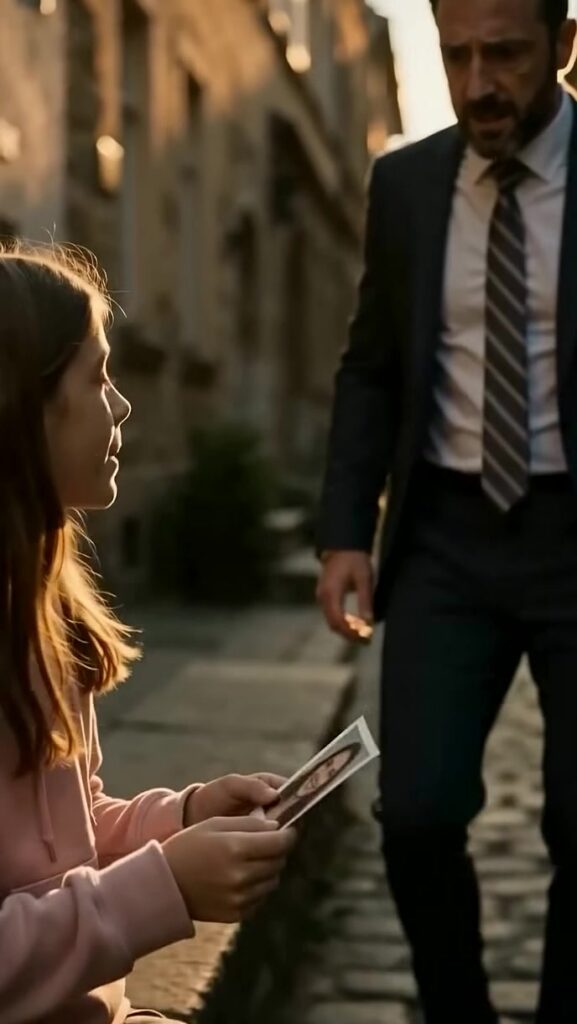
For five years, Daniel Reed had walked through life like a man already half-buried. He moved through mornings as if through wet earth, shoulders slightly bowed, breath careful, eyes fixed on the next obligation like it was a headstone he had to polish.
Each day began the same: the dark suit, the knot of the tie pulled tight enough to feel like penance, the cufflinks Elena had given him on their first anniversary. He kept them even after the metal dulled, even after the tiny scratches gathered, because he could not bear the thought of replacing anything she had touched. He could not bear newness. Newness was betrayal.
He took the same route to work and the same route back—down Market Street where the baker’s window steamed with bread he never bought anymore, past the boarded flower shop that used to send scent into the evening air, and into the narrow lane between old stone buildings where the city’s noise thinned to a murmur.
Inside the suit jacket, always, was the photograph: Elena in a slice of summer, sunlight caught in her hair, her smile open and unguarded as if the world had never hurt anyone. The picture’s corners had softened from constant handling. He told himself it was to remember her. The truth was simpler: it was proof he hadn’t imagined her.
She had vanished on a night that wouldn’t stop replaying. Rain had poured like a judgment, slapping the windows, turning streetlamps into smeared halos. Elena had left her office later than usual—she’d texted him, an apology and a joke about surviving on vending machine coffee. That was the last message. Three days later, the police found her scarf snagged on river reeds, blue fabric darkened by water and mud. No body. No purse. No phone. Just that limp strip of cloth and a stack of theories that all sounded like excuses.
People tried to help by finishing the story for him. They said the river took her. They said she must have run away. They said grief came in stages, as if it were a scheduled train. Daniel nodded and did what was required: made the reports, signed the papers, let friends and family fill his apartment with casseroles and pity. But at night he lay awake with his hand pressed to the empty side of the bed, listening to rain even on clear evenings.
On the fifth anniversary of her disappearance—a date he did not mark aloud but felt in his bones—Daniel walked home in a diluted gold light that made even broken cobblestones seem forgiving. His mind was elsewhere, trapped in that old rainstorm, when the photograph slipped from the inside pocket of his jacket without a sound. It fluttered down behind him like a tired leaf.
A little girl sitting on a low stone step saw it land. She looked about seven, with long brown hair gathered messily at the back, a pink hoodie too big in the shoulders, a plaid skirt, and shoes scuffed at the toes. She picked the picture up with both hands, careful, as if it might bruise.
Daniel kept walking until the girl’s voice reached him, thin but steady in the narrow lane. “Mister,” she called, and there was something in the way she said it—polite, but urgent, like a bell pulled too hard. “Mister… why do you have a picture of my mommy?”
He stopped, not all at once, but in layers. First his feet, then his breath, then the part of his mind that had been drifting. The city’s sounds stretched oddly, like elastic about to snap. He turned slowly.
The girl held the photograph at her chest, her fingers pressed along the edges. Her eyes were big and watchful, not frightened—more like she had been told to be ready. Daniel’s mouth went dry.
“What did you say?” he managed.
“My mommy,” the girl repeated, frowning slightly as if the answer should have been obvious. “That’s her.”
Daniel took a step toward her. The stones under his shoes felt uncertain. “That’s my wife,” he said, and the words scraped his throat. “Her name is Elena. She—” The old sentence tried to finish itself. She is dead. She is gone. But it caught and refused to form. “She disappeared years ago.”
The girl hugged the picture tighter. “No,” she whispered, almost offended by the idea. “My mommy is alive.”
The air seemed to thin. Daniel crouched, not trusting his knees. Up close, he saw the child’s seriousness, the lack of performance. Children could lie, yes, but lies had a flavor—too fast, too practiced. This wasn’t that. This was certainty.
“What’s your name?” he asked.
“Lucy.”
His tongue felt too large in his mouth. “And your mother’s name?”
Lucy blinked, then answered with the patience of someone repeating a lesson. “Elena.”
Daniel’s vision narrowed until all he could see was the girl’s face, and behind it, the photograph. The world tilted. His hands started to shake.
“Who told you that name?” he asked.
Lucy tilted her head. “She did.”
He swallowed hard. “Where is she, Lucy?”
Lucy glanced over her shoulder toward the far end of the lane. The last of the golden light was pooling between buildings, turning window glass into pale mirrors. “She told me to wait here,” Lucy said quietly. “She said if I ever saw a man carrying that picture, I had to ask why he still looked so sad.”
Daniel’s eyes stung. Elena used to say sadness showed like a shadow even when you tried to stand in the sun. She used to say it mattered who noticed. He brought one trembling hand to his mouth as if to hold himself together. “When did you see her?”
Lucy pointed down a side alley narrow enough to hide secrets. “This morning.”
Daniel followed her finger. At the alley’s end stood an apartment building with ivy crawling over its stone like veins. The second floor had one window half-open, a white curtain lifting and falling with the breeze, breathing.
Then a silhouette passed behind the glass—female, the same height, the same familiar tilt of the head as if listening for something that wasn’t sound. Daniel’s heart knocked once, hard, against his ribs. He stepped forward, helplessly.
“Lucy,” he whispered. “Who is up there?”
“My mom,” Lucy said, as calm as a verdict.
The curtain shifted again, and a woman moved close enough for the light to sketch her profile. Daniel’s lungs forgot their purpose. Even after five years, he knew the line of Elena’s cheek, the way she tucked hair behind her ear like a reflex. The world seemed to crack open, letting something impossible spill through.
“Elena,” he breathed, and the name left him like a prayer he didn’t deserve to say.
In the window, the woman’s head turned. Their eyes met through the glass and distance. For one suspended heartbeat, her face held a terrible mix of recognition and alarm, as if she had been caught between two lives.
Then panic erased her. She stepped back sharply, vanishing into the room. The curtain dropped. The light inside snapped off so suddenly it looked like darkness had been thrown like a blanket.
Daniel stood frozen, the lane suddenly cold despite the lingering sun. Lucy’s small hand found his sleeve, gripping him as if he were the only solid thing left. “Don’t yell,” she said in a hush, as if repeating another instruction. “She gets scared when people come too fast.”
Daniel’s voice came out ragged. “Why would she be scared of me?”
Lucy looked up at him, solemn. “Because she said you would have questions.”
Questions. Daniel had lived on them for five years, chewing them until they lost shape. But now the biggest one stood in a darkened room on the second floor: Elena alive, Elena hidden, Elena afraid.
He stared at the window, his grief changing form—no longer a burial, but a door that had just moved. Somewhere behind that glass was the answer, and it had turned off the light to avoid him. Daniel tightened his fingers around the edge of his jacket pocket, feeling the empty space where the photograph had been, and realized with a shock that for the first time in years, he did not feel half-buried.
He felt, instead, like a man standing at the lip of an open grave—and hearing someone breathe from below.