For most of his life, Lucien Moreau had walked through the city like a man nothing could touch. Doors yielded before his fingers found the handle. Conversations lowered themselves to a respectful hush as he passed. Even the weather seemed to negotiate—rain that had been punishing the boulevard minutes earlier thinned to a polite mist when his car arrived. He had built his life from architecture and certainty: the Moreau name on glass towers, his signature on contracts, his face on the business pages looking carved from confidence. He had trained himself not to feel the drag of crowds or the need in strangers’ eyes. Nothing was permitted to cling to him.
That afternoon, he was on foot only because he’d wanted to taste the city unfiltered—the damp stone, the exhaust, the river wind that turned collars up and made ordinary people hurry. His bodyguards followed at the regulation distance, two dark shapes that moved when he moved. He was halfway across a narrow cobbled lane when the sound found him: not loud enough to be called music at first, just a thread of notes trembling in the cold. It snagged on his attention like a burr. He turned his head, irritated at the intrusion, ready to dismiss it as another street performer trying to buy a moment of his public existence.
An old woman sat low on the curb where water collected. Her coat was thin, its hem dark with rain. In her hands, a violin looked older than the street itself, varnish worn to a dull glow. The case at her feet held a few coins and a folded paper cup, the kind of pleading arrangement Lucien had learned to step past without seeing. But she wasn’t playing to the crowd. She was aiming the bow toward him, as if the sound were an arrow and he the target. When he lifted his hand in a sharp, practiced gesture, she did not stop. The bow skated, caught, made a rough sound that drew a couple of heads. Then she found the note again—thin, fragile, almost swallowed by traffic—and in that note something inside Lucien split open with a quiet violence.
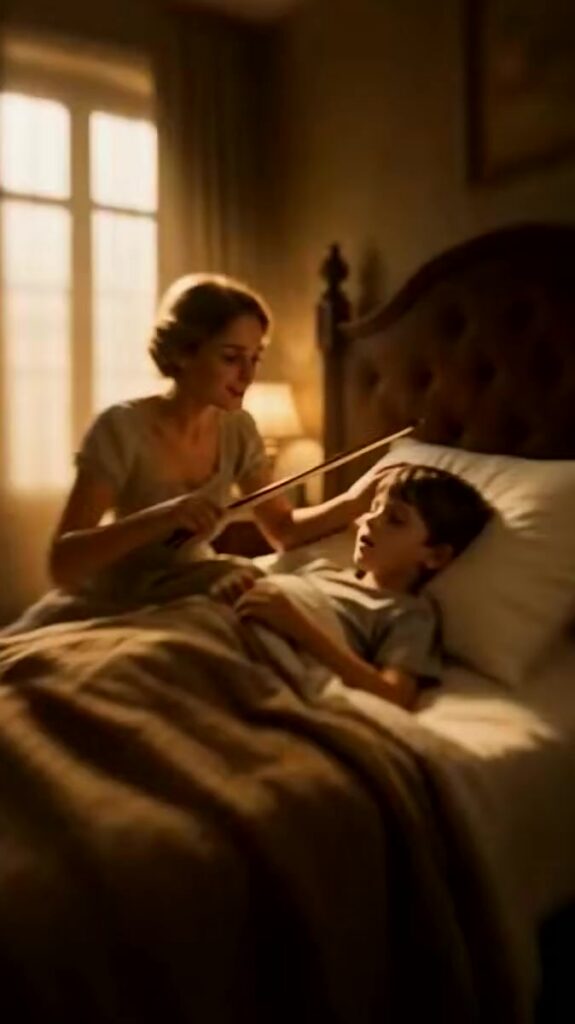
The street blurred. He tasted bitterness and metal, as if he’d bitten his tongue. The world changed temperature. Suddenly there was a lamp, not a sky. A small room warmed by amber light. A child’s breath—his breath—coming too fast under a blanket that smelled of soap. And beside the bed, a young woman with a tired smile and hair pinned carelessly back, her chin resting on a violin as she played that very melody, patient and steady, letting it braid itself into the air until it seemed the room could not hold fear. A hand brushed his forehead, smoothing fevered hair. In the memory, he heard his own voice, thin and pleading: again. Always, the woman whispered, and the word had the weight of a promise the universe itself was meant to keep.
Lucien jerked as if slapped. The lane returned—wet stone, sharp wind, the hard outline of a bodyguard at his shoulder. He was standing perfectly still, breath locked in his throat. One tear had already formed, betraying him, a traitor sliding toward the corner of his mouth. The old woman had stopped playing. She watched him with an expression that was not triumph but aching recognition, as though she had just watched someone rise out of a coffin. “You remember it,” she said, voice soft enough to be lost if the city wished. Lucien shook his head too quickly. Denial was an instinct as old as his power. “No,” he said, and even to himself the word sounded wrong.
“Look at me,” she insisted. The command had no authority in it, only need. Lucien wanted to refuse. He had refused whole governments. He had refused guilt. He had refused grief. But his eyes betrayed him, sliding back to her face. There was something in the mouth, in the shape of the cheekbones, in the way one eyelid lowered slightly more than the other. Things that logic could not assemble into coincidence. She lowered the violin and, with careful hands, reached into the inner pocket of her coat. What she brought out was wrapped in faded cloth tied with blue thread, the kind of color someone chooses when they mean a knot to last. She untied it slowly, as if unbinding a spell, and revealed a small silver thimble, a worn shirt button, and a photograph browned at the edges. Lucien took the photograph with fingers that did not feel like his own.
In it, a woman sat beside a child’s bed, violin on her lap, her face turned toward the camera with the weary devotion of someone who has been holding vigil for days. The child under the blanket had his own eyes—Lucien’s eyes—and above the brow, the faint scar he had once convinced himself came from a playground fall. The room behind them was the same room his memory had kept locked. His throat tightened until breathing became an effort. “My mother is dead,” he managed, because the sentence had been written into him with iron, repeated by tutors and priests and his father’s silent, relentless will. The old woman’s lips trembled. “That is what he told you,” she replied, and her gaze flicked past Lucien’s shoulder as if she could already see the man approaching.
The black car stopped hard at the curb, tires hissing on wet stone. The rear door opened with the calm precision of wealth. Lucien’s father stepped out as though he’d been summoned by his son’s doubt. Silver hair, black overcoat, posture that made even the street seem to stand straighter. Lucien had spent his life becoming a more polished version of that shape. But when his father’s eyes landed on the violin, the expression that crossed his face was not confusion. It was fear—raw and quick, like a mask slipping. The old woman went pale, clutching the instrument tighter, and Lucien understood in a cold rush that the triangle between them was not new. It was ancient.
“Get in the car,” his father said, not to the woman, but to Lucien, as if obedience were still the only language between them. The bodyguards shifted, awaiting instruction, uneasy in the way men become when power in the air changes hands. Lucien did not move. He turned slowly toward his father, the photograph still pinched between his fingers like proof that could burn. “You know her,” he said, and the words fell like stones into deep water. Silence answered him. It was the kind of silence that had built empires and buried inconvenient truths. The woman’s voice rose, trembling but unbroken. “He took you from me,” she said. “He told the world I vanished into illness, and he told you I chose to leave.”
Lucien’s father’s jaw tightened. “You are unwell,” he snapped, as though diagnosis could erase testimony. The woman gave a short laugh that sounded like pain forced into the shape of sound. “No,” she said. “I was made into a ghost because a ghost can’t testify.” She leaned forward, and in her eyes Lucien saw decades packed tight—hunger, waiting, the long discipline of staying alive for a single moment. “The grave you cried over,” she whispered to him, “was empty.”
Something inside Lucien—something that had never been allowed to be soft—turned liquid. He looked at the woman, then at his father, and understood that the untouchable life he’d walked through was not armor he’d forged but a cage built around him. All those years of invulnerability were suddenly recast as captivity, polished until it shone. The rain began again in earnest, drops striking the violin’s wood, the photograph’s glossy surface, his father’s immaculate coat. Lucien felt the city waiting, holding its breath. “Why?” he asked, and he meant everything: why steal, why lie, why murder someone into memory. His father’s eyes hardened, and for the first time Lucien saw not a ruler but a man cornered by the past. “Because,” his father said quietly, “love makes people reckless. And I could not afford reckless.” Lucien stared at him, shaking, while the old woman—his mother—lifted the violin once more. She drew the bow across the strings, and the melody rose between them like a verdict. Lucien did not step into the car. He stepped toward the sound, toward the wet curb, toward the woman who had been erased, and the world that had always moved for him finally did not know what to do.