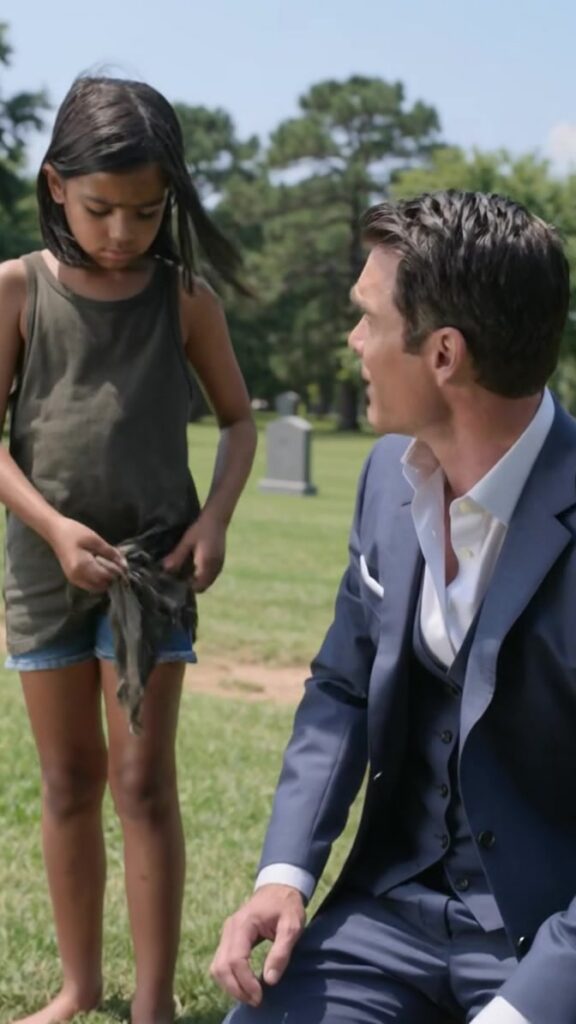
For two years, Adrian Vale arrived like a solemn appointment the world could predict by calendar. Same blue suit tailored to a body that had forgotten how to rest, same white lilies beaded with water from the florist’s fridge, same slow descent to his knees before the granite slab that bore the name CELINE VALE. The caretakers stopped trying to speak to him after the first season of condolences. Strangers learned to walk wide around him, as though his grief had a temperature and could burn. The richest man in the city bowed his head like a penitent and held still until the wind found its way inside his cuffs.
He had seen the casket lowered. He had stood beside a hole large enough to swallow a life, and when the first shovelfuls struck the lid, he felt something in him answer with a hollow sound. His mother had fainted with practiced elegance. His father had wept with dry eyes. The papers had printed photographs of Adrian’s face as proof that even titans could crack. And Adrian, obedient even in despair, had allowed the narrative to wrap around him: a billionaire undone by love.
On a gray afternoon when the sky hung low and metallic, the cemetery was emptier than usual. Trees scraped their branches together like brittle bones. Adrian traced the carved letters with his eyes, not touching, never touching, because contact felt like trespass. He was deciding which memory to feed himself next—Celine in the kitchen with flour on her cheek, Celine laughing at the gala where he’d mispronounced an artist’s name—when a voice rose behind him, small and frayed by fear.
“Sir… please.” The words trembled, then steadied as if the speaker pressed them out through clenched teeth. “Your wife isn’t here.”
Adrian turned so fast his knee ground into gravel. A child stood at the edge of the path, barefoot despite the cold, her toes dark with dirt. Her dress might once have been yellow, but it was now the color of old smoke. She held a rag in one hand, twisting it the way prisoners twist bedsheets, and her eyes—huge, fever-bright—kept darting to the surrounding hedges as though they could sprout men.
“You don’t know what you’re saying,” Adrian replied, and the calm of his voice scared even him. His security detail had been told to wait by the gates. He liked this part alone. “Go home.”
She shook her head hard enough to make her tangled hair slap her cheeks. “She told me you’d say that. She said you wouldn’t believe any mouth but you’d believe a thing.”
Her fist disappeared into a pocket and reemerged clenched around metal that caught the weak light. A necklace, silver, the chain delicate as a spider’s thread, the pendant a small oval locket engraved with a compass rose. Adrian felt his throat close. He had bought it in Lisbon, impulsively, because Celine had stared too long at a shop window and then pretended she hadn’t. On the night before the funeral, when the undertaker had turned his back for a heartbeat, Adrian had fastened it around her neck with shaking hands, begging whatever came after death to give her something of his to hold.
He took a step toward the girl and then stopped, as if the air between them were a glass pane. “Where did you get that?” The question came out raw, stripped of every boardroom polish.
The girl’s lower lip quivered. “She gave it to me. She said I was her proof.” She held it out but didn’t release it. “She told me to find you on a day when the wind was loud, because then they couldn’t hear us.”
“They?” Adrian repeated. His pulse hammered so hard he tasted iron.
She swallowed, eyes shining. “If you go after her before she says, they’ll kill you. They’ll kill me. She said you have enemies that call themselves family.”
The cemetery seemed to contract. Adrian heard, with sudden clarity, the faraway hum of traffic beyond the wall, the creak of a branch, the click of his own jaw. His family’s name—Vale—was carved into buildings, stamped on philanthropic plaques, whispered in courts. It was also the name of a private war waged in polite rooms. He had inherited a fortune and an empire built by men who believed love was a liability and secrets were the only true currency.
Adrian looked down at the gravestone. CELINE VALE. He had watched those letters hammered into place by a mason who did not know he was sealing a lie. “Tell me your name,” he said, forcing his voice into something gentler than the violence in his chest.
“Mara,” she whispered. “Mara Quinn. She found me behind the docks, when I ran. She said I could sleep without being afraid if I listened and remembered.” Mara lifted the necklace a fraction higher, like an offering. “She said you would know what to do when you saw it.”
Adrian’s mind leapt through two years with ruthless speed: the closed-casket insistence disguised as mercy; the doctor his father recommended; the security footage that vanished from the hospital corridor the night Celine supposedly flatlined. He recalled how his mother had clasped his hands and murmured, You must be strong, Adrian, and how her nails had dug into his skin as if she feared what he might do if he ever broke free.
He reached for the necklace and this time Mara let it go. The chain pooled into his palm, cold and undeniable. The locket’s hinge was stiff; he pried it open with his thumbnail. Inside was not a photograph. There was a sliver of paper, folded to near nothing, ink bled slightly as if it had been sweated against skin.
Three words: TRUST NO VALE.
Adrian’s breath left him in a quiet, defeated sound. This was Celine’s handwriting—her sharp V’s, the way she crossed her T’s like small swords. For the first time in two years, the grief that had kept him kneeling shifted into something sharper. Rage came in behind it like a tide.
“Where is she?” he asked, and the question was not a plea but a vow.
Mara glanced toward the mausoleums, then toward the gate, as if measuring distances in her head. “Not here. Not in the city. She’s… hidden. There’s a place with salt air. Boats that leave before sunrise.” Her voice dropped to a whisper. “She said you’d have to stop being who you are to reach her. Because they watch the billionaire. But they don’t watch a man who’s dead inside.”
Adrian almost laughed at the cruelty of how well Celine knew him. He had been dead inside on purpose, because it was safer than feeling. He had worn the same suit, brought the same flowers, performed the same monthly ritual because routine made him predictable. Predictable men could be managed.
He closed the locket and curled his fingers around it until the metal bit into his skin. “Mara,” he said softly, “did anyone follow you?”
She hesitated. That pause was answer enough.
Adrian rose, the movement deliberate, like a man standing up from a sentence. He placed the lilies at the base of the stone, but he didn’t look at the name anymore. He looked beyond it, beyond the lie, as if the earth itself had become a thin curtain. “Then we leave now,” he said. “And we don’t go through the gate.”
Mara’s eyes widened. “They’ll find us.”
Adrian’s gaze drifted toward the family crest carved on his signet ring, the one he’d worn like a shackle since childhood. He slid it off and dropped it onto the gravel beside Celine’s grave. The sound was small, but it felt like thunder. “Let them,” he murmured. “If they want me, they can come for a man who has finally decided to live.”
He took Mara’s hand—so light it seemed made of bird bone—and led her toward the row of old yews where the cemetery wall dipped low. Behind them, the wind rose and rattled the trees, loud as a warning. Ahead, somewhere beyond salt and shadows and dawn boats, the woman he had buried was waiting for the moment he stopped kneeling.
And as Adrian Vale swung a leg over the stone wall, tearing the knee of his immaculate blue suit, he understood the last, bitter twist of the story people told about him. They had said he buried half his soul with his wife. They were wrong. Someone had stolen it—carefully, expertly—and he was about to take it back.