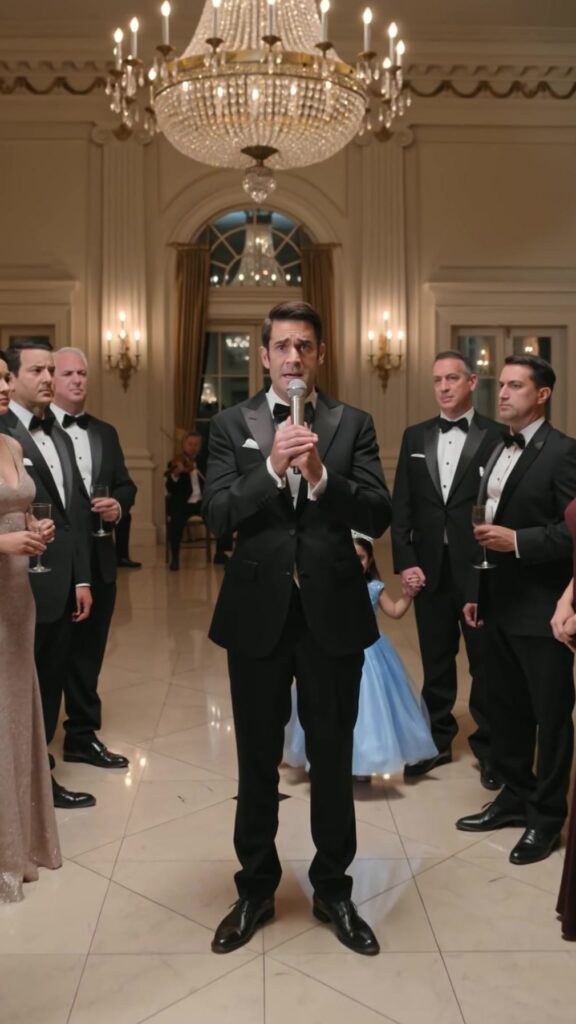
Golden light from dozens of chandeliers spilled across the polished marble floors of the Harrington mansion, sparkling like fragments of distant galaxies. The soft clink of crystal glasses mixed with the elegant hum of conversation drifting through the enormous ballroom, a sound so practiced it might have been rehearsed. Outside, through the tall glass doors, the driveway shone with the slick curves of luxury cars, as though the night itself had been hired to applaud.
Inside, Daniel Harrington stood near the stage as if nailed there. He was forty years old tonight, a milestone polished by wealth into something ceremonial. People knew his story in headlines: the boy who’d started with a basement office and a borrowed laptop, the man who now sat at the center of a technology empire that had rewired half the world. But beneath the tailored tuxedo and the controlled smile, his hands trembled around a microphone.
Beside him stood Emily.
Eight years old, a white dress stitched with silver thread, curls pinned back with a star-shaped clip. She held Daniel’s hand with the unyielding grip of someone clinging to the only solid thing in a room that swayed. Her eyes—brown, wide, too observant—moved over the crowd without landing anywhere for long. When the orchestra softened, conversations fell away like curtains, and the room leaned toward Daniel’s breath.
“I invited you here tonight,” Daniel began, the words dragging as though he had to pull them from somewhere deep and raw, “not only to celebrate my birthday.” He swallowed and glanced down at Emily, as if checking that she was still real. “But because I need your help.”
The hush was instant and brittle. There were senators and investors and celebrated surgeons under the chandeliers, all of them suddenly unsure where to put their faces. Daniel continued, voice thickening. “My daughter lost her voice. We’ve tried everything. Every specialist. Every therapy. Every miracle in a white coat.”
He paused. The microphone made his breathing louder than it should have been.
“If anyone here can help her speak again,” he said, and his control slipped on that last word, “I will pay one million dollars.”
The room twitched with disbelief. A million dollars was a number people used for wings on hospitals, not for a child’s silence. Emily squeezed his hand harder, but she did not look afraid. She looked resigned, as if silence had long ago become the language the world expected from her.
Three years earlier, she had been in the back seat when the accident happened. The details had been sealed behind insurance statements and careful press releases, but Daniel’s mind replayed it in unedited fragments: the wet road, the sudden flare of headlights, the sickening weightlessness before impact. His wife’s laugh—cut off. Emily’s small voice calling “Mom?” once, maybe twice, and then… nothing. Emily had walked away without a bruise, but from that night forward she didn’t speak. Doctors named it selective mutism. Daniel called it a curse he couldn’t buy his way out of.
As Daniel lowered the microphone, the silence in the ballroom grew so complete it made the chandeliers seem louder. Then a voice—small, clear, and utterly misplaced—rang from the back of the room.
“I can make her speak again.”
Heads snapped toward the entrance. A thin boy stood there as if he’d been delivered by the cold night and forgotten by the door. He looked nine, maybe, but hunger had sharpened him into something older. His clothes were torn and smeared with city grime, his shoes cracked and peeling. Dark hair fell into his eyes, and his face held a strange stillness, like someone who’d learned to watch without being seen.
Security moved fast. Two guards converged, hands already reaching. “Kid, you can’t be in here,” one hissed, trying to take him by the arm.
The boy didn’t flinch. “I can help her,” he repeated, eyes fixed not on Daniel but on Emily.
A ripple of murmurs rose, cynical and irritated. Some guests smiled with the tight politeness reserved for interruptions. Someone laughed once, too loudly, then stopped when Daniel’s gaze cut across the room like a blade.
“Who let him in?” Daniel demanded, the microphone still in his hand as if it were a weapon. His voice was sharp enough to make the nearest guests stiffen. He could feel humiliation creeping up his collar: this was supposed to be controlled, dignified desperation, not a spectacle.
Before the guards could drag him away, the boy stepped forward. “I heard what you said,” he told Daniel, calm as a physician. “A million dollars. But you don’t need money. You need her to remember something she’s avoiding.”
Daniel’s jaw tightened. “Go do your work,” he snapped, meaning whatever street job the boy had been forced into. “This isn’t a child’s game.”
The words struck the room like a slap. A few guests shifted uncomfortably; others looked relieved that Harrington was restoring order. But the boy didn’t shrink. He tilted his head slightly, as though listening to a sound no one else could hear.
Emily, who had been still as a statue, moved. Not a step—just her face lifting. Her gaze met the boy’s, and something in her eyes loosened. For the first time in years, Daniel saw not resignation but recognition.
The boy spoke again, softer now, not to Daniel, but to Emily. “You don’t have to hold it by yourself.”
Emily’s fingers tightened around her father’s hand, then—slowly—she let go. A collective intake of breath swept the ballroom. She took one small step toward the boy, then another, like someone testing whether the floor would betray her. Daniel started to follow, panic rising, but he stopped when he saw her shoulders: tense, yes, but determined.
“Emily,” Daniel whispered. His voice cracked. He hadn’t realized how long it had been since he’d spoken her name and expected an answer.
The guards hesitated, glancing at Daniel for instruction. Senators watched like judges. Billionaires watched like gamblers. The chandeliers continued pouring down their golden light, uncaring, lavish, blinding.
The boy reached into his pocket and pulled out something small. Not a trick coin, not a talisman—just a battered keychain with a tiny silver star attached, dulled by time. He held it up between thumb and forefinger. “This fell under the seat,” he said. “The night of the crash.”
Daniel’s heart lurched. He knew that star. He had bought it for Emily at a roadside stop on their way back from the lake, hours before their world shattered. Emily had insisted on holding it instead of clipping it to her backpack. After the accident, it had vanished. Daniel had searched the wreckage until paramedics pulled him away.
“Where did you get that?” Daniel demanded, stepping forward now despite himself.
The boy didn’t answer. His eyes stayed on Emily. “You remember,” he said to her, not as a question. “You remember the sound.”
Emily’s lips parted. No words came. Her throat worked as if it had forgotten the mechanics. Her small hands rose, hovering near her ears. Daniel saw her blinking fast, fighting tears that made her eyes shine brighter than the chandeliers.
In the quiet, Daniel heard it too—memory’s ghost: the wail of tires, the crunch of metal, his wife’s breath leaving in a sound that had no name. He had tried to bury it under money, under work, under speeches and philanthropy and a carefully curated life. Emily had done something different. She had swallowed it whole and sealed it behind silence.
The boy took one more step closer, careful, as if approaching a frightened animal. “You weren’t the reason,” he said.
Emily’s face twisted as if struck. A sound escaped her—thin, broken, half a sob. The ballroom held its breath, suddenly terrified of startling her back into quiet. Daniel’s eyes burned. He couldn’t move.
Emily opened her mouth again. Her voice emerged like something dragged from a deep well, raw and small and unmistakably hers.
“I… told her… look,” she whispered.
Daniel’s knees almost gave way. The words were barely audible, but they landed with the force of a collapsing wall. Emily’s eyes filled, and she continued, each word a stone pried loose. “I… pointed… and she—she turned. I made her—”
“No,” Daniel said, stepping forward, unable to contain himself. He knelt in front of her, his tuxedo brushing the marble, heedless of every watching eye. “You didn’t make anything happen.”
Emily’s breath came in shudders. “If I hadn’t—”
Daniel reached for her hands and held them tightly, as though he could keep her from falling into that guilt again. “The road was slick. The other car crossed the line. The reports—Emily, sweetheart, it wasn’t you.”
Emily looked at him as if hearing it for the first time. Perhaps she was. Perhaps all these years she’d been living with a verdict no adult had managed to pry from her clenched heart because she couldn’t bear to give it words.
Behind them, the boy stood very still, the little star keychain glinting faintly. A few people in the crowd had begun to cry, surprised by their own tears. Others stared, unnerved, as if they had witnessed something far more intimate than any toast.
Daniel turned toward the boy, voice hoarse. “Tell me your name.”
The boy’s gaze flicked toward the glass doors, where the night waited like an open mouth. “Names change,” he said. “But I used to be in the car behind you.”
Daniel froze. “You—”
“I saw it,” the boy continued. “I saw her turn. I saw you reach back. I saw the other car. And I saw her keep that star in her hand even after everything.” He extended the keychain toward Emily. “She never dropped it. It was taken from the wreck when they cleaned the road. It ended up in a box at the impound lot. My uncle worked there.”
Emily reached out and took the star. Her fingers closed around it like a promise reclaimed. Her voice, still trembling, rose a fraction. “Mom… liked stars,” she said, and then, as if the words unlocked a door, she began to cry—not silently, not trapped behind a wall, but openly, with sound.
Daniel pulled her into his arms, holding her so tightly he feared he might break her, yet terrified that if he loosened his grip, she would vanish back into wordless distance. “It’s okay,” he whispered over and over, though he didn’t know if he was comforting her or himself.
When he looked up again, the boy was already backing away. The guards, uncertain now, didn’t stop him. The crowd parted as he moved through it, no longer a nuisance but a shadow that had delivered something priceless and could not be repaid with a check.
“Wait!” Daniel called, standing abruptly, Emily still clinging to him. “The money—at least let me—”
The boy paused at the threshold and glanced back once. In the golden spill of chandelier light, his face seemed briefly older, as though it carried the weight of too many nights spent outside warm rooms. “Buy her more than silence,” he said. “Buy her time.”
Then he slipped out into the dark, swallowed by the line of cars and the cold air and whatever life waited beyond the mansion gates.
Inside, the chandeliers continued to shine. The guests would eventually return to their conversations, to their deals and their accolades, telling each other they had witnessed a miracle at Harrington’s birthday. But Daniel knew it hadn’t been a miracle. It had been something harsher and truer: a child finally daring to name the terror she had been carrying, and a stranger at the door insisting she didn’t have to carry it alone.
Emily lifted her face from Daniel’s shoulder. Her cheeks were wet, her eyes red, but her voice—still fragile—found him again. “Dad,” she said.
Daniel’s breath caught, as if the world had just restarted. “I’m here,” he answered, and this time, he didn’t need a microphone for the room to hear the sincerity in it.
Above them, the golden light scattered across the marble like galaxies breaking apart, and for the first time in three years, Daniel Harrington felt that the universe might be capable of rearranging itself into something livable.