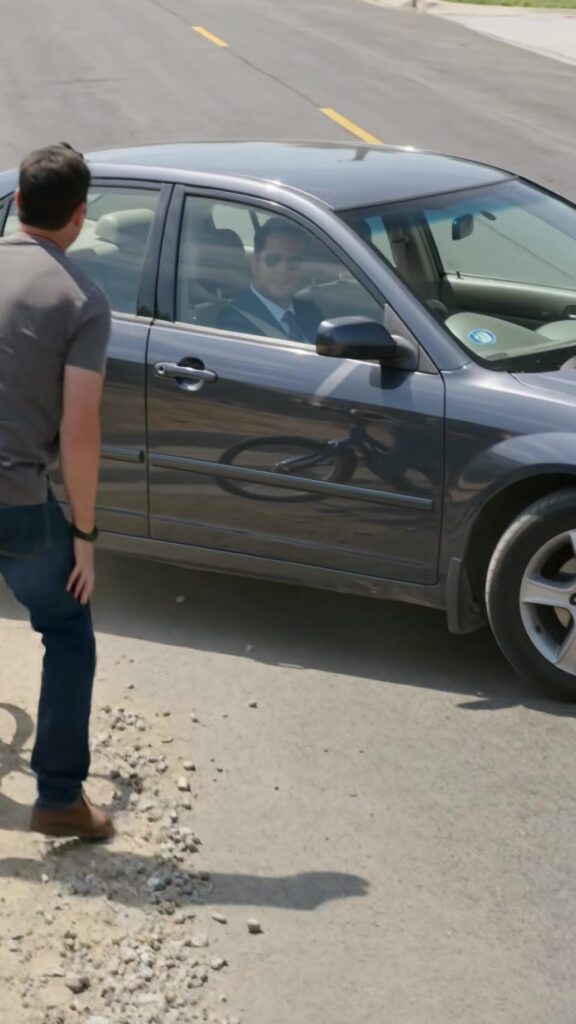
He didn’t just almost hit my son. That’s the sentence people kept trying to shorten, the way they do when something makes them uncomfortable. They’d say, “So there was an accident?” or “At least nobody got hurt.” But it wasn’t an accident, and the almost was the cruelest part—like the universe had leaned close, shown us the edge, and then whispered, Remember this feeling.
It happened on Willowbend, that narrow street with the old maples and the soft curves that lull drivers into thinking they’re on a private road instead of a neighborhood where children still ride bikes. It was late afternoon, the kind of light that looks like honey spilled across asphalt. My son, Eli, had begged to take his new bike to the corner and back. Eight years old, helmet a little too large, sneakers flashing when he pedaled. I watched from the sidewalk with my coffee cooling in my hand, pretending I was casual while my eyes tracked every wobble.
He was doing everything right. Staying near the curb, hands tight on the grips, chin up like he’d practiced. He wasn’t even fast—just careful, earnest. That’s what burns me most. It wasn’t a reckless kid darting into traffic. It was my boy, trying so hard to be good.
The car came out of nowhere, the way nightmares do. A silver sedan eased around the bend, quiet at first, like any other commuter slipping through the neighborhood. I noticed the tinted windows, the gleam of the hood, nothing more. Then the front end shifted—just a subtle angle, like the driver adjusted to avoid a pothole. Except there was no pothole. There was only Eli, a small bright shape on two wheels.
I remember the motion with painful clarity: the sedan gliding closer to the curb, the distance collapsing, Eli’s head turning at the last second. His front tire jerked. The bike slipped, the handlebars snapping sideways. For the briefest moment his body went weightless, and my mind did what it always does in a crisis—it ran ahead to the ending.
In that ending I saw the tires roll over him. I saw his helmet crack. I heard, before it happened, the sound a parent is never meant to hear.
I screamed his name so hard my throat tore. “ELI!”
The sedan didn’t hit him. Not fully. It clipped the edge of his bike, close enough to rattle the spokes and shove him into the gutter. Eli fell, palms scraping the pavement. His knee smacked hard. His helmet bounced once, a plastic knock that felt like a hammer against my ribs.
And the driver did not stop.
He slowed.
That detail is what makes the story rot from the inside. He slowed as if to savor it, as if to confirm the damage. The driver’s window slid down. A man leaned out, face sharp in the slanting light—mid-forties maybe, clean haircut, a grin that didn’t belong on any street where children lived. He looked from Eli to me, and his mouth curved in a smile so easy it was almost friendly.
Then he spoke, voice calm, words tossed like gravel. “You need to teach your kid where he belongs.”
Eli was trying to be brave, the way little boys do when they think courage can stop pain from being real. He pushed himself up, shaking, cheeks blotchy. His lower lip trembled, and he fought it like it was an enemy he could defeat. The scrape on his palm was already oozing. His eyes kept darting to the car, as if it might lunge again.
The man watched him the way someone watches a show. Like he’d paid for the seat and wanted his full entertainment. He chuckled, a small sound, and the car crept forward another foot. His gaze slid past Eli’s helmet to the bike on its side, then back to my face as if waiting for me to do something—yell, run, swing my coffee mug like a weapon. He wanted the escalation. He wanted my anger to be the excuse.
Something inside me tightened, not hot like rage, but cold—focused. In the same moment, I realized two things: I was being studied, and this wasn’t the first time he’d done this. Men who act like that don’t improvise. They practice. They pick their stages. They choose targets who won’t be believed.
I ran to Eli and knelt, hands hovering, afraid to touch him too hard. “Look at me,” I said, forcing my voice into steadiness. His pupils were wide, his breathing shallow. He nodded, trying to swallow the fear.
Behind us the sedan idled, patient. The driver leaned one elbow on the window frame. He was smiling still, that same bright, casual cruelty. Like he’d just told a joke at a barbecue.
I didn’t yell. I didn’t lunge. I didn’t give him the satisfaction of a scene he could twist later into “crazy mom attacked me.” I pulled my phone from my pocket with hands that did not shake—at least not enough to see.
“Eli, stay right here,” I whispered. “Eyes on me.”
I stood, turned slightly so the driver could see the phone, and I took a photo of his license plate. Then another of his face, framed in the window, grin intact. The click of the camera sounded loud as a door slamming.
His smile faltered for the first time, just a flicker. Then it returned, broader, forced. He laughed, as if I’d shown him a magic trick. “Go ahead,” he said. “Call whoever you want.”
He believed—truly believed—that nothing would happen. That the world belonged to men like him, men in cars with tinted windows and a sense of ownership over the street, the curb, the air.
I brought the phone to my ear and made one call. Not to 911. Not at first. My thumb moved with a certainty that surprised even me, dialing a number I hadn’t used in years.
When the line picked up, I didn’t waste words. “Marisol,” I said, voice low. “I need your help. A man in a silver sedan just tried to run my son off his bike. I have his plate and his face.”
There was a pause, the kind that isn’t hesitation but ignition. “Where are you?” she asked.
“Willowbend. Near the playground.”
“Stay there,” Marisol said. “Don’t engage him. I’m ten minutes away.”
“Ten minutes?” I echoed, not understanding.
“I’m on duty,” she replied. “And I’m not coming alone.”
The driver’s laughter changed when he saw my expression. He couldn’t hear the call, but he could sense the shift, the way my posture settled like a locked door. His grin thinned. He glanced in his rearview mirror as if suddenly aware of how many houses were watching.
My son whimpered softly behind me. I crouched again and touched his shoulder, careful. “You did nothing wrong,” I told him, each word a vow. “Do you hear me? Nothing wrong.”
Eli nodded, tears finally spilling, silent and furious. He pressed his scraped palm against his shirt, trying to hide the blood like it embarrassed him.
The sedan inched forward, then stopped again. The man leaned out, eyes narrowed. “You think you’re tough?” he called. “You think anybody’s going to care?”
I looked straight at him and said nothing. I held my phone up just enough for him to see the screen where his plate number sat in clear black text. Then I turned the camera back on him and began recording.
His expression tightened into something uglier than a smile—annoyance, maybe fear. He wasn’t amused anymore. He was calculating.
In the distance, the faintest wail began to rise, thin at first, then growing. A siren braided itself into the quiet afternoon. Somewhere nearby, another joined it, a second thread of sound, tightening around the street like a net.
The man’s head snapped toward the noise. His eyes darted to me, to Eli, to the houses. He swallowed, jaw working. For the first time he looked like a person who understood consequences.
He put his car in gear.
I kept filming, tracking the plate as he rolled forward. My voice, when it came, was steady and loud enough for the microphone to catch. “Silver sedan leaving the scene,” I said. “Driver male. Plate captured. Child injured.”
Eli’s fingers curled around my sleeve. I felt how hard he was shaking. I wrapped my arm around him and held him close, anchoring him to my body, to the fact that he was still here.
The sedan accelerated toward the bend, trying to vanish back into ordinary life. But the sirens grew louder, closer, no longer abstract. And as the car disappeared around the curve, I realized the driver had been wrong about one thing.
Something would happen.
Not because I was stronger than he was in that moment. Not because I’d screamed louder or swung harder. But because I had refused to let the story be simplified into an “almost.” I had his face. I had his plate. I had my son’s shaking breath against my ribs. And I had a friend in uniform, on duty, already turning onto Willowbend with a squad car behind her.
Eli looked up at me, eyes wet, voice small. “Is he coming back?”
I pressed my forehead to his helmet, tasting salt on my lips, and listened to the sirens swell like thunder. “No,” I told him. “He made his choice. Now we make ours.”