He had imagined her face the entire way home, the way a man presses a photograph to the inside of his skull until it becomes more real than the road. In the dark of transport planes, in the fluorescent hum of overseas terminals, in the rattling silence of buses that smelled like diesel and old coffee—he held on to the same picture. Maren in the doorway. Maren in the porch light. Maren with hands on his cheeks as if checking he wasn’t smoke. He rehearsed her name in his mouth, the way it would sound spoken in their hallway again, not into a satellite phone that delayed his words just long enough to make him feel like he was talking to the past.
Through every mile and every checkpoint, when strangers in uniforms glanced at his papers and waved him forward without looking at his face, he kept that picture steady. It soothed the parts of him that had learned to wake at the smallest sound. It kept his hands from shaking when he finally sat alone in an airport bathroom, listening to the water run and trying to remember how to be in a place where no one was watching the sky.
On the ride from the base to town, the driver filled the cab with small talk—weather, a new grocery store, football—each topic landing like a pebble thrown at a locked door. Jonah answered when he had to and watched the neighborhood rise around him like a familiar dream. The same trees. The same bent stop sign. The same pale blue mailbox with the chip on the corner from the time he backed into it too fast with the boat trailer. His chest tightened the way it always did before something important, that sensation that was almost joy and almost fear and, in the end, mostly wanting.
The house looked smaller than he remembered, as if the years had pinched it in. A warm rectangle of light spilled from the front windows. He adjusted the olive duffel on his shoulder and climbed the steps, boots heavier than they should have been. For a second he paused, hand hovering over the doorbell like it mattered. Then he chose the key under the flowerpot, the old habit, and let himself in the way he’d always done.
Music met him first. Not the triumphant hush he’d pictured, not the breathless stillness of someone waiting for a long-delayed knock. Music, soft and casual, as if this were just another night. The notes drifted from the living room, blending with the smell of wine and something sweet, like a candle burning too long.
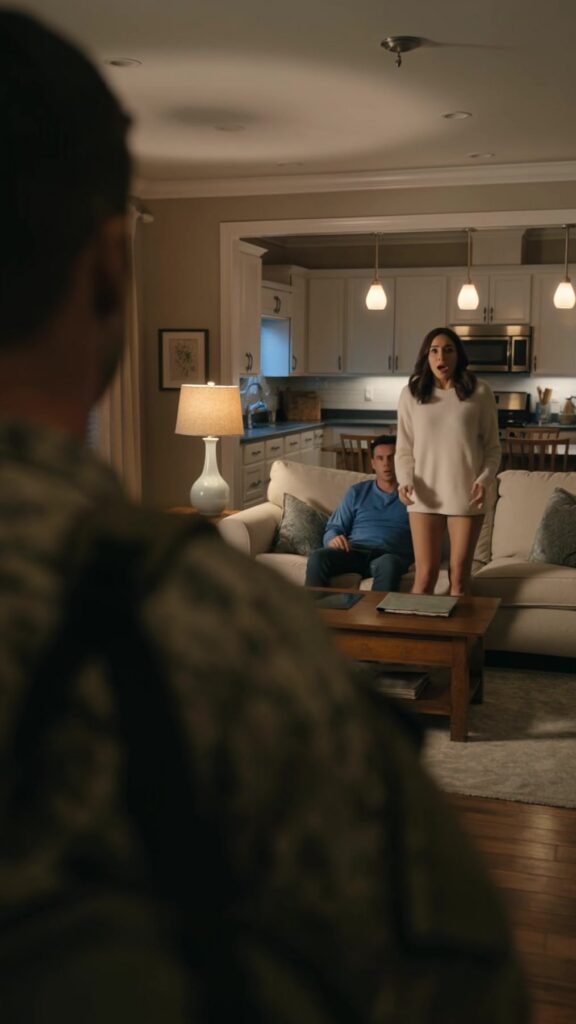
His eyes adjusted. The living room glowed amber, shadows rounded by lamplight. On the beige couch, Maren sat turned toward a man Jonah had never seen. Not laughing. Not making space. Close in the way people are when they believe they have time. Their knees almost touched; the man’s hand hovered in that uncertain territory between her wrist and her thigh.
The music stuttered, or perhaps Jonah’s hearing did. Maren’s head snapped up. The man jerked back as if the air had turned to ice. Maren stood first, her face blanching as if all the blood in her had been drained in one frightened breath.
“Jonah—” she began. Her voice came out thin, a sound that didn’t belong in his memories. “I can explain.”
He wanted words. He searched for them like he used to search a room—fast, methodical, scanning corners—but the sentence never formed. His mouth stayed closed. His face did not contort into a roar or split into tears. It went blank, a kind of dead calm that felt worse than either. In that silence, the man in the blue shirt stood too quickly and tried to smile, as if friendliness could rebuild the world in a single expression.
Jonah’s eyes moved once across the room—couch, wine glass on the coffee table, a second glass with lipstick that didn’t look like Maren’s shade—and then landed on something half-hidden under the table. A small pink stuffed rabbit, one ear bent at the tip, its fur dulled by years of being held too hard.
His daughter’s.
The picture he’d carried for months adjusted itself, like a photograph in a frame suddenly jarred. Emma was supposed to be with her aunt tonight. That was what Maren had told him in their last phone call, when her voice had trembled with what he’d mistaken for excitement. Emma would be asleep in a guest bed, Maren had said, so Jonah could come home to quiet, so they could have a moment alone. Jonah’s gaze stayed on the rabbit as if it were a flare in fog.
His voice, when it came, was low and unfamiliar. “Where is Emma?”
Maren stopped moving. The man’s eyes slid away toward the hallway, a reflex, an instinctive glance toward the place he hoped Jonah wouldn’t look. Wrong move. Jonah’s duffel slid off his shoulder and hit the floor with a heavy thud. The sound made the room jump as if the house itself had flinched.
“Please,” Maren said, stepping toward him with her hands half-raised, palms out, the universal gesture of trying to calm an animal that might bolt. Tears spilled without warning, and Jonah hated them for being real. “Just listen to me. Please.”
He moved past her, not shoving, not violent, simply unstoppable. He reached for the rabbit with hands that trembled in a way they never had when he held a rifle. The toy was warm, as if it had been hugged recently. As he lifted it, something else caught under his fingers—paper, crumpled near the couch. A child’s drawing, folded and unfolded too many times. He smoothed it carefully on the table as if flattening it might flatten his own racing thoughts.
Three stick figures stood in front of a house. One was colored in green, with a square head and lines that could be a helmet or a cap. One had long yellow hair. And beside her, inside the house, a third figure was drawn in blue with arms stretched toward the woman, as if claiming the space. Across the top, in messy, earnest handwriting that made Jonah’s throat seize, were words that tilted at a childish angle: MOMMY SAID DADDY MUST NOT SEE.
The room drained of sound. Even the music, which had been playing from a small speaker, seemed to shrink into nothing. Jonah stared at the letters until they blurred. He heard his own breathing—too slow, too controlled. He heard Maren’s small sobs. He heard the man shift his weight, like someone preparing to run.
Then, from upstairs, a sleepy voice called through the railing, stretched long with confusion: “Mommy… is the soldier man home?”
Jonah’s head lifted. For a moment he was nowhere—back in a place where voices in the dark meant danger, where the wrong sound could split your world. Then the voice came again, softer, closer to the top of the stairs. Little feet padded. A door creaked. Jonah felt something in his chest tear and knit itself at the same time.
Emma appeared at the landing in pajamas with tiny stars. Her hair stuck out on one side, flattened by sleep. She blinked down into the living room, eyes narrowing as if she couldn’t quite make sense of the shapes below. Then her gaze found Jonah, and recognition hit her like sunlight. Her mouth opened, a pure, startled joy breaking across her face.
“Daddy?”
Jonah took one step forward, and the floorboards complained under his boots. He wanted to run to her, to scoop her into his arms and bury his face in her hair until the world made sense again. But he was aware of Maren beside him, shaking, and the man hovering near the couch, and the drawing on the table like a confession. He felt split into two people: the father who had survived for this moment, and the husband standing in the wreckage of his imagined return.
Emma started down the stairs, gripping the banister with small fingers. Jonah held out the pink rabbit like a signal. “Hey, Em,” he said, forcing warmth into a voice that wanted to crack. “Come here, kiddo.”
She hurried, half-walking, half-sliding, and when she reached the bottom she hesitated—glancing at Maren’s tear-streaked face, at the unfamiliar man, at the stiffness in Jonah’s shoulders. Even at six, she could read a room the way some children learned to read storms.
Jonah knelt and opened his arms. Emma stepped into them and clung. Jonah closed his eyes. The weight of her was real. Her heartbeat against his chest was real. In that embrace, everything else became both sharper and more unbearable. Over Emma’s head, Jonah looked up at Maren. His expression wasn’t rage. It was a question made of ash.
“You told her to hide it,” he said quietly, nodding once toward the drawing. His hand tightened gently on Emma’s back, not to restrain her, but to anchor himself. “You asked my daughter to keep your secret.”
Maren’s lips parted, and for a second Jonah saw the woman he’d married trapped behind her panic, desperate to reach him and unable to cross the distance she’d created. “Jonah,” she whispered, as if his name could undo the last months, as if it could pull a thread and sew the night back together. “It wasn’t supposed to be like this.”
“No,” Jonah said, voice still calm, still dangerously steady. “It was supposed to be me walking in and seeing your face.”
Emma stirred and pulled back just enough to look at him. “Daddy, are you mad?” she asked, the word small and scared.
Jonah swallowed, tasting metal, and smoothed her hair with fingers that had once been steady under fire and now shook with the effort to be gentle. “Not at you,” he told her. “Never at you.”
He stood, lifting Emma onto his hip, her arms around his neck like the picture he’d imagined—but the silence was not safe. It was heavy with what he now knew. The man in the blue shirt shifted again, opening his mouth, perhaps to explain or plead, perhaps to insist on innocence that no longer mattered.
Jonah’s eyes met his for the first time, not with violence, but with a cold finality. “Go,” Jonah said. One word, flat as a closed door.
The man hesitated, looking to Maren as if for permission. Maren didn’t look at him. She stared at Jonah and Emma, tears tracking down her cheeks, and the absence of denial was louder than any confession. The man grabbed his jacket from a chair and hurried out, the front door clicking shut behind him with a soft, ordinary sound that made Jonah want to scream. Instead, he breathed in and out, counting like he’d learned to do when the world tilted.
“We need to talk,” Maren said, her voice breaking on the words.
Jonah glanced at the drawing on the table, at the pink rabbit pressed between his forearm and Emma’s pajama sleeve. He looked down at his daughter’s face, already tense with worry, already too aware of adult fractures.
“Not in front of her,” he said. Then, after a beat, “Not tonight.”
He turned toward the hallway, toward the stairs, toward the bedroom where he had once dreamed of collapsing into his own sheets and waking to a life that still belonged to him. Each step felt like walking through water. Behind him, Maren made a small sound—half-sob, half-word—like someone reaching for a hand that was no longer offered.
Jonah carried Emma upstairs, and as he passed the family photos along the wall—Maren smiling at a picnic, Emma with frosting on her nose, Jonah in uniform before he left—he understood with brutal clarity that the face he had imagined all the way home was gone. In its place was another face entirely: his daughter’s, looking up at him in the dim light, trusting him to make sense of what even he could not. And that, he realized, was the only thing he could still come back to.