Marcus Vale learned early that money could pull almost anything toward him—attention, forgiveness, silence. When his daughter, Elara, was born, he built a world around her with the same certainty he built his empire: if he threw enough force at a problem, it would move.
At seven, Elara began squinting at street signs Marcus insisted she could read. She stumbled over the edge of rugs. She held books close enough to fog the pages with her breath. One evening, during a storm that turned the city into a smear of lightning and glass, she asked him, very softly, if the lights had always had “halos.”
They sat in the penthouse kitchen while the rain hammered the windows. Marcus watched her blink too many times, trying to clear the world. He told himself it was fatigue. Screens. A growth spurt. Anything with a solution attached. He didn’t sleep that night, and by morning he had already dialed the first specialist.
He spent millions the way other people spent afternoons. He flew in the best ophthalmologists from London, Dubai, New York—each doctor arriving with polished instruments and the calm, clinical gravity of someone who believes certainty is a virtue. They examined her eyes, ordered scans, murmured to one another in corridors that smelled like disinfectant and expensive carpet.
Every single one said the same thing, dressed in different medical vocabulary but identical in meaning. A slow degeneration. No cure. Managing expectations. Preparing for changes. Marcus learned to hold his face still while his insides cracked like ice on a river.
Elara took it with an eerie kind of composure, as if she had already made friends with the darkness approaching her. She began memorizing the layout of their home with the seriousness of a cartographer. She asked the piano teacher to describe the keys instead of pointing. She listened more than she spoke.
Marcus, meanwhile, became a man who couldn’t bear quiet. He filled it with alarms and appointments and donors’ galas where he pretended to be the same person he had always been. At night, he sat at her door like a guard, listening to her breathe and bargaining with a universe that never replied.
Something didn’t feel right. It wasn’t denial. It was the misalignment of details, like a painting hung a fraction crooked. Elara’s tests came back inconsistent. One week she could track a finger perfectly; the next she couldn’t see a ball tossed directly to her hands. Sometimes, when she forgot to be careful, she’d glance toward the far end of the hall and smile at something Marcus couldn’t see, her eyes bright and direct—as if the world were sharp for a second and then blurred again.
He asked the doctors. He paid for more tests. He upgraded clinics like one upgrades hotels. The answer never changed. They spoke about “progression” with the neatness of an equation. Marcus left each consultation wanting to break something cleanly in half.
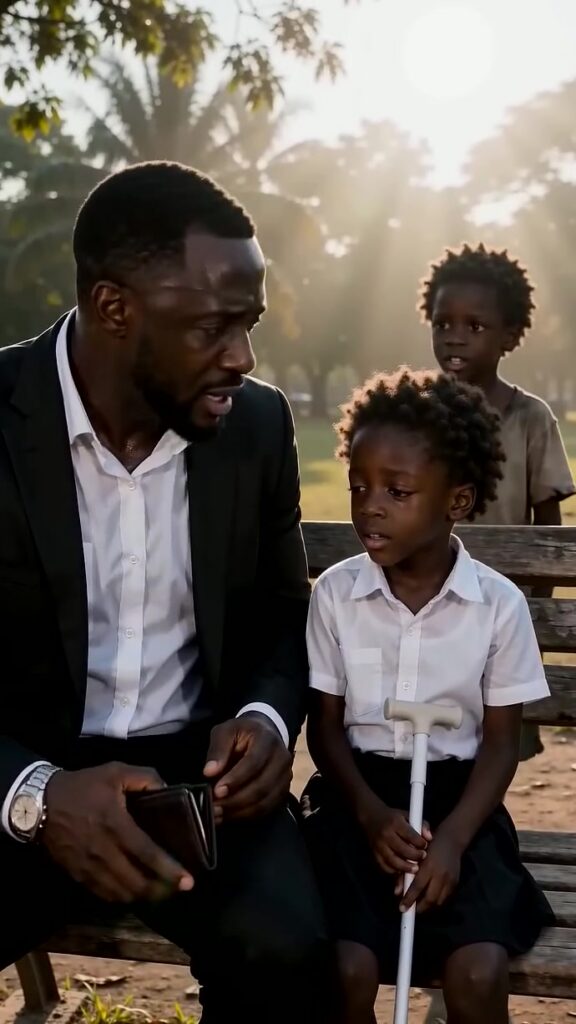
On a day when the city wore spring lightly—trees trembling with new leaves, the air smelling like cut grass—Marcus took Elara to a small park near the river. It was one of the few places she loved that he hadn’t bought or built. She liked the wind there, how it carried distant laughter and the metallic cry of train tracks. She sat on a bench with her fingers wrapped around a paper cup of hot chocolate, even though the sun was warm.
Marcus watched her face as if he could memorize it against the coming change. Her eyelashes flickered, her gaze unfocused on the ducks combing the water. He felt anger like a second skeleton inside him.
A boy appeared at the edge of the path, barefoot despite the gravel, his clothes too thin for the season. He couldn’t have been more than twelve. His hair fell in dark curls, and his eyes—impossibly steady—fixed on Elara as if he recognized her.
Marcus stiffened. In his world, strangers did not approach without a motive. He stood, the instinct to shield his daughter rising like a reflex.
The boy stopped a few feet away. He didn’t look at Marcus. He looked only at Elara, and he spoke one sentence with a certainty that cut through the park’s gentle noise.
“Your daughter isn’t sick.”
Marcus laughed once, short and sharp, the sound of a man hitting the edge of his own desperation. “Walk away,” he said. “Now.” He reached for Elara’s shoulder, to pull her behind him, but she didn’t move. Her head tilted slightly, like she was listening to a note only she could hear.
The boy took one step closer.
“Don’t,” Marcus warned, his hand tightening. The boy’s calm was infuriating, dangerous. A trick. A scam. People had tried to sell Marcus miracles before—crystals and prayers and proprietary supplements in glossy bottles. He’d thrown them out, furious at the cruelty of hope packaged for profit.
But this boy’s voice had no pitch of bargaining. It was almost tender, as if he were correcting a mistake someone had made about the weather.
Elara spoke, barely above a whisper. “I can see you,” she said.
Marcus froze. “What did you say?”
Elara’s eyes—her damaged, doomed eyes—focused on the boy with a clarity Marcus hadn’t seen in months. Her pupils steadied. She blinked once, and her face changed, a slow astonishment blooming across it.
“I can see,” she repeated. “I can see his freckles.”
Marcus felt his heart stumble. He turned to the boy, searching for wires, lenses, anything. “What are you doing?” he demanded. “Who sent you?”
The boy finally looked at Marcus. His gaze was old in a way that made Marcus’s skin prickle. “No one sent me,” he said. “But you keep paying the wrong people to name the wrong thing.”
“Her retina—” Marcus began, swallowing. “They showed me the scans. The degeneration.”
“There’s nothing wrong with her eyes,” the boy said. He lifted his hand, palm open, not touching Elara, just hovering near her line of sight. “There’s something wrong with what she’s been given to look through.”
Marcus’s mind raced. “Glasses? She doesn’t wear—”
“Not lenses,” the boy interrupted. “Stories.”
The word hit Marcus with a strange, nauseating force. He thought of the endless appointments. The solemn declarations. The careful way adults spoke around Elara, as if blindness were already in the room with them. He thought of his own obsession, the way he watched her like a countdown. He thought of the fear he poured into every day like poison in water.
Elara rubbed her eyes and looked around the park. “Dad,” she said, wonder trembling at the edges of her voice, “the river is… bright. I forgot it was this bright.”
Marcus’s throat tightened so hard he could barely breathe. “This isn’t possible,” he managed. “We’ve seen everyone.”
“You’ve seen the best money can summon,” the boy replied. “But not the best question. Your daughter’s sight didn’t start fading because she’s broken. It started fading because someone needed you to believe she was.”
Marcus stared, the world tilting. “Someone?” he echoed.
The boy’s eyes flicked toward the path behind them, toward the row of trimmed hedges and the street beyond, where parked cars glinted in the sun. “The first doctor,” he said softly. “The one who told you it was inevitable. The one who never met your eyes when he spoke.”
Marcus’s mind flashed back to the beginning: a consultation room, the doctor’s hands folded, his voice gentle, his gaze angled slightly left of Marcus’s face. He remembered the way that man’s assistant had hovered too close to Elara’s backpack, offering stickers and a lollipop with a bright, unnecessary eagerness.
“Why?” Marcus whispered. He felt suddenly cold, as though the park had lost its sunlight.
“Because fear is a lever,” the boy said. “And you are a man with a lot of weight on the other end.”
Elara reached for Marcus’s hand, her fingers warm and real. “Dad,” she said, “I can see you crying.” Her voice was not scared. It was certain, almost accusing him of having wasted sorrow on a lie.
Marcus wiped his face with his free hand, trembling. “Tell me what to do,” he said to the boy, his pride collapsing like wet paper. “Please. If there’s a way—”
The boy took another step forward, close enough now that Marcus could see the faint scar at the corner of his mouth. “Stop running her through machines that can be lied to,” he said. “Stop teaching her that darkness is coming. And when the man who started this calls again—because he will—don’t answer him with money. Answer him with the truth.”
“What truth?” Marcus asked, almost pleading.
The boy’s voice lowered. “That you know.”
A gust of wind bent the trees. A flock of pigeons burst upward, sudden and loud. For a second Marcus lost the boy in the motion, the swirl of feathers and sunlight. When the birds cleared, the path was empty. No bare feet on gravel. No thin jacket. Only the bench, the river, and Elara’s small hand gripping his like she might anchor him back to sanity.
Marcus stared at the space where the boy had stood, and a terrible clarity settled in his chest. He had spent millions trying to defeat a disease. If the boy was right, Marcus hadn’t been fighting illness at all. He’d been feeding a story someone else wrote—one that turned his love into a pipeline for greed and control.
Elara squeezed his hand. “Dad,” she said, looking up at him with eyes that were suddenly, unmistakably, seeing. “Can we go home? I want to draw the park. I want to draw it before I forget.”
Marcus swallowed the taste of rage and relief, both sharp as metal. He nodded. He stood, and for the first time in months, he didn’t guide Elara like she was fragile glass. He let her walk beside him, her steps sure, her gaze lifted to the bright, treacherous world.
Behind them, the river kept moving, indifferent. Ahead, Marcus could already feel the next storm gathering—not of weather, but of names and evidence and vengeance. He had bought doctors and time and false certainty. Now he would spend something else entirely.
He would spend the truth.