He timed it perfectly, of course.
The chandelier above the Grand Armitage Ballroom threw down hard, clean light—expensive light, the kind that makes everyone look a little more innocent than they are. Cameras clustered near the stage like glittering insects, and the string quartet had been instructed to keep it romantic but not distracting. Even the waiters moved like they’d been trained to carry secrets on silver trays.
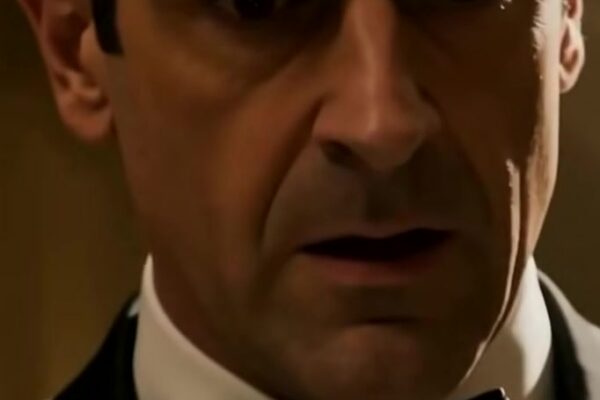
And there he was on the marble steps, tuxedo immaculate, hair combed into the same confident part it had always had. The only thing out of place was the man himself: on one knee, head slightly bowed, hands open as if surrendering. Like a prince in a fairy tale, except the fairy tale had a legal department.
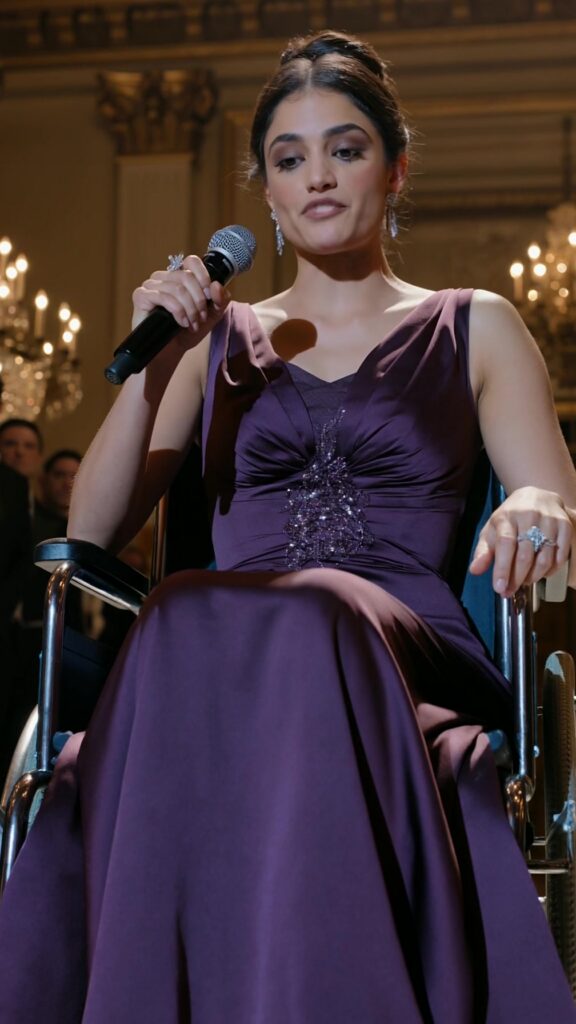
Clara sat above him, centered beneath the crystal canopy, wearing a deep purple gown that didn’t try to hide her wheelchair. It framed it. The fabric pooled like a night sky around the metal and leather, and she’d chosen jewelry that didn’t sparkle so much as it dared you to stare longer.
Her left hand rested on a microphone. Her right hand was steady on the chair’s armrest. Not clenched. Not shaking. Just… there. Present. Unmoved.
When he spoke her name—soft, practiced, the way you say a word you’ve been rehearsing in the mirror—she didn’t answer right away. She let the silence do some work.
People who could afford to pretend they’d never enjoyed cruelty watched, frozen in their tailored restraint. These were the donors, the heirs, the “family friends.” People who’d once sent Clara flowers after her accident and then stopped calling when the injury stayed.
“Clara,” he said again, and this time his voice pitched lower, pleading. “Please. I— I didn’t mean—”
He thought kneeling was a cheat code. He thought humility was a key that opened any locked door. He thought if he made himself look smaller, she’d forget how he’d once tried to make her disappear.
Years ago, there had been a different ballroom. A different event. She’d been standing then, leaning slightly into his arm because her legs were still learning how to be legs again after the crash. He’d smiled through it, the smile he wore for photos, and later—in a quiet hallway that smelled like lilies and champagne—he’d taken her hand, kissed her knuckles, and whispered a sentence that rerouted her life.
Not “I don’t love you.” Nothing so honest.
Something worse: “I need someone easier.”
As if love were a suitcase and she’d suddenly become too heavy to carry into his future.
He’d said he wanted to “conquer” the world. The family empire. The board. The politicians who collected their favors like cufflinks. And he couldn’t do it, he’d explained, with a reminder of tragedy on his arm.
Clara had nodded. She’d smiled, because it was easier than falling apart in a hallway. Then she went home and did the one thing he’d asked of her: she vanished.
At least, that’s what society believed.
They assumed she’d melted into a private grief, into rehab and bitterness and whatever story made them comfortable. They told each other she was “so brave,” and then they stopped inviting her anywhere that required stairs, or patience, or seeing her as more than a cautionary tale.
Meanwhile, Clara rebuilt.
Not loudly. Not for applause. Quietly, the way you rebuild after something burns: you sift through what survived, and you start laying new foundations where no one thinks to look.
She made calls the night she “disappeared.” She met with people who’d been treated as invisible their whole careers—assistants, accountants, compliance officers, the tired souls who kept the rich from setting themselves on fire. She read contracts like bedtime stories. She listened until listening turned into leverage.
And because she had been written off, no one watched her closely.
It turned out invisibility could be useful.
Now, tonight wasn’t just a gala. It was the board ceremony, the final flourish before the family empire’s ownership was formally announced. He’d been smug for weeks, shaking hands, calling it “the next era,” accepting compliments as if they were legally binding.
Until ten minutes earlier, he believed the decision was already his.
Clara tilted her head, studying him like a document that didn’t match its own signature.
“You were ashamed of me,” she said into the microphone. Calm. Clean. No dramatic tremble, no tearful edge. Just a statement, placed on the table like a knife.
The audience shifted, a collective flinch. Everyone knew it was true. Everyone had known and let it happen because it was easier. And now they had to sit in their rented sincerity and watch what comes after easier.
He swallowed. “That’s not— I was scared. I was under pressure. My father—”
Clara lifted a folder from her lap, holding it up so the front row could see the embossed seal. The paper was thick. The kind that feels like a verdict.
His face changed instantly, like someone had turned off the oxygen.
He recognized it. Private succession records. Documents that were supposed to live behind a lawyer’s locked door and a reputation’s locked mouth.
“You told them I was too broken to lead,” Clara said, her voice steady enough to make the room colder. “So I brought proof of what you did while you thought I was gone.”
She opened the folder.
The first page wasn’t a scream. It didn’t need to be. It was a name, printed in clean type, paired with a marriage certificate and a date that made his whole relationship timeline fold in on itself.
Not because it named him. That was almost expected.
Because it named his secret wife.
A woman no one in the room had ever seen at family holidays. A woman who wasn’t in any photos. A woman with a last name that belonged to a rival firm, tucked neatly into the kind of merger you can’t announce without causing a war.
Someone in the back gasped like they’d been slapped.
He pushed up from his knee, but it was too late. Kneeling had been his performance; standing was his panic.
“Clara,” he hissed, forgetting the microphone could catch anything now that the room leaned toward her, not him. “You don’t understand. This is complicated.”
Clara almost smiled. Almost.
“Complicated is what you call something when you don’t want to admit it’s a choice,” she said. “You didn’t marry her because you loved her. You married her because it made you untouchable. You wanted the empire without the inconvenience of earning it.”
She turned another page. Emails. Signatures. Transfers. A trail of carefully disguised payments, each one a thread in a net.
“You told the board I was unstable,” Clara continued. “You told investors my injury made me unreliable. While you were diverting funds and hiding liabilities like they were party favors.”
His lawyer—slick hair, slicker conscience—shifted in his seat. Clara didn’t look at him, but her folder did. She’d included his name too, right there in the margins of the paper trail, like a watermark.
The board chair cleared his throat. Once. Twice. He tried to speak and found he’d been demoted by paperwork.
“This… this can’t be real,” the kneeling man said, voice cracking now in a way that wasn’t charming. He reached toward the folder like he could grab truth and tear it up.
Clara leaned back slightly, not flinching, but the security beside the stage stepped forward anyway. She didn’t need them. That wasn’t the point. The point was: she could have them.
“Don’t,” she said, softly now. Not pleading. Warning.
He froze, hand hovering in air. For a second he looked like he might cry, and for another second the room almost believed him. People love a man who looks sorry. It’s one of society’s favorite hobbies, forgiving the powerful when they bend their knees.
Clara let that moment pass without catching it.
“You’re here because you thought an apology could undo a strategy,” she said. “But I didn’t come back for your regret.”
She flipped to the last page. A signed proxy statement. A voting agreement. Neat lines of ink that had been gathered not through begging, but through remembering who had been dismissed and who was tired of being told to wait their turn.
“I came back for control,” Clara said. “And for the record— I didn’t vanish. I relocated.”
The board chair took the page with hands that suddenly looked very old. He read it. His eyes flicked up, then down again, then up at Clara as if he were seeing her for the first time without the filter of pity.
“According to these proxies,” he said slowly, “the majority vote…”
He paused, and the ballroom held its breath, a room full of expensive lungs.
“…belongs to Clara Hartwell.”
A sound ran through the crowd—shock, relief, admiration, fear. The kind of reaction that means the story has changed and everyone’s scrambling to adjust their loyalties without looking like they’re moving.
The man on the steps made a small, strangled noise. Not words. Not even anger. Just the sound of someone realizing the universe isn’t negotiated with posture.
He sank back down, not as performance this time, but because his legs finally admitted the truth.
Clara watched him for a beat, then leaned toward the microphone one last time.
“Get up,” she said, almost gently. “Not because you’re forgiven. Because you’re done.”
Then she turned her chair with a smooth, practiced motion and rolled forward beneath the chandelier’s hard light, toward the podium that had never been built for her until she rebuilt the room itself.
Behind her, the man stayed where he was, still kneeling in a ballroom that no longer belonged to him, learning the difference between an apology and a reckoning.
Clara didn’t dream of him anymore.
Tonight, she dreamed in signatures, in justice, in doors opening—wide enough for her wheels to pass through without anyone’s permission.