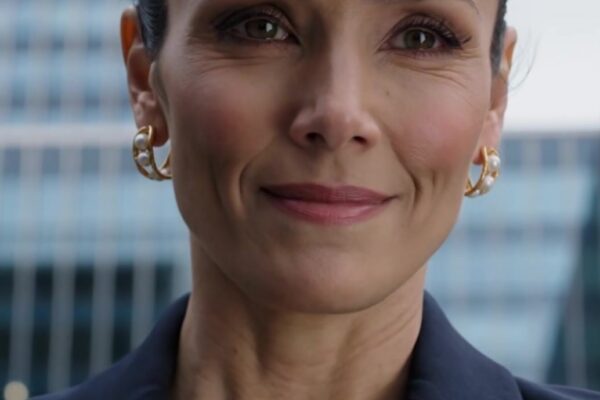
“Hey—don’t touch me!”
The words cracked through the terrace like a whip. Champagne laughter faltered. The string quartet hit a sour note and recovered too late, as if even the music needed a second to pretend it hadn’t heard. Every face in the gilded crowd turned toward the commotion at the dessert table: a woman in a black satin dress, her jaw set hard enough to cut glass, and a boy so small he barely reached the edge of the linen.
He had withdrawn his hand as if it had been burned. His knuckles were scraped raw, his fingernails rimmed with dirt, the cuffs of his shirt gray with old sweat. But his eyes—wide, green, too old for his face—held their ground.
“I wasn’t—” he began, then stopped. He looked past the towering cake, past the silver trays of fruit, straight to her hair. The woman’s irritation, sharp and reflexive, started to loosen in the space between one breath and the next.
“She has the same hair…” the boy said quietly, almost to himself. Then louder, as if repeating a line he’d practiced. “The same braid. The same clip.”
“What are you talking about?” the woman demanded, though the edge had gone thin. She reached for composure the way people in her world reached for a napkin—automatic, necessary, clean. Her name was Celeste Marrow, and every guest here had arrived to celebrate the opening of her foundation’s new wing. Everyone knew her as polished philanthropy with a diamond spine. No one knew what her hand did when she couldn’t sleep: it went to the spot behind her left ear, searching for a ghost of pain.
The boy lifted his face. His breathing steadied. The hurt remained, but it was controlled, shaped like a bruise you press to prove it’s real.
“My mom said I’d find you here,” he said.
The surrounding noise began to thin, not all at once but like a tide pulling back: a chair not scraping, a laugh swallowing itself, the clink of ice fading into a hush. Heads angled closer. A few phones rose—slow, hungry.
Celeste’s throat tightened. “Your mom?” she repeated. “Who are you?”
He didn’t answer. He opened his small fist instead.
In his palm lay a silver hair clip studded with tiny pale stones, dulled by time. The hinge was bent. One jewel was missing, leaving a dark, triangular tooth of empty metal. It was not expensive in the way the guests understood expense; it was old in the way a scar is old—worn into a person’s life, not purchased into it.
Celeste’s skin drained of color.
Her mind did what it always did when it sensed danger: it tried to rename it. A coincidence. A reproduction. A prop. But her body didn’t cooperate. Her breath stopped halfway in, held hostage behind her ribs.
“That’s…” she whispered. Her fingers rose without permission, then hovered inches from the clip as though it were radioactive. “Impossible.”
A tear slid down the boy’s cheek. He didn’t wipe it away. “She said you’d say that.”
The quartet fell quiet. Someone’s glass chimed against a plate and then stilled. Even the fountain at the terrace edge sounded far away, like a memory of water rather than water itself.
Celeste leaned in fast, panic breaking through the lacquer of her social face. “Where is she?” The question came out raw, as if it had been waiting twenty years for a mouth to use. “Where is she?!”
The boy’s mouth tightened. He wasn’t defiant; he looked like someone fulfilling instructions. He didn’t point with his hand—he turned his head instead, slowly, deliberately, guiding attention like a conductor.
Celeste followed his gaze.
Beyond the tables and the pale orchids, a hedge-lined walkway led toward the gardens, where lanterns floated like tame moons. At the end of that corridor of green, a woman stood perfectly still.
Same posture. Same face.
Identical, down to the tilt of the chin that had always made photographers sigh with relief.
Celeste’s glass slipped from her fingers. It fell in slow motion, a thin arc of crystal catching the light, and then shattered on the marble with a brutal, definitive crack.
Gasps rippled through the crowd. More phones rose. A few people backed away as if the air itself had changed density.
Celeste could not move. Her mind flashed through locked rooms: a rented coastal cottage, the smell of iodine, a mirror that didn’t reflect the way it should. A man’s voice counting down. A signature on a contract she hadn’t been allowed to read. The sound of a heartbeat in an ultrasound, and someone saying, “Two is better than one.”
Beside the identical woman stood a man, half in shadow. He wasn’t tall, but he filled the space as if it belonged to him by right. His suit was plain, his tie immaculate. His eyes never blinked.
Celeste knew him immediately, in the way prey recognizes the hunter it escaped.
Dr. Rellan. Not a doctor anymore, if the rumors were true. Not officially alive, if the papers she’d paid for meant anything. Yet there he was, watching her as if this moment had been scheduled.
Celeste’s face collapsed—fear, recognition, disbelief mixing into something childlike. “That’s not possible,” she said again, but now it sounded like a prayer.
The identical woman stepped forward. Her movements were economical, precise. She lifted a hand to her own hair, and there, behind her ear, was the same indentation Celeste hid with curls. Except hers was fresh, angry pink, as if reopened.
“Hello, Celeste,” the woman called, her voice carrying cleanly over the stunned crowd. “Or should I say… hello, Sister.”
Celeste’s knees threatened to buckle. She clutched the edge of the dessert table and felt icing smear under her fingertips, absurdly sweet against the sudden bitterness rising in her throat.
The boy stepped closer to Celeste, just enough that she could smell the street on him—exhaust, rain, something metallic. He looked up at her, and the steadiness in his eyes wavered for the first time.
“She told me to give you that,” he murmured, nodding at the clip still resting in his palm. “And to tell you… they didn’t let her keep me.”
Celeste’s vision narrowed. The terrace, the guests, the cameras—all of it blurred. The only sharp things were the clip, the boy’s trembling hand, and the woman by the hedges lifting her chin like someone about to deliver a verdict.
Celeste forced her lungs to work. “Who are you?” she called, though she already knew the answer her bones were beginning to accept.
The identical woman’s smile was thin. “I’m the part of you that got left behind,” she said. “The part you paid to bury.”
Dr. Rellan placed a hand on the identical woman’s shoulder, not gentle—claiming. His gaze remained fixed on Celeste, and when he finally spoke, his voice was almost affectionate. “You ran,” he said. “But you kept the proof. You kept the scar. And you kept pretending the past was dead.”
Celeste took a step forward, then another, as if pulled by a rope tied around her heart. The crowd parted without understanding why. The boy walked with her, close enough that his sleeve brushed her hand. His touch was accidental, light—and Celeste flinched anyway, not from him but from the memory of restraints, from hands that had held her still while decisions were made for her body.
“Don’t,” she breathed, then caught herself. Her voice broke. “No—please. Just tell me where she is. Tell me where my—” She stopped, because the word mother didn’t fit, and the word daughter didn’t fit, and twin felt like a lie told by a mirror.
The identical woman’s eyes glittered. “Where is she?” Celeste asked again, smaller now, bare. “Where is my sister?”
Dr. Rellan’s smile widened, and Celeste knew, with a cold clarity, that the boy had not wandered into this gala by chance. He was a message. A key. A hostage shaped like hope.
“Right here,” the identical woman said softly, and extended her hand—palm up, inviting Celeste to take it.
Celeste stared at that hand. At the lines that matched hers. At the clean nails, the unbroken skin. The old, familiar command rose in her mind like an alarm: Don’t touch. Don’t trust. Don’t let them close.
Yet the boy’s small palm pressed the hair clip into her fingers, and the cold metal bit into her skin like an oath.
Celeste lifted her gaze to the identical woman and felt the past crash into the present with the force of a door kicked open. Every locked memory surged forward: the bargain she’d made to survive, the name she’d signed away, the night she fled with nothing but a clip in her pocket and blood on her thighs.
Her voice came out as a whisper that carried anyway. “What do you want?”
The identical woman’s smile didn’t reach her eyes. “What you took,” she said. “And what you owe.”
Dr. Rellan stepped out of the shadows. The lantern light caught his face, and Celeste saw, with sick relief, that age had touched him—just not enough. He lifted a small remote in his hand, thumb poised as if over a trigger.
“We can do this politely,” he said. “Or we can do it loudly. You’re very good at loud, Celeste. You made a career out of it.”
Celeste tightened her grip around the hair clip until its bent hinge dug into her palm. Pain anchored her.
She looked at the boy—at the tear tracks, at the bravery built from neglect—and then at the identical woman who wore her face like a mask she’d been forced to memorize.
The crowd watched, recording, devouring. Their silence was its own hunger.
Celeste raised her chin. “Hey,” she said, voice gaining steel as fear sharpened into purpose. She stepped forward one last time, closing the distance. “Don’t touch me.”
And then, before anyone could stop her, she reached out first and took her sister’s hand anyway—hard, undeniable, dragging the truth into the light as if she could tear it free by force.
The moment their skin met, Dr. Rellan clicked the remote.
All the terrace lights went out.
In the sudden darkness, the boy’s voice rose—small, steady—like a match struck against stone. “Mom said you’d be brave,” he whispered. “She said… now you’ll remember where they hid her.”