“I can’t feel my legs…”
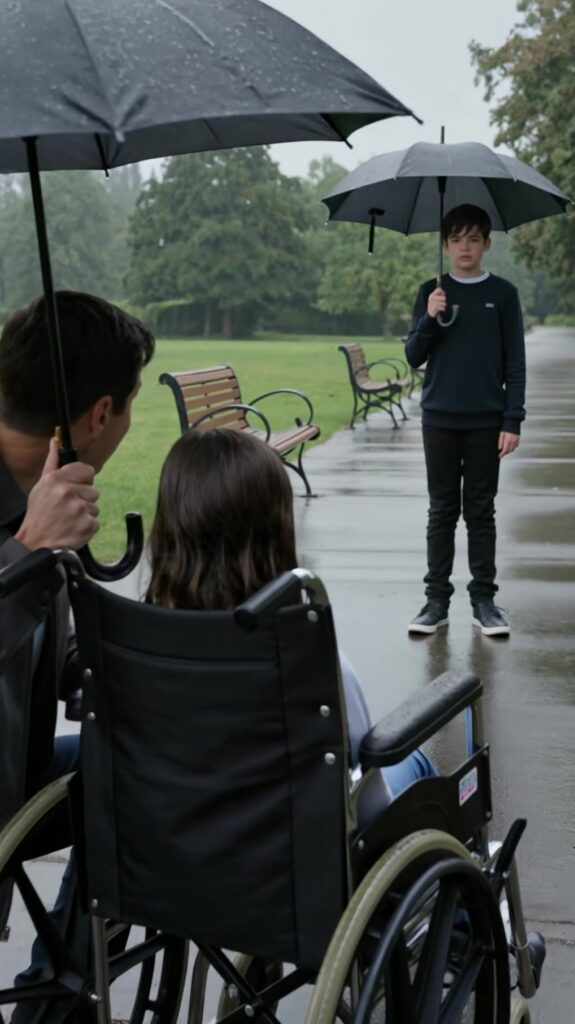
The words slipped out of Mara like something torn loose. One moment she’d been laughing at nothing, at the way the rain misted the lake and turned the gravel path into a ribbon of glass. The next, her knees buckled and she folded to the ground as if the bones inside her had been unfastened. Cold soaked through her jeans, through the thin layer of skin over her shins, but below her hips there was only a dull, unreachable distance.
Her father hit the ground beside her so hard his palms slapped the wet stones. He was a big man—hands like shovels, shoulders trained by years of lifting and carrying—yet in that instant his strength looked useless. “I know,” he said, voice raw, as if he’d swallowed the rain. “I’m here. I’m right here.” He tried to cradle her, then stopped, fingers hovering at her waist, unsure where to touch without breaking something. His eyes flicked over her legs as if searching for a wound that explained the absence.
The rain kept falling. Not dramatic, not thunderous—just steady and patient, the kind that erased footprints and softened edges. It made the park empty. It made their small crisis feel like the only sound in the world.
Mara stared at her shoes, at the mud crawling up the white rubber. She tried to command her toes to wiggle. Nothing. Panic rose, sharp and bright. “Dad,” she whispered. “I can’t… I can’t—” Her throat closed. The world narrowed to the hard slap of her heartbeat and the unresponsive weight of her legs, as foreign as someone else’s limbs left at her doorstep.
Then a voice drifted in, quiet as a page turning. “Let me dance with her.”
It didn’t belong in the rain. It didn’t belong in panic. It sounded like the beginning of music.
They both turned. A boy stood a few steps away on the path, thin as a reed, his hair plastered to his forehead. He wore no hood, no umbrella—just a worn coat too large in the shoulders. Water ran from his sleeves in threads. He wasn’t smiling. He wasn’t pitying them. He simply watched, as if the scene were familiar and he’d been waiting for his cue.
Mara’s father’s face tightened into something protective and hard. “Go home, kid.”
The boy didn’t flinch. He stepped forward. A small splash, gentle, like a polite knock. “I can help her walk.”
Silence pooled between them. The father stared, measuring the boy’s narrow wrists, the hollowness beneath his cheekbones. “That’s not possible,” he said, each word a door being shut. “My daughter needs a doctor.”
Mara would have agreed if fear hadn’t already made her superstitious. She’d heard stories when she was younger—whispers about the lake taking what it wanted, about certain people who could bargain with it. She’d always rolled her eyes, until now, until her body refused her, until the air itself felt as if it held its breath. Her fingers, numb from gripping the fabric of her father’s coat, found his sleeve and tugged. It was a small movement, almost accidental. But it made him look down.
“Dad,” she said. The sound came out thin. Her eyes met his, and he saw something in them that wasn’t there before: not calm, not resignation, but a strange focus, like a candle refusing to go out. “Let him try…”
The father’s face shifted in quick, painful layers—shock, hope, fear, and a guilt so heavy it seemed to bend his neck. “Mara, no.”
The boy waited. Rain slid down his fingers as he extended his hand, steady and open. No rush. No insistence. Just an offer placed between life before and life after.
Mara stared at his palm. It looked ordinary: a line of lifelines, a faint scar near the thumb. Yet something about it pulled at her like gravity. She inhaled; the air tasted of wet leaves and metal. Her own hand trembled as she lifted it. She half-expected her arm to fail too, but it rose, slow and unsure, as if moving through thick water. Her fingertips hovered a breath away from his.
Her father grabbed her shoulder. “Don’t,” he begged, and the word sounded like prayer. “We’ll get help. I’ll carry you. We’ll—”
“You can’t carry me forever,” Mara said before she could stop herself. The truth cut through her. She saw it then, in a flash: her father’s aging knees, the stairs at their apartment, the way he’d already begun to groan when he stood up too fast. She couldn’t picture the rest of her life as a burden on his back. The fear of that was sharper than the fear of this boy.
The boy’s fingers finally brushed hers. The contact was not warm, not cold—it was like touching a tuning fork. A vibration traveled up Mara’s arm and into her chest. For a heartbeat she thought it was pain, but it wasn’t. It was awareness, sudden and startling, as if a forgotten room in her body had been unlocked.
“Close your eyes,” the boy said. “If you look at the ground, you’ll believe it owns you.”
Mara obeyed. Darkness filled her. She heard the rain. She heard her father’s breathing, ragged and close. She heard, faintly, something else—an old melody, not from a phone or a speaker, but from memory she didn’t recognize. Her legs were still absent, still distant. Then the distance began to shrink. Pins and needles flared in her calves, in her ankles, in her feet. She gasped.
“That’s it,” the boy murmured, as if coaxing a skittish animal. “Don’t force it. Invite it.”
Mara felt her knees. Not strength—yet—but presence. She imagined them as doors that could open. She imagined her feet as anchors. The melody threaded through her, tying her to herself. The boy’s hand tightened around hers in a grip that was not possessive but guiding, like a partner leading the first step of a dance.
“Stand with me,” he said.
Mara’s father swore under his breath. He shifted behind her, ready to catch her. “I don’t trust you,” he told the boy, voice shaking with anger that was really terror. “If you hurt her—”
“I won’t,” the boy replied simply. “I know what it’s like to lose the map back to your own body.”
Mara opened her eyes. The world was blurred by rain. She saw her father’s face close to hers, pale and desperate. She saw the boy’s calm gaze, steady as a shoreline. And somewhere beneath all of it, she felt her legs again—not fully, not safely, but enough to try.
She planted her hands on the slick ground. Her arms shook. Her stomach clenched. She pushed. Her hips lifted. For a terrifying second, her lower body lagged behind, as if it might be left there like a discarded coat. Then sensation surged—burning, alive—and her knees drew under her.
Her father let out a sound that might have been a sob. “Mara—”
“One step,” the boy said. “Just one. We only ever live in one step.”
Mara’s foot slid forward. It found the ground. It held. She stood, trembling, leaning on the boy’s hand as if it were a railing. The rain struck her face and felt like proof. Her breath burst out in a laugh that cracked into tears.
Her father rose too, hands hovering at her elbows, afraid to touch and afraid not to. “How?” he whispered.
The boy looked past them to the lake, its surface wrinkled with rain like an old brow. “Sometimes,” he said, “the body forgets because the heart is carrying something too heavy. Sometimes it takes a stranger to hold out a hand so you remember you’re allowed to come back.”
Mara’s legs wobbled, but they were hers. She tightened her grip on the boy’s fingers. “What’s your name?” she asked, voice small in the rain.
For the first time, his expression softened, as if her question granted him permission to be real. “Eli,” he said. “And this isn’t finished. Not yet. But you’re standing.”
Behind them the park remained empty, the rain unrelenting, the world pretending nothing had happened. Yet Mara could feel the ground under her feet, solid and faithful. She glanced at her father, saw the fear still lodged in him like a thorn, and squeezed his hand with her free one. Between father and stranger, between rain and breath, she took another step—shaky, imperfect, miraculous—and the lake did not take it away.