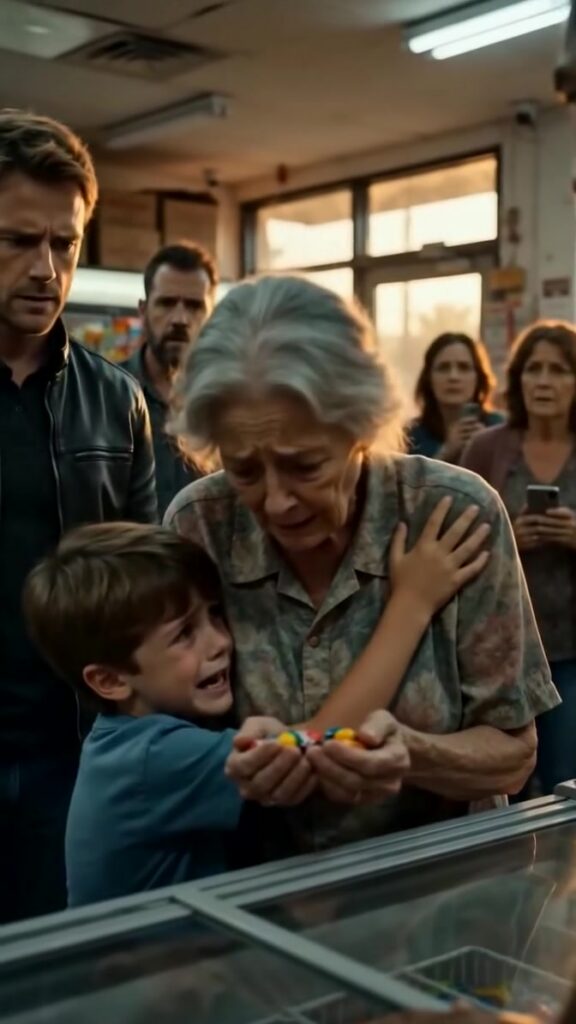
“If you can’t pay—get out!”
The words cracked across the fluorescent aisles like a ruler snapped over knuckles. They weren’t loud in the way of panic; they were loud in the way of certainty—sharp enough that every shopper suddenly remembered they had ears, suddenly remembered their own hands could be empty one day.
Mara stood at the counter with her shoulders drawn up as if she could fold herself small enough to disappear between the gum display and the lottery tickets. Her fingers trembled around a paper pouch of candies—cheap ones, bright wrappers, the kind children held like treasure because they didn’t know what real treasure cost. Beside her, a little boy tugged at the cuff of her coat with both hands, pulling as though he could drag food out of the air by force alone.
“Grandma,” he whispered, and it was already a cry, “I’m hungry.”
The cashier didn’t glance down. He stared past them as if his attention was a locked door and their need didn’t have the right key. “This isn’t a shelter,” he said, louder now for the benefit of the line forming behind them. “I’m not losing my job because you forgot your wallet.”
Mara wet her lips. Her eyes were the watery gray of late winter. “I didn’t forget,” she murmured. “My pension comes tomorrow. I can pay tomorrow. Please, just these… and the bread.” She pointed to the half loaf at the edge of the counter as if it might plead for her.
The boy’s face was streaked with a grief too big for his small cheeks. “You said we’d eat today,” he hiccuped. That sentence didn’t bounce around the store. It landed. It sank. It made every cart feel heavier with its luxuries.
Someone in aisle three dropped a can into their basket a little too hard, the metal clanging like guilt. A woman near the self-checkout raised her phone, not openly, but with the practiced movement of a person who had learned that watching could be profitable.
“Not my problem,” the cashier said, and slapped the candies back toward Mara with the flat of his hand. The wrappers skittered and flashed under the lights, festive and cruel. “If you can’t pay, you’re done. Out.”
Mara’s fingers closed around the paper pouch again, as if holding those sweets could keep her dignity from spilling out. She began to gather the scattered candies with frantic precision, her knuckles pale, her nails split. “It’s all right,” she told the boy, though the lie trembled worse than her hands. “We’ll… we’ll go.”
She turned, already shrinking, already apologizing with her body, and that was when a man stepped out of the back of the line.
He wasn’t imposing. He didn’t stomp or shout. He moved as if the air made room for him. His coat was plain, the color of wet stone, and his hair was dark with a single line of silver at one temple like a warning. He held no basket, no impatience, no performance.
“How much is it?” he asked.
The cashier snorted. “It’s not about the total. It’s about the rules.” Then, because contempt always wants an audience, he added, “Besides, it’s too much for her.”
Mara’s head snapped up, not with hope—hope was too risky—but with panic. “No,” she said quickly. “Please, don’t. I can’t—” Her gaze darted to the line, to the phones, to the boy, as if charity would brand him. “We don’t need—”
“You need to eat,” the man replied, not unkindly, not dramatically, as if he were stating the weather. He reached into his pocket with a slow, deliberate motion that made the cashier’s eyes track his hand.
The man’s fingers came out holding a card.
Not a credit card. Not a bank card with a cheerful logo. It was matte black, without numbers on the front, with a faint emblem pressed into it—an old seal, the kind that looked better on paper than plastic. As he set it on the counter, it made no sound at all, which somehow made it louder.
The cashier leaned forward. His sneer hesitated, then thinned. “Wait,” he muttered. “What card is that?”
The boy’s crying stopped as if someone had turned a dial. He stared at the card, then at the man, eyes wide with the solemnity children reserve for adults who can change outcomes.
The cashier’s face shifted through disbelief to a sudden, sweaty alertness. His hands hovered over the scanner like they didn’t know how to behave anymore. “This—this is—” He swallowed. “Sir, I didn’t realize—”
“You didn’t ask,” the man said. His voice stayed level, but something in it pulled the store tighter, like a string around a throat.
Behind them, a few shoppers lowered their phones. One woman’s cheeks reddened, not from being caught filming, but from realizing she’d been ready to share someone else’s humiliation for entertainment.
Mara looked at the card as if it were a blade. “Please,” she repeated, softer now. “I can’t repay you.”
“I’m not asking you to,” the man said, and then he nodded at the bread and the candies and, after a pause, at the boy’s small hand clutching his grandmother’s coat. “And add the soup. The kind with the vegetables. He needs something warm.”
The cashier’s throat worked. “Of course.” He began scanning with frantic obedience. “Of course. Whatever you want.”
The receipt printer whined, and the noise felt obscene—such an ordinary sound in a moment that had gone strange. The cashier slid the bag across the counter with two hands, as if offering tribute. “I’m… I’m sorry for the misunderstanding,” he said, eyes not quite meeting the man’s.
The man didn’t take the bag right away. He leaned closer, just enough that the cashier’s breath hitched. “There was no misunderstanding,” he said quietly. “You understood her. That’s the problem.”
The cashier’s face drained, and the bravado that had filled him minutes before seeped out like water through a crack.
The man finally picked up the bag and placed it into Mara’s hands. The candies crinkled as her fingers closed, still shaking. For a second she looked like she might collapse, not from hunger, but from the sudden relief of being treated like a person again.
“What is that card?” someone whispered from behind. It wasn’t asked loudly. It was asked the way people ask the name of something that scares them.
The man glanced over his shoulder. “A reminder,” he said.
He turned to Mara and crouched so his face was level with the boy’s. “What’s your name?” he asked.
“Eli,” the boy said, voice small but steadier now.
“Eli,” the man repeated, as if committing it to memory. Then, with a gentleness that made the cashier’s earlier cruelty look even uglier by contrast, he tucked a wrapped candy into the boy’s palm. “Take care of your grandma.”
Eli nodded solemnly, as if given a mission.
Mara’s eyes shone. “I don’t even know who you are,” she managed.
The man stood. For the first time, he looked directly at the cashier, and the air in the store seemed to thin. “You don’t need to,” he said, and slid the black card back into his pocket like it weighed nothing at all. “But you’ll remember what you were willing to do when you thought no one important was watching.”
He walked toward the doors, unhurried, leaving behind a silence that felt earned. The automatic doors parted for him with a sigh.
Only when he was gone did the store begin to breathe again. The cashier stared at the counter as though the black card had burned an outline into it. A man in line cleared his throat, embarrassed to exist. Someone else, quietly, set a loaf of bread on the counter and paid without looking up.
Mara drew Eli close, the bag pressed against her chest like a heartbeat. She didn’t look at the phones. She didn’t look at the cashier. She looked at the exit where the man had disappeared, and in the bright, indifferent lighting of the grocery store, she whispered a thank-you that felt like a prayer—one offered not to a savior, but to the rare, terrifying idea that decency could still walk in without announcement.
Outside, through the glass, the man paused beside the window for a fraction of a second. In the reflection, his face was calm, almost weary. He adjusted his coat, and the city swallowed him as easily as it swallowed everyone.
Inside, the cashier began ringing up the next customer with hands that no longer looked so steady.
The sign above the register still boasted: NO CREDIT. NO EXCEPTIONS.
But the words “IF YOU CAN’T PAY—GET OUT!” hung in the air like smoke.
And every person in that store understood, in a way they hadn’t before, that some debts are collected immediately—paid in shame, paid in silence, paid in the memory of a child’s hungry voice splitting a room in half.