It didn’t make sense, not the way the hallway held its breath, not the way the rain beyond the high windows fell in straight, disciplined lines as if the sky itself had been trained. The building had been erected to control variables: temperature, light, human error. Everything measurable. Everything obedient.
And yet the girl walked through the front doors as if she had always belonged there.
Her shoes left no wet prints on the polished floor. The guards at the checkpoint turned their heads a fraction too late, blinking as if they’d missed something obvious. She moved with a quietness that wasn’t stealth so much as certainty. Her hair was braided tight, and the braid carried a thin ribbon the color of dried blood. She held her hands visible, empty, except for the smallest thing tucked against her palm—a sliver of something dark, like glass that had learned to drink light.
In the central room, a boy sat in a metal chair bolted to the floor. The chair had restraints, but they were open. The boy didn’t move. His eyes, pale and unfocused, tracked the flicker of a monitor that showed nothing but a steady line, a heartbeat not his own. The staff called him Subject Seven, but the man who owned the room called him Eli because it made him seem like a person.
Eli was fifteen, maybe sixteen. He had the posture of someone who’d been taught not to take up space. A thin scar ran from the corner of his mouth toward his jaw, like a mistake that had been corrected too late. When the girl entered, he didn’t startle. He only narrowed his eyes as if he were trying to remember a scent.
She stopped a few feet from him and spoke softly, as if continuing a conversation interrupted minutes ago rather than years. “You said you’d stand when I came back.”
The boy frowned. Confusion creased his forehead, slow and painful. His gaze lifted toward hers, then drifted away again, as if his mind were skidding on ice. “I… don’t know you,” he said, but it sounded like he was repeating a line he’d been given.
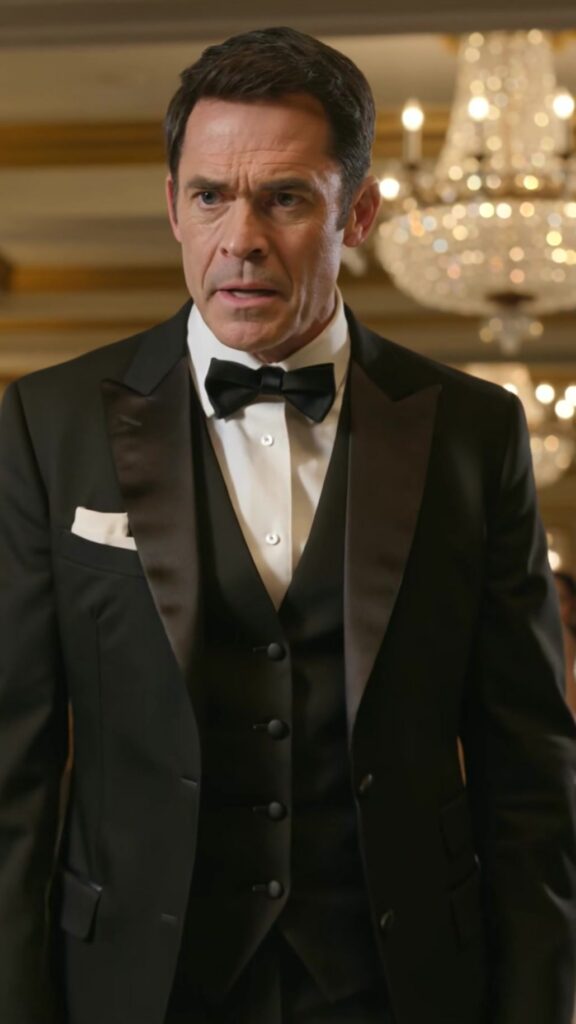
The door behind her opened with a pressurized hiss. A man stepped in, tall, well-dressed, clinical down to the angle of his tie. Dr. Harlan Voss didn’t rush; he didn’t need to. This was his vault, his corridor, his locks. His voice was measured and carefully gentle, the way predators can be when they’re enjoying themselves.
“You’re not cleared to be here,” he said, and then, to the boy without taking his eyes off the girl, “Eli, look at me.”
Eli’s pupils dilated. His chin lifted toward Voss as if tugged by a string.
Voss’s mouth tightened at the small display of obedience, then he addressed the girl again. “What did you do to him?”
She didn’t flinch. Her calm didn’t look rehearsed—it looked old. “I didn’t do anything,” she said. “Not yet.”
Voss’s gaze dropped to her hands. “You’re carrying something.”
“Yes.” She took one step closer to Eli. Not close enough to touch. Close enough that he could feel her heat. “I brought him back what you took.”
Voss’s expression sharpened. The room seemed to listen harder. “That’s impossible,” he said, and for the first time the control in his voice frayed at the edges. “You can’t retrieve an excised imprint.”
The girl opened her palm. The dark sliver lay there like a splinter from a star. It didn’t glow. It didn’t hum. It simply existed with a wrongness that made the air around it feel thinner.
Eli’s eyes dropped to it. Something in him shifted—an almost invisible tremor, like the first crack in a frozen lake. His hands, which had been limp in his lap, curled into fists.
“No,” Voss whispered, and the word came out too small, too human. “He remembers.”
Silence followed, heavy and stunned. Because it shouldn’t have happened. Not after the procedure. Not after the months of repetition and conditioning, the sedatives, the tranquil voice recordings, the careful erasure of the one event that anchored Eli’s will. The lab had built an entire doctrine around the premise that memory could be trimmed like a hedge.
The girl held the shard out, not offering it to Eli’s hand but to something deeper in him. “You didn’t remove it,” she said. “You hid it. You packaged it. You buried it inside your own archive and called it a cure.”
Voss moved fast then, the smoothness breaking. He crossed the room, reaching, his fingers spread as if to snatch the shard from reality itself. “Put it down,” he ordered. “You have no idea what you’re doing.”
But Eli moved first.
He didn’t stand as if he had strength. He stood as if he’d remembered he had bones. The chair scraped against the bolts, metal shrieking. His gaze lifted from the shard to the girl, and the confusion that had softened his face began to rearrange into recognition—ugly, sharp, alive.
“Mara,” he said, and his voice was not the voice of Subject Seven. It carried the weight of a different hallway, a different rain, a promise made in the dark. “You came back.”
The girl—Mara—let out a breath as if she’d been holding it for years. “I told you I would.”
Voss froze, hand suspended midair. His eyes darted from Mara to Eli, as if counting exits that no longer existed. “That name,” he said hoarsely. “He shouldn’t—Eli, listen to me. She’s a contaminant. She’s part of the implanted narrative.”
Eli’s lips parted. For a heartbeat, it looked like he might obey. The conditioning was a deep groove, and deep grooves love to catch wheels.
Then his gaze fell again to the shard in Mara’s palm. A pulse passed through it, not light but presence. Eli’s breath hitched, and the groove in his mind shattered sideways.
His eyes filled, not with tears but with images he couldn’t stop: a stairwell smelling of bleach, his own hands shaking as he held a door closed, Mara’s braid brushing his cheek as she whispered, “Stand when I come back.” Voss’s voice behind them, amused. Men in white coats. A needle sliding in. Eli’s scream swallowed by foam walls.
He looked up at Voss with a clarity that made Voss step back.
And just before anyone could understand the new geometry of the room, the boy spoke.
“It wasn’t just me,” Eli said. His voice was steady now, and that steadiness was the most terrifying thing Voss had ever heard. “You didn’t erase a memory. You copied it. You carved it into pieces and planted them in the others so none of us would know what we were missing.”
Mara’s fingers tightened around the shard. Her face stayed calm, but her eyes flickered—warning, grief, anticipation. “Eli—”
He didn’t look at her. He stared at Voss as if Voss were an equation that finally balanced. “You wanted to see if pain could be shared,” he continued. “If guilt could be distributed. If a mind could be made obedient by making it incomplete.”
Voss’s throat bobbed. “You don’t know what you’re saying,” he rasped. “Those were experimental redundancies. Safeguards.”
“No,” Eli said. “They were cages.”
Then he turned his head toward the glass wall at the far end of the room, the one-way pane behind which other subjects sat in other chairs, living quiet, partial lives. Eli’s gaze seemed to pierce it. Mara followed his stare, and for the first time her composure cracked, just a hairline fracture. She understood before he said it.
“Mara,” Eli murmured, “you didn’t bring back my memory.”
He reached toward the shard. His fingertips hovered, trembling, but he did not touch. “You brought back the key.”
Voss lunged, panic overtaking protocol. “Don’t!”
Eli looked at Mara at last. There was apology in his face, and something like love, and something like doom. “You asked me to stand,” he said. “I will.”
He spoke one more sentence, not loud, not theatrical, but precise—an arrangement of syllables that made the monitors in the room flicker and the air tighten as if it were being drawn through a narrow throat.
“I remember how to open the doors.”
All across the facility, locks clicked as if startled awake. Lights dimmed, then surged. In the glass wall, silhouettes shifted, heads turning in unison. Somewhere down the corridor, an alarm tried to begin but choked on its own first note.
Voss stood very still, watching his world unhinge. His whisper was almost reverent, almost prayerful. “That should never have happened.”
Mara closed her fingers around the shard until her knuckles blanched. Her eyes stayed on Eli, not on the chaos blooming outward. “It didn’t make sense,” she said, voice breaking on the truth. “Not until now.”
Eli’s expression hardened, not with cruelty but with resolve. “It’s going to get worse,” he said, and he wasn’t threatening. He was warning her. He was warning everyone.
And then he smiled—not because he was happy, but because he was finally whole enough to choose.
“Good,” he said. “Let it.”