It started so simply. A late lunch at a corner café I’d visited often enough that the barista no longer asked my name, only whether I wanted the same bitter coffee with a slice of lemon on the side. The rain had been threatening all morning, a gray curtain held up by stubborn wind, and the windows were filmed with the kind of damp that softened the world into watercolor. Inside, the air smelled like toasted sugar and wet coats. I had my laptop open and a folder of papers beside it—things I was supposed to turn into a coherent report before nightfall.
I remember thinking that I had finally learned to live inside ordinary moments. That I could sit at a table and let my mind stay where it belonged—in the present, in numbers and deadlines—without being dragged back into old corners where grief waited.
Then a boy walked up to my table.
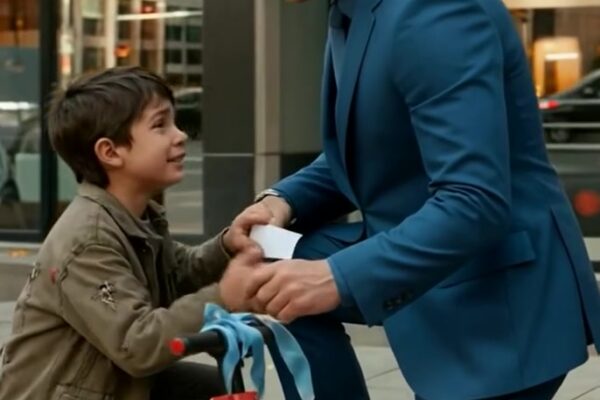
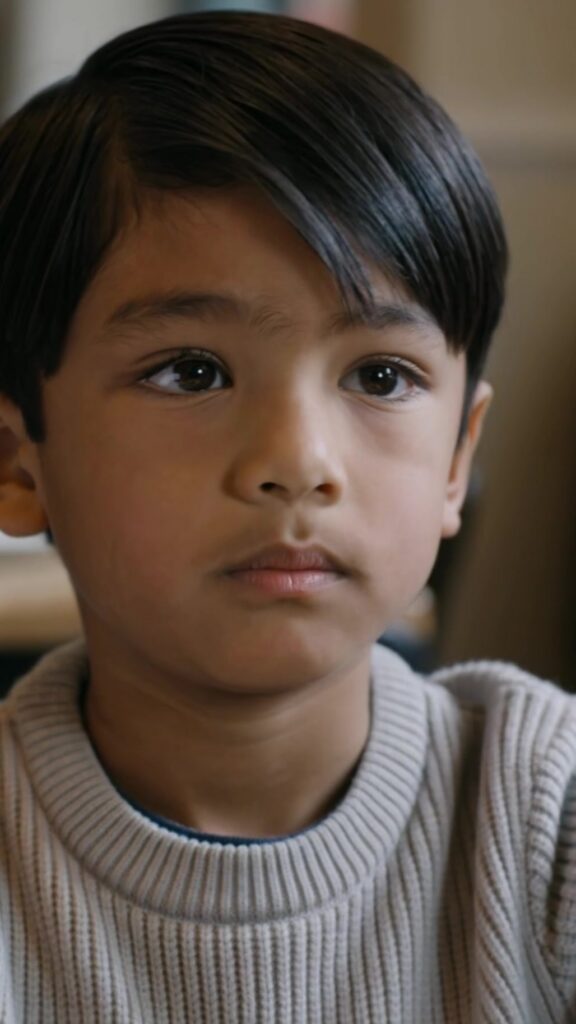
He was small, no more than seven or eight, and so silent that he seemed to have been cut out of the rain itself. He wasn’t dressed for the weather; his jacket hung open, the cuffs darkened with water. Most children carried noise with them, even when they tried to be quiet, but he moved with a careful stillness that made me look up before I knew why. His shoes left no muddy tracks. His eyes didn’t dart around the café in curiosity. They fixed on me like I was the only thing he came to find.
Out of place, my mind supplied. Lost, maybe. I glanced around for an adult, for a frantic parent with an umbrella and a phone pressed to their ear. No one seemed to notice him.
He stood beside my table, hands at his sides, waiting.
I should have asked if he needed help. I should have waved down the barista. Instead, I went still and pretended I hadn’t seen him. The instinct came from a place I didn’t like to admit existed: the part of me that believed attention was an invitation to trouble. I stared at my screen, moved my cursor, tapped a key I didn’t need to tap.
The boy didn’t speak. He didn’t clear his throat. He simply leaned forward, just enough that I could smell rain on his hair, and reached out.
His fingers touched my necklace.
My entire body froze.
The pendant was small and plain, a thin oval of worn silver on a chain I never took off. It didn’t gleam like jewelry meant to be admired; it was the kind of thing you wore because it mattered, because removing it felt like taking your skin off. I’d found it once, years ago, inside a shoebox I was sure I’d thrown away. There had been no explanation, only the weight of it in my palm like a secret.
“How do you know this?” I asked.
My voice sounded calm. It even looked calm, if you watched only my mouth. But my eyes burned, and my hands trembled so hard I had to curl them into fists under the table.
The boy’s fingers lingered on the pendant as if he recognized it by touch.
“Mom said I should show you,” he said.
That didn’t make sense. Not even close.
My mother was buried three years ago in a cemetery outside town, under a stone that still looked too new. I had watched the earth fold over her like closing hands. I had gone numb with the kind of certainty only death gives. There were no more messages, no more instructions.
Yet the way he said it—flat, factual, as if he’d been told to bring milk home—made unease seep into my chest.
“Who is your mother?” I asked, keeping my voice low.
The boy slipped his hand into his pocket and pulled something out.
A bracelet.
Not a shiny trinket. A battered leather band with a cracked copper clasp and a single bead carved into the shape of a tiny bird. I knew every mark on it. I knew where the leather had been scorched near the edge, where the stitching had come loose, where the bead’s wings had worn smooth from being rubbed by anxious fingers.
My breath caught so hard I heard it in my ears.
I had buried that bracelet with my sister.
We’d placed it on her wrist in the hospital because her hands looked too empty without it. Because she’d worn it every day since she was twelve, since she’d found it at a street market and declared it lucky. When the machines went quiet and the room lost its tension, I had clung to that bracelet like it could keep her tethered. Later, when the nurse asked if we wanted any personal items removed, I said no. I couldn’t bear to strip her down to nothing. I couldn’t bear to take the last familiar thing away.
It shouldn’t be here.
I swallowed, forcing my lungs to work. “Where is your mother?” I asked again, more carefully this time, like any sudden movement would cause the world to snap.
The boy didn’t answer. He simply turned his head toward the entrance.
I followed his gaze, my heart pounding against my ribs as if it wanted out.
At first I saw only the fogged glass door and the blur of the street beyond, the rain finally beginning to fall in sheets. Then the door opened and a gust swept in, bringing the smell of wet asphalt, and a figure stood in the doorway as if the storm had sculpted her.
Still. Watching. Waiting.
She was soaked through, hair plastered dark against her cheeks, but she did not shiver. Her posture had the same stubborn angle I remembered from childhood arguments. Her hands were empty, her shoulders squared, and her eyes—those eyes—were fixed on me with a look that made the café around us dissolve.
My voice dropped to a whisper. “No… that’s not possible.”
Because if I was seeing what I thought I was seeing, then everything I knew—about grief, about endings, about the rules that kept the world from becoming a nightmare—just shattered.
Her name rose in my throat like something sharp. “Mara,” I breathed, though I didn’t hear my own voice over the pounding of blood.
My sister stepped inside.
She looked older than the last time I saw her alive, not by years but by weathering, as if she’d been worn by distance. A thin scar cut along her jawline. Her lips were pale. Yet her gaze held steady, as if she’d practiced this moment in her mind until it no longer frightened her.
The boy—her boy, my mind supplied, though the logic made me dizzy—moved a half-step closer to me, as though he were a bridge between us.
“You’re dead,” I said. The words came out harsher than I meant, but truth has edges.
Mara’s eyes flickered. “That’s what you were told.”
“I watched—” My throat tightened. “I watched them cover you.”
She took a breath, and for a moment she looked like she might fold. But then her gaze sharpened. “You watched a coffin,” she said. “You watched people who needed you to believe it was me.”
The café noise returned in fragments: a spoon clinking, someone laughing too loudly, the espresso machine hissing like a warning. No one else seemed to see her. Or if they did, they treated her like any other customer walking in from the rain.
My hands found the edge of the table, gripping hard enough to hurt. “Why?” I managed. “Why would anyone—why would you—”
Mara’s eyes cut to the bracelet in the boy’s hand. “Because I didn’t have a choice,” she said. “And because you were the one person they could use to make it stick.”
I shook my head, tears blurring the room. “Who are they?”
She hesitated. In that pause I saw exhaustion, and fear, and something I had never seen in her before: regret that lived deep in the bones.
“The day I disappeared,” she said quietly, “Mom put that necklace on you.”
My fingers flew to the pendant. It felt suddenly heavier, as if it had absorbed all the years since.
“She told you it was a keepsake,” Mara continued. “She didn’t tell you it was also a signal. A promise. A way to make sure you’d stay exactly where you were.”
The boy looked up at me then, solemn as an old soul. “Mom said you’d know,” he murmured, as if repeating a line he’d memorized. “She said you’d remember the bird.”
I stared at the bead on the bracelet, at the tiny wings worn smooth by my sister’s thumb. A memory surfaced: Mara at twelve, holding it up to the light, declaring it would always lead her home.
“I don’t understand,” I said, and it was true. Every part of me was splintering under the weight of a world that had been rearranged.
Mara took a step closer. Water dripped from her coat onto the café floor, darkening the tile like spreading ink. Her voice lowered, the way it used to when she dared me into trouble. “You will,” she said. “But not here. Not with ears everywhere.”
“Ears?” I echoed, my panic sharpening into something else.
She nodded once, barely. “I didn’t come back for apologies,” she said. “I came back because you’re in danger. And because Mom’s gone now, the thing keeping you invisible is gone too.”
I thought of my mother’s empty house, of the shoebox that had appeared where it shouldn’t have, of the sudden accidents and near-misses I’d brushed off as bad luck. I thought of how often I’d felt watched without ever seeing who watched me.
My stomach turned. “You’re saying—”
“I’m saying this started long before your grief,” Mara interrupted, her gaze hard. “And it’s about to end, whether we’re ready or not.”
The boy held the bracelet out to me like an offering. My hands hovered, then closed around it. The leather was cold and damp, but familiar in a way that made my chest ache.
Mara’s eyes softened for a heartbeat. “Come with us,” she said. “Right now.”
I looked at my laptop, my papers, my coffee gone cold—my carefully constructed ordinary life. Then I looked at my sister in the doorway of the impossible, rainwater streaming from her hair like she’d walked out of a storm that had been waiting specifically for me.
The world had already shattered. There was nothing left to hold on to but the truth, however jagged it was.
I stood.
And that was how it began—how something that started so simply became the moment my life stopped pretending it belonged to daylight.