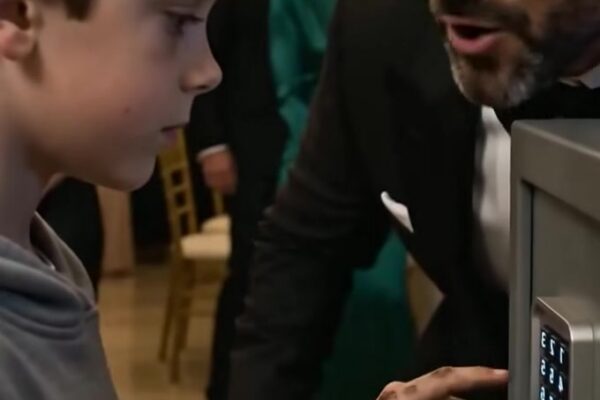
The bell above the glass doors chimed with a thin, embarrassed sound, as if it already knew the boy who stepped inside didn’t belong. Rainwater slipped from his hair in slow beads, darkening the collar of his hand-me-down jacket. His shoes—canvas with peeling rubber and frayed laces—left damp half-moons on the polished marble floor. The bank lobby smelled like lemon polish and money that had never been folded into a pocket.
Eli paused near the brochure stand, clutching an envelope the way people held prayer cards at funerals. The paper was soft at the edges from being read too many times. He had written the account number carefully, checked it, checked it again. It wasn’t a lot of money—not compared to what lived behind the marble and brass—but it was everything that had been left to him, sealed up in a trust with his name typed in clean black letters.
He had rehearsed the words all morning in his aunt’s mirror. “I’m here about my account.” “I need to make a withdrawal.” His throat tightened anyway when he approached the counter. The teller’s workstation was a neat square of acrylic and chrome, a small fortress of professionalism. Behind it sat a woman with perfect eyeliner and a small smile that didn’t reach her eyes.
“Can I help you?” she asked, her voice pitched to carry—pleasant, but designed to control a room.
Eli held out the envelope. “I… I need to take out some money. My aunt said—”
The teller glanced at his shoes first. It happened so quickly Eli almost doubted himself, but the corner of her mouth twitched like she’d caught a smell. “You have an account here?”
“Yes, ma’am.” He slid forward his school ID, the only photo identification he had. “My name is Elijah Monroe.”
The teller didn’t touch it. “We require state-issued identification for withdrawals,” she said, and her tone sharpened as if a rulebook had been opened. “And you need an adult present if you’re a minor.”
Eli’s fingers curled over the envelope. “I’m seventeen. My aunt is working. She said the letter—” He tapped the paper. “It says I can access it now. For school.”
Behind him, a muted laugh escaped from the seating area near the manager’s office. Eli turned. Two men in tailored suits were leaning over a laptop, their ties loosened as if the air itself was paid to be comfortable around them. One of them—a man with a watch that looked like it could buy a car—nudged the other and nodded toward Eli’s feet.
“Those shoes are having a hard day,” he murmured, not quiet enough.
The other man chuckled. “Kid’s probably here to cash in a jar of pennies.”
The teller’s smile broadened, feeding off the room. “Sweetie,” she said, softening her voice in a way that made it crueler, “this is a financial institution. We have certain standards. Maybe you should come back with a parent. Or go to the credit union on Fourth. They’re… more flexible.”
Heat climbed Eli’s neck. He looked down at his shoes. They had cost two dollars at a church sale, and he’d scrubbed them so hard the fabric had thinned. He thought of his aunt’s hands, cracked from disinfectant, and the way she had sighed when she pressed the envelope into his palm. “This is your shot,” she’d said. “Don’t let pride stop you.”
“I’m not asking for anything I don’t have,” Eli said, his voice tighter than he meant. “It’s mine.”
The teller leaned back, assessing him like a misplaced item. “Sir,” she called, lifting her chin toward a door frosted with the bank’s logo, “we might need assistance. There’s… a situation.”
The manager appeared a moment later, smooth-haired and smiling, with a suit that seemed designed to reflect authority. He glanced at Eli, at the envelope, at the shoes, and his expression arranged itself into polite irritation.
“What seems to be the problem?” he asked.
“He’s attempting to withdraw funds,” the teller said, “without proper identification.”
The manager’s gaze lingered on Eli’s damp jacket. “Young man,” he said, as if addressing a stray dog, “we can’t just hand money to anyone who walks in. There are procedures. This place isn’t for—” He stopped himself, then finished with a smile. “This transaction isn’t appropriate without a guardian.”
Eli’s hands shook. “My aunt—”
“Come back when you’re prepared,” the manager said, already turning away.
Eli swallowed. He could feel the eyes on him—the suited men, the people waiting in line, even the security guard by the door whose hand drifted lazily toward his belt as if practicing for a different kind of day. Eli stepped back, the brochure stand scraping slightly as his shoulder brushed it. A stack of pamphlets fanned like nervous birds.
The bell over the door chimed again, louder this time. Eli turned, expecting another customer. Instead, a man entered with rain on his coat and a calm that cut through the room like a blade. He was tall, broad-shouldered, dressed in a charcoal overcoat that looked expensive without trying. His hair was peppered with gray, and his eyes were the kind that didn’t waste time blinking at nonsense.
He took in the scene in a single sweep: the manager angled away, the teller stiff with triumph, Eli standing with his envelope like a shield. The man’s gaze settled on Eli’s face and softened for half a heartbeat.
“Eli,” he said.
Eli’s throat loosened in shock. “Uncle Vaughn?”
The name landed with weight, though most people in the lobby didn’t understand why. The manager did. His shoulders shifted as if someone had tightened a string down his spine.
Vaughn Monroe walked forward slowly, the soles of his shoes making no sound on the marble. He put a hand on Eli’s shoulder—not possessive, but steadying. “You called,” he said quietly.
Eli nodded, embarrassed and relieved all at once. “They said… they wouldn’t—”
“I heard enough,” Vaughn replied.
The manager stepped closer, smile returning like a mask pulled from a pocket. “Mr. Monroe,” he said, voice suddenly warm, “what a surprise. We weren’t expecting you today.”
Vaughn didn’t offer his hand. “I wasn’t expecting my nephew to be humiliated while trying to access his own funds,” he said. His words weren’t loud, but they carried, and the lobby began to quiet. Even the suited men near the seating area stopped typing.
“There’s been a misunderstanding,” the manager said quickly. “We have compliance obligations. A minor—”
Vaughn lifted the envelope from Eli’s grip with careful fingers, as if it were fragile evidence. “This is a distribution letter from the Monroe Education Trust,” he said, flipping it open. He glanced at the teller. “You didn’t read it.”
The teller’s face flickered. “We— I—”
Vaughn looked at the manager. “Page two authorizes direct withdrawal with school identification, notarized signature on file, and a call-back protocol to the trust administrator.” He tapped the paper. “The trust administrator is me.”
Silence fell so cleanly it felt engineered. The security guard’s hand lowered from his belt. Someone in line cleared their throat and then thought better of making noise.
The manager’s smile tightened. “Of course,” he said, the word stretched thin. “If you could step into my office, we can resolve—”
“We’ll resolve it right here,” Vaughn said. His voice remained calm, but it made the air heavy. “My nephew came in to take out tuition money. Instead, your staff judged him by his clothes and treated him like a problem to remove.” Vaughn’s gaze slid briefly toward the two suited men; they looked down at their laptop as if it had suddenly become fascinating.
The teller swallowed. “Sir, I didn’t mean—”
“Intent isn’t the same as impact,” Vaughn cut in, eyes never leaving the manager now. “Process the withdrawal. Then print your policy on minors and trusts. Then bring your security footage and complaint procedure to this counter.”
The manager’s jaw worked once. “Mr. Monroe, we pride ourselves on professionalism—”
“Then demonstrate it,” Vaughn said. “Because I will be speaking with your regional director this afternoon. And before anyone asks, yes, I’m aware this bank has been courting the Monroe Foundation’s endowment accounts.” He paused, just long enough for the implication to sink into the marble. “Consider this your interview.”
The manager’s eyes widened a fraction. He turned to the teller with a look that was almost fear. “Do it,” he hissed under his breath.
The teller’s hands trembled as she finally took Eli’s ID, typed, made a call. Her earlier confidence dissolved into a strained efficiency. When the cash drawer opened, the sound was oddly loud, like a confession.
Eli watched the bills slide into an envelope—his name written neatly this time, not like a child’s. His chest ached with relief so sharp it felt like pain. He hadn’t wanted revenge. He’d wanted dignity. But the room had decided to take a lesson the hard way.
Vaughn leaned down slightly, speaking only to Eli. “You did the right thing coming here,” he said. “Don’t let someone else’s comfort decide your worth.”
Eli nodded, gripping the new envelope. “I thought I did something wrong.”
“You didn’t,” Vaughn said, straightening. He faced the manager once more. “One more thing.”
The manager braced. “Yes?”
Vaughn’s eyes moved to Eli’s shoes. “The next time a kid walks in here with wet hair and bargain shoes,” he said, “you treat him like a client, not a contaminant. Because you have no idea who taught him to be brave enough to open that door.”
When Vaughn guided Eli toward the exit, the bell chimed again. This time it sounded different—less embarrassed, more awake. The rain had slowed outside, and the air smelled like pavement and possibility. Eli stepped onto the sidewalk, his shoes still cheap, still frayed, but carrying him forward all the same.
Behind the glass, the bank remained silent, as if it had finally learned what money couldn’t buy: the right to look down on someone and feel safe doing it.