Lucien built his life the way some people built bunkers: with thick walls, clean angles, and no unnecessary windows. The kind of life you couldn’t accidentally fall into. You had to earn your way in, and even then you’d get a polite smile and a glance at the perimeter cameras.
He lived in a penthouse that looked out over the city like it was keeping an eye on the skyline. Everything inside it was sharp and minimal—steel, glass, black leather—like warmth was a design flaw. His fridge was stocked like a hotel. His closets were organized like a museum. Even his schedule was armored: meetings, dinners, flights, gym, sleep. No gaps for feelings to slip through.
He told himself it was discipline. He told other people it was focus. But the truth—one he never said out loud—was simpler. If you kept your world structured enough, nothing could get in. Not grief. Not confusion. Not questions that didn’t have answers.
That Saturday, he was supposed to go to a charity gala for the Sancourt Foundation. His father’s foundation. The kind of event where donors and politicians sipped champagne and congratulated each other for being generous in rooms that cost more than most people’s homes. Lucien was meant to smile, shake hands, and look like the future: calm, polished, inevitable.
He didn’t make it past the block.
A thin, trembling melody reached him between traffic noises and city chatter. It was coming from the corner near the old fountain—the one the city never bothered to fix, so it constantly leaked and stained the pavement a rusty orange. A violinist stood there in a frayed wool coat, the case open at her feet with a scattering of coins.
Lucien almost kept walking. His phone was buzzing with reminders. His driver would be circling. His father would be irritated.
Then the melody turned, the way a river suddenly takes a hard bend, and it hit him in the ribs.
His feet stopped without permission.
It wasn’t just a tune. It was a memory with sound—something that belonged to a different life, before the fortress. He stood frozen, watching the bow move like it was cutting the air into shapes he recognized, even if he couldn’t name them yet.
The violinist’s face was half-hidden by a scarf, her dark hair slipping out in loose strands. She looked too thin. There was a kind of fatigue in her posture, as if her bones were carrying someone else’s weight. But her hands—her hands were steady, purposeful. The music was the only thing that didn’t tremble.
When she finished the phrase, she lowered the violin and looked up.
Her eyes met his, and the world went quiet in that specific, terrifying way it does right before something breaks.
Her lips parted, like she’d been holding her breath for years.
“Lucien,” she said. Not like a stranger guessing a name. Like a person stepping into a room she used to live in.
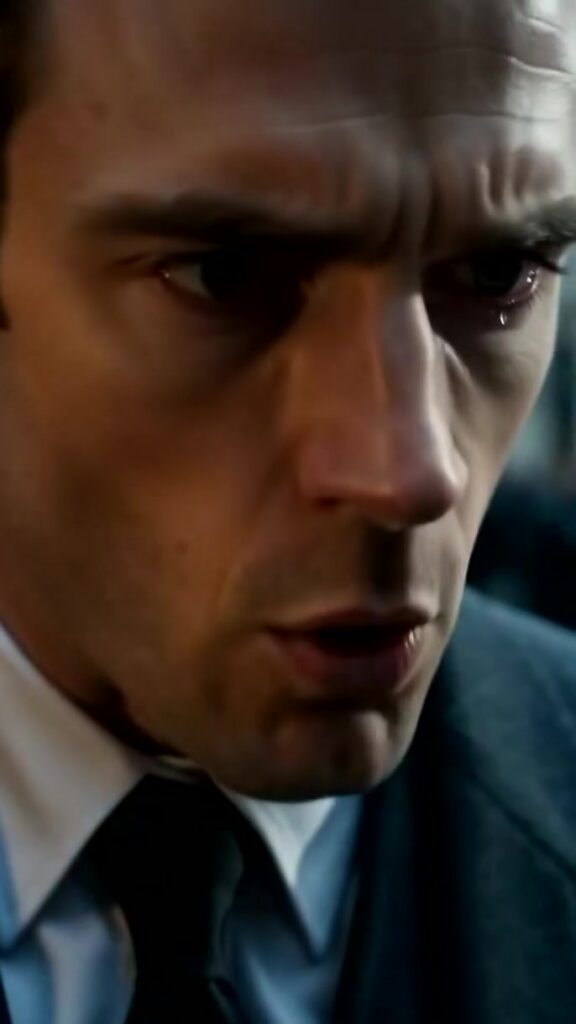
He couldn’t move. His throat tightened until swallowing hurt.
He’d been ten when she disappeared. Ten when his father told him there had been an accident, that it was tragic, that it was better not to ask too many questions. Ten when his mother’s face turned into a locked door and then, eventually, into nothing at all.
And now she was standing on a sidewalk with a violin.
“You’re…” he started, and the rest of the sentence refused to form.
Her eyes filled fast, tears spilling over like she’d been keeping them pressed behind her lids by sheer force of will. “I tried to come back for you,” she said, voice rough. “Every door was closed. Every record disappeared. So I kept the only thing they couldn’t take from me.” She touched the violin with the kind of tenderness people saved for living things. “The song.”
Lucien could barely breathe. His chest felt too small for his heart. “Why now?”
She swallowed, and it looked painful. “Because I’m dying.”
The words weren’t dramatic. They were blunt, almost tired, as if she’d used them on doctors and paperwork and late-night ceilings too many times already.
Lucien stared at her as if he could will the sentence to undo itself. “What do you mean you’re dying?”
She pressed a trembling hand against her side. Her coat shifted, and he caught the slightest glimpse of a medical bandage near her ribs. For the first time he saw the grayness beneath her skin, the effort in each breath, the way her shoulders sagged like she was fighting gravity one second at a time.
“I didn’t want to die a second time,” she whispered. “Not before you knew.”
Lucien’s mouth opened. Nothing came out. He had a thousand questions and no language for any of them.
Behind them, an engine roared too loud for the street. A black luxury car slammed to the curb hard enough to make the coins in her violin case jump. The rear door flew open.
Lucien turned, instinctively, like the fortress inside him recognized an approaching siege.
His father stepped out.
Étienne Sancourt always looked like he’d been carved out of careful decisions. Elegant coat. Silver hair combed perfectly back. Posture straight as a threat. The city had called him a visionary, a benefactor, a man who’d risen from nothing and never forgotten to bring others with him.
Lucien had called him “sir” for most of his childhood.
But the moment his father’s eyes landed on the violinist, something dropped out of his face.
No surprise. Only recognition. Only fear.
Lucien watched it happen with a strange, detached clarity, as if he was seeing his father’s true expression for the first time.
“You,” Étienne said, and the word sounded like it scraped his throat on the way out.
The woman—his mother, his mind insisted, his mind that had been trained not to insist on anything—gave a small, shattered smile. It wasn’t triumph. It wasn’t even anger. It was the expression of someone who’d carried a heavy truth for too long and was finally setting it down in front of the person who’d forged it.
She looked at Lucien then, eyes bright with tears and something steadier underneath. “Ask him,” she said softly, “why he buried me alive in your memory.”
Lucien’s stomach lurched.
He turned to his father. “What is she talking about?”
Étienne’s jaw tightened. “This is not the place,” he said quickly, reaching for composure like it was a coat he could put back on. “Lucien, we can discuss—”
“No.” The word came out sharper than Lucien expected. He stepped closer, putting himself between them like he was finally choosing a side. “Right here. Right now. What happened?”
His father’s gaze flicked to passersby. To the open violin case. To the fountain. To the street cameras on the corner. He looked like a man calculating exits.
The woman’s breathing grew ragged, but she kept her chin lifted. “Tell him,” she said, voice shaking. “Or I will.”
Étienne’s mouth pressed into a thin line. “You left,” he said at last, each word clipped. “You abandoned him.”
Lucien’s mother gave a hollow laugh that turned into a cough. She doubled slightly, pressing her hand to her side harder. When she straightened, her eyes were blazing. “I didn’t leave,” she said. “I was removed.”
Lucien’s head spun. The sidewalk felt unstable beneath his feet.
“Removed?” he repeated, like he didn’t understand the concept.
His father’s voice dropped, controlled, venom disguised as calm. “You were unstable. You were going to ruin everything.”
“Everything,” she echoed. “You mean your deals. Your image. Your campaign. Your precious foundation money.”
Lucien’s hands curled into fists. He could feel the fortress in him trembling at the foundation—hairline cracks forming, spreading. “Dad,” he said, and the word tasted foreign. “What did you do?”
Étienne stared at him, and for a split second Lucien saw something like pity. “I protected you,” his father said. “From her. From chaos.”
His mother’s eyes softened when she looked at Lucien again. “He told you I died,” she whispered. “Didn’t he?”
Lucien felt cold flood his veins. He remembered the black suit, the closed casket, the adults speaking in low voices. He remembered being told not to cry in front of cameras. He remembered being moved to a new house the next week, like grief was something you could outrun if you drove fast enough.
“There was a funeral,” he said, stunned. “I saw—”
“You saw what he wanted you to see,” she said gently. “He made me disappear. He paid people. He erased papers. He called it mercy.”
Lucien looked at his father and realized, in one horrible flash, why his life had always felt like it came with invisible guards. Why questions were discouraged. Why his childhood photos had gaps. Why any mention of his mother made the air in the room go sharp.
“Where were you?” Lucien asked her, voice breaking. “All this time.”
She took a shaky breath. “In places with locks,” she said. “In hospitals that weren’t on maps. In apartments borrowed from strangers. In waiting rooms. I tried to get to you. But your father’s world is… a fortress.”
The word landed hard because it was true. Lucien had inherited the architecture of it without even noticing.
Étienne stepped forward, his composure returning like a mask sliding into place. “Enough,” he said. “We’re leaving.”
“No,” Lucien said, surprising himself again. His voice was steadier now, anchored by anger and grief braided together. “You’re not deciding anything for me anymore.”
His father’s eyes narrowed. “Lucien. Don’t do this.”
Lucien looked at his mother, who swayed slightly, and instinctively reached out to steady her. She felt fragile under his hand, like she might dissolve if he held too tight. She smelled faintly of soap and cold air and something like rosin from the violin bow.
“How long?” Lucien asked, afraid of the answer.
She hesitated. “Months,” she admitted. “Maybe less.”
The city noise returned in a rush—horns, footsteps, distant laughter—like the world had kept going without permission. Lucien felt furious at all of it. Furious at time. Furious at silence. Furious at himself for living inside a story someone else wrote for him.
He turned to his father one more time. “If you did this,” he said quietly, “if you stole my mother and replaced her with a lie…” His voice shook. “Then you don’t get to call this protecting me.”
Étienne’s expression hardened, but there was panic in the tightness around his eyes. “You don’t understand what was at stake,” he said.
Lucien nodded slowly. “I’m starting to.”
His mother lifted the violin again, not to play, but to hold it like a shield. “Lucien,” she said, “I don’t have a lot of time to give you the whole truth. But I can give you enough.”
Lucien swallowed. The fortress inside him was cracking wide open, and instead of falling into ruin, he felt something else in the empty spaces—air. Light. Possibility.
He looked at her, really looked, and realized the cruelest part wasn’t the lie. It was the way it had trained him to stop reaching.
“Then tell me,” he said. “Tell me everything. And then we’re leaving.”
His father took a step toward the car, like he could still steer the scene. “Lucien—”
Lucien didn’t glance back. He slipped an arm around his mother’s shoulders and guided her away from the curb, away from the black car, away from the life that had been built like a fortress. The city around them felt suddenly huge and unfamiliar, full of doors he’d never tried.
Behind him, Étienne’s voice rose, sharp with command. “Get back here.”
Lucien kept walking anyway. Each step felt like crossing a drawbridge he’d always assumed was locked.
And somewhere in the space between the fountain and the next streetlight, his mother began to hum the melody she’d played—softly, brokenly—like a map home drawn in sound.