The first time Lucien noticed his life had turned into a fortress, he was thirteen and standing in the marble foyer of his father’s townhouse, watching men in dark suits remove a grand piano as if it were contraband. The movers didn’t meet his eyes. They followed instructions with the reverence of priests. When the piano’s legs cleared the threshold, the house seemed to exhale—relieved, or ashamed, he could never tell which.
“Music makes people weak,” his father said, buttoning his cuff with slow precision. “Weak people are easy to buy. Easy to break.”
Lucien learned to nod. He learned to swallow questions like pills. He learned that affection was a currency and his father was the only bank.
By the time he was thirty, he lived in a tower of glass that reflected the sky and gave nothing of itself back. His schedule was locked in increments. His assistant filtered his calls, his calendar was a gate with barbed wire. Friends were business partners. Lovers were temporary alliances. The only thing that felt remotely his own was the empty hour before dawn when he stood at the window with his coffee and stared at the city like it was an enemy whose habits he might one day memorize.
On a Thursday that began like all the others, he drove himself—an indulgence he allowed on days he needed to remember he had hands—to the riverfront where the financial district gave way to old stone streets. He had a meeting, he had numbers to defend, he had a plan for the next decade. He didn’t have space for ghosts.
Then the first note of a violin cut through the morning like a blade.
The sound was impossible in a street full of engines and footfalls. It wasn’t loud, but it carried the way a secret carries: straight to the center of you. Lucien braked without meaning to. His chest tightened as if someone had tied a rope around his ribs.
A woman stood near the iron railing above the river. She wore a dark coat too thin for the weather, its collar turned up. Her hair, once black in his fragmented recollection, had threads of silver now. The violin was tucked beneath her jaw with the intimacy of a promise. Her fingers moved with the economy of someone who had learned to survive on less than hope.
Lucien stepped out of the car. The cold bit him, but the music burned hotter. He walked toward it, each step a trespass into territory his mind had walled off years ago.
When the final note fell, it didn’t end so much as dissolve. The woman lowered the bow. Her gaze found him with a steadiness that made the street go quiet.
“Lucien,” she said, as if she had spoken his name every day for a lifetime.
His mouth went dry. He tried to answer and discovered his tongue had turned to stone. The memory of a smell—lavender and rosin—bloomed behind his eyes. A flash: a small apartment with sun on the floor; a child’s laughter; the warmth of arms that didn’t demand anything in return. Then, like a book slammed shut, nothing.
“Do I know you?” he managed, and hated himself for it the moment the words left his throat.
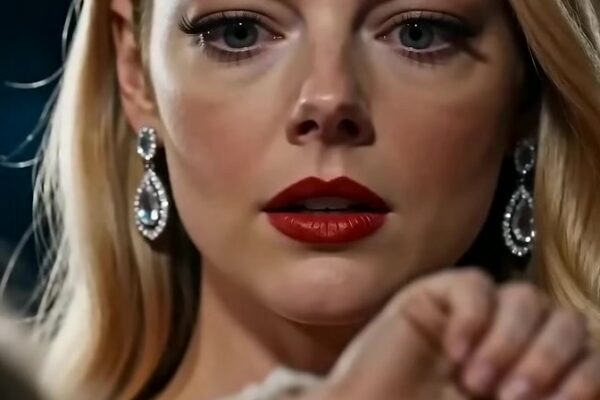
The woman’s face crumpled in a way that was almost imperceptible, like paper resisting a tear. Tears gathered, stubborn and bright, and then spilled down her cheeks. She didn’t wipe them away. She let them exist, unapologetic.
“I searched,” she said, voice roughened by distance. “When they took me, I tried to find you again. Every entrance I knew was sealed. Records altered. Names replaced. People who had known me pretended they’d never heard my voice.” Her hand, pale and unsteady, reached up to touch the violin’s varnished wood. “So I kept the one thing no one could confiscate. The melody.”
Lucien’s heartbeat stumbled. The world narrowed to her, the instrument, and the ache that had always lived in him without a name.
“Why come now?” he asked, though the question felt like an accusation he didn’t have the right to make.
She inhaled, and it looked like it hurt. “Because my body is done bargaining.”
Only then did he notice what grief had hidden: the tremor in her wrist, the gray cast under her skin, the careful way she held herself as if keeping something inside from spilling out. She pressed her palm against her side. Pain flickered across her features and vanished, disciplined.
“I couldn’t vanish again,” she whispered. “Not without you knowing I didn’t choose it. Not without you knowing I tried.”
Lucien took a step forward, instinctively, as if he could catch her before she fell. “Who are you?” he asked, and the words cracked.
She looked past him suddenly, beyond the traffic, to the corner where the street widened. A vehicle glided into view—black, polished, expensive enough to be more symbol than transport. It stopped with a finality that made pedestrians slow down. The rear door opened.
Lucien felt the air change. His spine tightened the way it always did when his father entered a room, a reflex trained by years of invisible discipline.
His father stepped out, immaculate in an overcoat that hung from his shoulders like authority. Silver hair. Perfect posture. The face the business papers loved: controlled, handsome in a severe way, carved from restraint.
He looked at Lucien first, then at the woman with the violin.
All the color drained from him.
No confusion. No disbelief. Only recognition, sharp and immediate—and something else that didn’t belong on his face. Fear.
The woman’s mouth curved into a small, broken smile. She looked at Lucien as if she were trying to pour an entire history into his hands before time took her fingers away.
“Ask him,” she said softly, each word heavy with years, “why he entombed me in your mind while I was still breathing.”
The sentence landed in Lucien’s chest like a stone dropped into deep water. The ripples reached places he’d never dared examine. A migraine of images threatened: a hospital corridor; a white door with a number; his father’s hand clamped on his shoulder; a lullaby that became screaming when interrupted; the smell of antiseptic and violin resin intertwined.
“What is she talking about?” Lucien turned to his father. He expected denial, the smooth lie, the practiced outrage. Instead his father’s eyes were fixed on the violin as if it were a weapon aimed at his throat.
“Leave,” his father said to the woman, voice thin with control. “This isn’t the place.”
“There was never a place,” she replied, her breath short. “You made sure of that.”
Lucien’s hands curled into fists. “Tell me,” he demanded, and the force of his own voice surprised him. “If she matters enough to frighten you, then she matters enough for me to know.”
His father’s jaw tightened, a muscle jumping. He took a step closer, lowering his voice as if secrecy were still his favorite tool. “You were a child,” he said. “Children form attachments to the wrong people. The wrong stories. I saved you from a life of weakness.”
The woman swayed, bracing herself on the railing. “He saved you,” she repeated, and the bitterness in her laugh was so raw it made the passersby glance away. “He told you I died. He told you I was dangerous. And while you mourned an invented funeral, he paid men to erase me from every paper trail, every school file, every photograph. He didn’t want you to remember that someone once held you without turning it into a transaction.”
Lucien stared at his father, searching for the familiar armor of certainty and finding only cracks. “You told me my mother died when I was five,” he said, words shaking loose like trapped birds. “You showed me a headstone.”
His father’s gaze flicked, infinitesimal, toward the woman’s face. “Grief is simpler than truth,” he said. “Truth invites questions.”
“I wasn’t allowed to see him,” the woman said, voice thinning. “They said it was for his safety. Then they said he’d forget. And you did.” She lifted the violin slightly, a ritual. “But my hands remembered him. They remembered the way he used to press his cheek against the wood and claim he could hear a song inside it.”
Lucien’s vision blurred. He could almost feel that childhood cheek pressed to varnish, almost hear a distant heartbeat of music that belonged to him. He reached out, not touching her, afraid she would vanish if he did.
“What’s your name?” he asked, because it was the simplest key he could think to turn in a locked door.
She swallowed, and tears slipped again. “Elena,” she said. “You used to call me Len.”
The nickname detonated something. Not a full memory—more like a fracture that let light in. He saw, for a second, a small kitchen table and a woman humming while stirring soup, her violin case open beside her like a second shadow. A man’s footsteps in the hallway. The sudden closing of the case. A child being lifted, hurried, someone whispering, “Don’t look back.”
Lucien turned on his father with a fury so clean it felt like clarity. “You built my life like a fortress,” he said, and tasted the metal of that truth. “You called it protection. But it was a prison.”
His father’s face hardened, the mask returning as if pulled by a string. “Everything you have—your position, your power—came from my choices,” he said. “From my sacrifices.”
Elena’s knees bent. She gripped the railing, bow slipping from her fingers. Lucien moved without thinking, catching her elbow. Her skin was cold, and she trembled as if the wind lived inside her.
“I don’t have long,” she murmured, leaning toward him. “That’s why I came. Not for revenge. For you.” Her breath warmed his ear with the last of her strength. “There’s a piece I wrote for you. I carried it through every locked door. If you remember nothing else, remember that I loved you before anyone taught you love had a price.”
His throat tightened until it ached. “Stay,” he said, helpless. “Tell me everything. We can—”
“You can,” she corrected, with a softness that broke him. She reached into her coat and drew out a folded sheet of music, worn at the creases. She pressed it into his palm like a relic.
Behind them, his father spoke sharply into his phone, summoning someone, controlling, containing. The old reflex urged Lucien to comply, to step back inside the walls built for him.
Lucien looked at the paper in his hand, then at the violin resting against Elena’s shoulder, then at his father’s face—an empire trembling at the edge of exposure.
He made a choice so small it felt like nothing, and yet it cracked the foundation of everything: he stepped away from his father and toward the woman who had been buried alive in his memory.
“Play it,” he said, voice raw. “If I forgot the door, show me the way back.”
Elena lifted the violin, bow shaking. She drew it across the strings, and the first note rose—frail, defiant, unmistakably his. The fortress around Lucien’s heart shuddered, and somewhere inside the stone, a child began to remember how to breathe.