The bistro was the kind of place that tried to soften the world—amber sconces, linen napkins folded like swans, a pianist who played as if heartbreak could be kept polite. Marianne Vale sat in the brightest pool of light at the center table, the one she always requested. It was easier to be seen than to be studied. She lifted her left hand to catch the warm glow, letting the diamond wink at the room the way a warning sign winks at an oncoming driver.
She was halfway through a toast, champagne hovering near her mouth, when the child’s voice cut through the music like glass against stone.
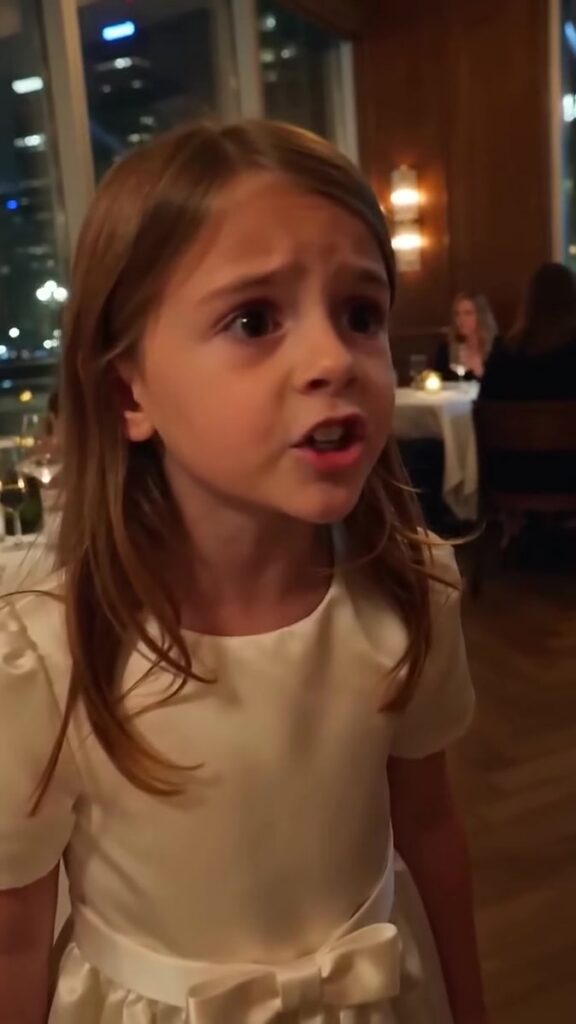
“Ma’am—that ring is my mom’s!”
The sentence wasn’t loud, yet it landed with a weight that made forks still and shoulders turn. The air tightened. Someone laughed uncertainly and then stopped when nobody joined. Marianne’s hand remained suspended, and for a beat the only sound was the faint clink of ice in a tumbler settling back into place.
Marianne turned toward the speaker with the careful composure of a woman who had been photographed enough times to learn where panic betrayed itself. The girl stood at the end of an aisle between tables, small enough to be overlooked until she decided not to be. She had dark hair pulled into a crooked ponytail and the blunt seriousness of someone who didn’t yet know she was supposed to soften her accusations.
“I’m sorry?” Marianne asked. She kept her smile, but her voice held the sharp edge beneath it.
The girl stepped closer, shoes squeaking against the polished floor. “My mom has that exact ring. She says it’s the only thing she has left from before. She doesn’t wear it. She keeps it hidden.”
A ripple moved through the room—curiosity, discomfort, and something like hunger. Marianne’s pulse kicked against her throat. The diamond on her finger suddenly felt heavier than any stone had a right to feel.
“That’s… not possible,” Marianne said, though the words lacked their usual authority. She had rehearsed denials for investors, for reporters, for men who asked why she didn’t visit her hometown anymore. She had never rehearsed one for a child.
The girl shook her head as if correcting a math mistake. “She hides it under her pillow. She said if she loses it, she’ll forget who she was.”
Marianne’s breath snagged. Under her pillow. The ring hadn’t been under a pillow in twenty years. It had been under a floorboard, wrapped in cloth that smelled like cedar and fear. It had been on the finger of a woman who held Marianne’s face in both hands and whispered, You keep moving, no matter what they say you did.
“Where is your mother?” Marianne asked. The question came out too quickly. Too urgently. She heard the tremor and hated herself for it.
The girl pointed without drama, as if indicating the dessert cart. “Outside. In the car. She didn’t want to come in.”
The chair legs shrieked as Marianne stood. Every eye followed her, but she no longer had the energy to manage their interpretation. She walked faster than grace allowed, heels striking the floor with a frantic rhythm. The restaurant door loomed, a dark pane reflecting her face back at her—pale, rigid, eyes too wide for a woman who bought confidence in tailored suits.
Her fingers closed around the handle. Cold metal. Reality. She pushed.
Night air hit her with blunt force. The street was wet from an earlier rain, reflecting neon and passing headlights in broken streaks. The city felt suddenly indifferent, as if it had never heard of Marianne Vale and never would. Behind her, the bistro’s warmth spilled out in a rectangle that shrank as the door began to swing back.
At the curb, a car idled with its headlights off. A modest sedan, paint dulled by time. The driver’s window was down. The silhouette inside didn’t move at first, and Marianne’s mind supplied a hundred alternatives—mistake, prank, coincidence, an old ring among many, a child’s imagination attaching itself to sparkle.
Then the person in the driver’s seat lifted her face into the spill of streetlight.
Marianne’s knees turned to water. Her stomach dropped as if the sidewalk had opened beneath her. The woman was thinner than the last time Marianne had seen her, and older in the way that came from years of wrong decisions made by someone else. But the eyes were unmistakable: gray-green, storm-lit, refusing to apologize for existing.
“No,” Marianne whispered. The word wasn’t denial. It was grief recognizing its own handwriting.
The bistro door continued its slow closing behind her, narrowing the warm light into a thin blade. In that dimming glow, Marianne saw the woman’s hands on the steering wheel—hands that had once braided her hair, hands that had once shoved her toward a back door and said Run, Mari, run. The woman’s left hand was bare.
The girl appeared beside Marianne, suddenly smaller without the restaurant’s attention on her. “That’s my mom,” she said, as if offering context in case Marianne couldn’t keep up.
Marianne couldn’t speak. The diamond on her finger flashed, and in the car the woman’s gaze locked onto it like a hook finding flesh. Her lips parted. For a long moment she didn’t get out, didn’t wave, didn’t smile. She simply stared, absorbing the impossible.
“Marianne?” the woman said at last, voice roughened by smoke or silence. “They told me you were dead.”
All the rehearsed denials evaporated. Marianne felt suddenly twelve years old again, standing on a porch with a duffel bag and a borrowed coat, watching a police cruiser idle in the driveway while her mother argued with a man in a uniform. She remembered the neighbor’s whispers, the accusation that her mother had stolen from the church, from the town, from the truth. She remembered how the ring had vanished that same week, how everyone assumed it had been pawned to pay for escape.
“I… couldn’t come back,” Marianne managed. “I tried. I wrote letters.”
The woman’s laugh was a small, bitter sound. “They burned anything with my name on it.” Her eyes flicked again to the ring. “Where did you get that?”
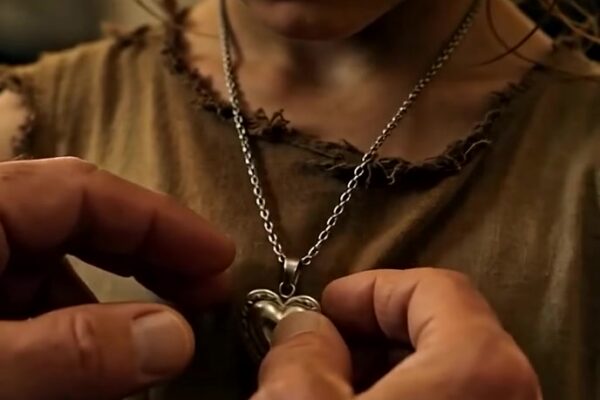
Marianne’s throat tightened. She looked at the diamond, at the thin band etched with tiny roses—an heirloom from a woman neither of them had met, passed down through a line of mothers who had survived their own disasters. Marianne had told herself she deserved it. She had told herself it was proof she’d made it out. She had told herself a hundred stories to cover the one she couldn’t face: that she’d taken it the night she ran, because she couldn’t bear to leave with empty hands.
“I took it,” Marianne said, the confession tasting like iron. “From under the floorboard. I told myself you’d come after me and I’d need something to bargain with, or…” She swallowed. “Or maybe I just wanted to make sure you couldn’t leave me too.”
Silence pressed in. A car passed, splashing through a shallow puddle. Somewhere down the block, someone laughed, oblivious.
The woman closed her eyes briefly, as if she’d been carrying that missing weight in her chest for decades and had finally found its shape. “I didn’t leave you,” she said, opening them again. “I was taken. They drove me out of town before sunrise. I spent years trying to find you.” Her voice cracked, and it was the first time Marianne had ever heard her mother’s strength fail. “I thought you forgot me.”
The girl tugged her mother’s sleeve through the open window. “I told you,” she whispered. “I told you it was real.”
Marianne stared at the child and realized with a dizzy jolt that she hadn’t just dragged the past into the street—she had dragged it into the present tense. This wasn’t only about what had been stolen. It was about what had been built on top of the theft: Marianne’s name in magazines, her carefully curated origin story, the polished interviews where she spoke of being “self-made” without mentioning the woman who had made her first.
The bistro door clicked shut behind Marianne with a finality that felt like a verdict. Warmth sealed away. The night claimed her.
She slid the ring off her finger. For a second it stuck, as if reluctant to surrender its lies. Then it came free, a small circle of light resting in her palm. She stepped to the car window and held it out.
Her mother didn’t reach for it immediately. She looked at Marianne’s empty hand, then up into her face. “You can keep it,” she said quietly. “If you want. The ring isn’t the point.”
Marianne’s eyes burned. “It is to me,” she whispered. “Because I’ve been wearing it like an alibi.”
Her mother’s hand finally lifted, trembling as it covered Marianne’s. Their skin touched—warm, real, unmistakable. The ring passed between them, and with it a current of memory so strong Marianne swayed.
“Come inside,” Marianne said, surprising herself with the plea. “Let them see. Let them know I didn’t appear from nothing.”
Her mother’s gaze slid past her to the glass door, to the room full of strangers waiting to turn this into gossip. She shook her head once. “Not tonight.” Then, after a pause, softer: “But I’m not disappearing again.”
Marianne nodded, tears spilling at last. The girl watched her with solemn satisfaction, as if she’d simply returned a lost thing to its proper place. Marianne wanted to thank her, but gratitude felt too small for what had just been undone.
In the reflected glow of a streetlight, Marianne saw her own hand bare, pale against the dark. She expected to feel diminished. Instead she felt stripped down to something truer and far more frightening: a daughter standing at the edge of a life she’d edited, facing the unedited version waiting in a car with the engine running.
“I’m here,” her mother said again, as if staking a claim against the years. “This time, I’m here.”
Marianne leaned in, resting her forehead for a moment against the cool edge of the window frame. “Then I’ll be here too,” she replied, and for the first time in decades, she meant it without condition.