The boutique was built to make people whisper. Light fell from hidden fixtures like warm honey, breaking into a thousand small suns across glass cases and polished marble. Every reflection repeated the same lie: that beauty was harmless, that wealth was clean. Even footsteps softened as if the floor had been trained to absorb arrogance.
Then the man with the microphone shattered the custom of quiet.
He stood at the center counter where the largest stones were displayed, tall enough to look imposing and yet trembling like a paper sculpture. One hand clamped around the mic so tightly the metal squeaked. The other gripped the edge of the display as if the diamonds inside were the only things that could keep him from falling through the world.
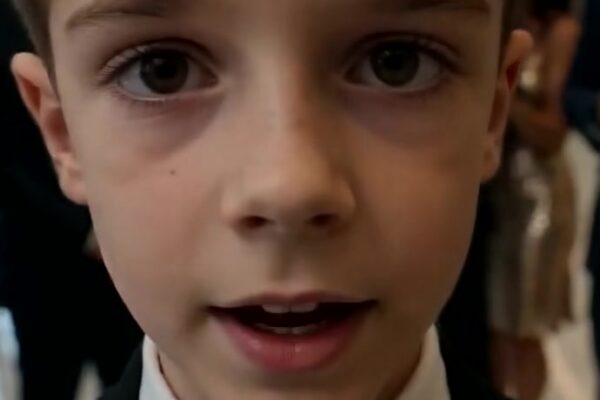
At his side was a girl in a pale blue dress, small shoulders drawn tight, hair pinned back with a ribbon that had been retied too many times. Her eyes were too old for her face. She did not cling to him; she simply stood there, braced, as if she had learned that a body could endure anything if it did not move.
“My daughter cannot speak,” the man said, and his voice broke on the word daughter like glass. “If anyone can bring back her voice, I will give away my entire fortune.”
Silence rolled outward, swallowing the boutique. A salesman froze with a velvet tray midair. A woman in an ivory coat—elegant, cold, the kind of customer who never looked directly at employees—turned slowly as if she’d heard a confession meant only for her. Somewhere near the entrance, security guards shifted their weight, uncertain whether they were witnessing grief or a stunt.
Everyone in that room carried some knowledge of the story, because tragedies in places like this became gossip that tasted like expensive wine.
Two years earlier, on a winter night when the city’s streets shone with frozen rain, the girl’s mother had vanished. And the child had been found hours later in this very boutique, wedged between a counter and a locked display cabinet, clutching a broken jewelry box as if it were a life raft. She had screamed until dawn. By morning, her voice was gone—erased, as if her throat had paid the price for what her eyes had seen.
Doctors had offered terms with neat edges. Trauma. Dissociation. Functional mutism. Therapists had guided her through drawings and breathing and gentle questions. None of it reached the place where her voice had been buried.
Her father had tried anyway. He’d bought silence with money: private specialists, retreats with ocean air, experimental treatments that came with non-disclosure agreements. Every failure left him a little thinner, a little more desperate, until desperation drove him back to the scene like a man returning to a burning house to look for something already ash.
He raised the microphone again, as if volume could bend fate. “I’m not begging for sympathy,” he rasped. “I’m begging for—” The word help strangled in his throat.
That was when the boy in the green hoodie walked forward.
He moved through the boutique with a steady pace that did not match the room’s careful rhythm. His shoes were scuffed. His sleeves were frayed. Under the glow of the lights his skin looked wind-chapped, as if he’d spent too much time outdoors where nobody cared about reflections. He was young—maybe seventeen, maybe older in the way hunger could age a person.
He stopped a few feet from the father and daughter, hands visible, posture calm.
“I can help her,” he said. It wasn’t loud. Somehow it didn’t need to be.
The father’s grief snapped into fury, swift and bright as a struck match. “Enough,” he spat, voice echoing off glass. “Do you think this is some kind of stage? Leave before security throws you out.”
The guards took a step, relieved to be given a simple task.
The boy didn’t back away. He didn’t argue. Instead, he lifted his right hand slowly, like someone offering a fragile thing to the air.
Something silver glimmered between his fingers.
The girl’s gaze, which had been drifting unfocused over the crowd, locked onto the object with sudden violence. Her entire body went rigid. It was as if an invisible rope had tightened around her spine.
A bracelet dangled from the boy’s hand—thin chain, small charms, one charm shaped like a crescent moon worn smooth from touch. The metal was scratched in places, the clasp repaired poorly with a twist of wire. It did not belong among the boutique’s perfection.
But it belonged to her.
It had been on her mother’s wrist the last night she’d been alive.
“Where did you get that?” the father demanded, stepping so fast his knuckles whitened on the microphone. The bracelet caught the light and flung it back at him like a dare.
The boy’s eyes flicked to the girl, not the father. “I found it,” he said. “Not on the street. Not at a pawn shop. I found it where it was left.”
The woman in the ivory coat stiffened. The movement was small, but the boy noticed. His gaze passed over her like a knife’s shadow.
“This is theft,” the salesman murmured, though his voice carried no conviction. “Call the police—”
“Call them,” the boy agreed, and there was something terrifyingly calm in his tone. “They should have been called two years ago.”
The father’s face shifted—anger cracking open into raw hope, then slamming shut in fear. Hope was expensive; he had paid for it too many times. “If you’re lying—”
“I’m not,” the boy said. “But she won’t speak because you keep asking her to. You keep pulling at a door she nailed shut to survive.”
He lowered the bracelet to the height of the girl’s hands, but he didn’t force it into her palm. He held it out like a question.
The girl stared. Her throat worked. No sound came. Her eyes filled, then cleared, as if tears were an old habit she no longer trusted.
“Do you remember,” the boy asked her softly, “what the bracelet sounds like?”
People leaned in without meaning to. The boutique’s luxury felt suddenly obscene, like someone had draped velvet over a wound.
The girl’s fingers lifted a fraction, trembling. She did not touch the bracelet. She looked past it, through it, to something else that existed only in her memory—her mother’s laughter, perhaps, or the click of charms when she reached for a glass in the kitchen.
The boy gently shook the bracelet once. The charms chimed, a tiny, bright sound swallowed quickly by the room’s held breath.
The girl flinched as if the chime had struck her skin.
The father whispered her name—just a breath, a plea—and the sound of it seemed to hurt him.
The boy leaned closer, careful, respectful. “You don’t have to tell the whole story,” he said. “Not yet. But you can tell one true thing.”
He turned his head slightly, letting the girl see what he saw: the woman in the ivory coat, standing too still, gloved hands clasped at her waist. Her lips were perfect and pale. Her eyes were not.
“One true thing,” the boy repeated. “About the night your mother disappeared.”
The girl’s gaze traveled to the woman in ivory. Recognition—slow, reluctant—moved across her face like dawn creeping under a door.
The boutique held its breath with her.
Her mouth opened. For a moment, nothing happened. Then, as if sound had to claw its way up from someplace deep and locked, her voice emerged—thin, scraped raw by disuse, but unmistakably hers.
“She wore that,” the girl said, pointing at the bracelet, her finger steady now. Her words landed like stones. “And… she came here.”
A gasp rippled through the crowd. The father swayed, eyes wide, as if he’d been struck and saved at once.
The girl swallowed, her face tightening with effort. The boy didn’t interrupt. He just kept his hands open, as if he could catch whatever fell out of the past before it hit the floor.
Her eyes did not leave the woman in ivory when she spoke again.
“She didn’t leave alone.”
The woman’s composure cracked. Her chin lifted a millimeter, a reflex of defiance, but her pupils flashed with something that had nothing to do with diamonds.
And in that instant, the father understood what his money had never purchased: that the boutique’s glitter had been hiding a crime in plain sight, and that no diamond in that room—no fortune, no legacy—was worth as much as the sound his daughter had just reclaimed.
The boy let the bracelet fall gently into the girl’s hands. The charms chimed again, softer this time, like a promise.
“Good,” he said, voice low. “Now we can start.”
Behind them, someone finally remembered how to breathe. Someone else reached for a phone with shaking fingers. And the boutique—built for whispers—filled with the first tremors of a truth that had waited two years to speak.