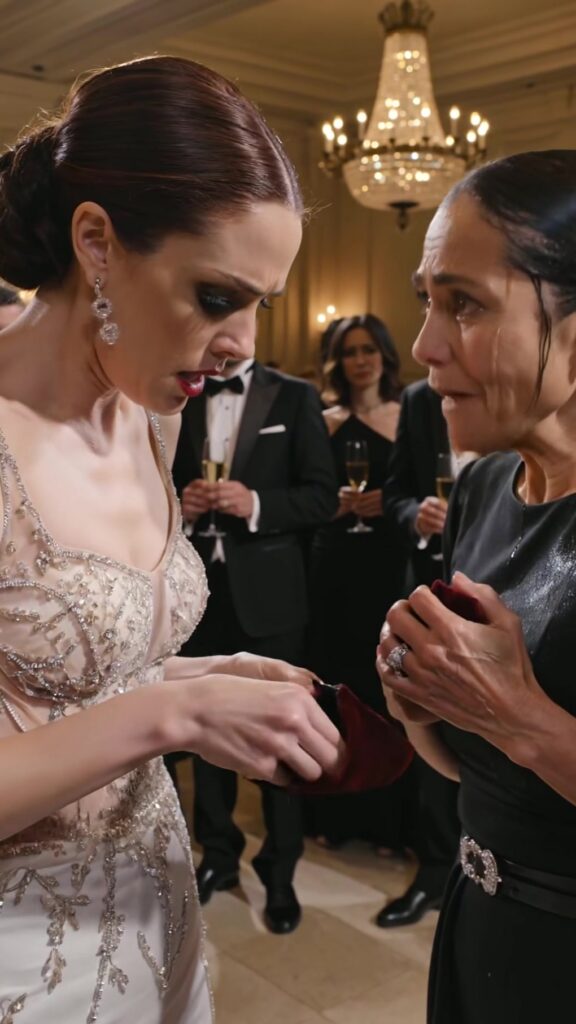
The gala had been designed to make hunger look elegant.
In the ballroom of the Harrowgate Hotel, crystal chandeliers scattered light like coins tossed into a fountain. Silk brushed silk. Diamonds winked on wrists that had never known restraint. A string quartet played something gentle enough to let conversations glide over it, and the air smelled of white lilies and expensive alcohol—clean, sharp, forgettable.
No one noticed the older woman until she was already inside.
She moved as if the polished marble might tilt beneath her, as if the room were a cliff edge and she had to keep walking or fall. Her coat was too thin for the season; her dress underneath was plain and a shade of blue that did not match the décor. The soles of her shoes had been repaired more than once. Her hands trembled with a fatigue that looked like fear, and every few steps her gaze flicked toward the door as if it might still accept an apology and let her leave.
She didn’t leave.
The usher at the entrance opened his mouth to stop her, then hesitated. Perhaps it was the expression on her face—something raw and determined that did not belong to the world of guest lists. Perhaps it was the velvet pouch she held tight against her chest, knuckles white around the drawstring, as if it contained her heart.
Within minutes, the whispers found her.
She’s lost. Someone’s grandmother. Did she sneak in? Is she staff? The questions circled her like perfume, sweet and suffocating. A donor’s wife in an emerald gown leaned toward her companion and laughed softly, as if the older woman were a curious stain on the evening.
At the center of it all stood Celeste Arundel, the face of the Arundel Foundation and tonight’s honored patron. The photographers loved her because she offered them angles on command: chin slightly lifted, smile calibrated to warmth, eyes shimmering with curated compassion. The news anchors loved her because she could speak of tragedy without letting it touch her voice. People who had never met her spoke of her as if she were an inevitability—beautiful, philanthropic, untouchable.
Celeste was halfway through a toast when her gaze snagged on the older woman near the back.
It was not recognition at first. It was something older than recognition, some instinctive shift—like an animal hearing a sound it cannot explain. Her smile held for a heartbeat too long, then fractured.
“Who is that?” Celeste asked, the words clipped. Her microphone caught it, and a few heads turned. “Why is she here?”
The older woman, as if she had been waiting for that question all her life, stepped forward.
She did not weave around tables the way a timid person would. She walked straight through the center aisle between linen-covered tables, past towers of champagne flutes and silent waiters. Each step seemed to cost her something. She blinked rapidly, as if trying to keep the room from blurring. Still, she kept going.
When she reached the dais, her voice came out hoarse but steady. “I came for my daughter.”
A ripple moved through the crowd. A laugh died mid-breath. Someone’s fork clinked against a plate. The quartet stumbled into silence, bows hovering like frozen questions.
Celeste’s face tightened with a quick, violent composure. “Security,” she snapped, not looking away. “Get her out.”
“Please,” the older woman said, and the word did not sound like begging. It sounded like a door that had been locked too long finally straining open. “Just—listen. Twenty-four years ago, they told me my baby died. They told me there was nothing to bury. No casket. No body. They said it was… merciful.”
Celeste’s jaw worked once. Her eyes flashed toward the crowd, toward the cameras. “This is a fundraiser,” she said coldly. “Not a confession booth.”
The older woman lifted the velvet pouch slightly, her hand shaking. “I didn’t come to ruin anything. I came because I couldn’t carry this alone anymore.”
Celeste’s composure cracked into fury, quick and bright. She seized a champagne flute from the nearest tray and flung it.
The liquid struck the older woman’s face and chest in a shimmering, humiliating splash. Bubbles clung to her eyelashes. Her dress darkened, clinging to her ribs. The room inhaled as one body.
Phones rose, slow as a tide. A flash popped. Another.
The older woman stood with her arms rigid at her sides, drenched and trembling, as if her bones might give up. She blinked hard. Tears mingled with champagne and slid down her cheeks. For a moment, it looked like she might flee, like she might finally take the exit the room had offered her from the beginning.
But she did not run.
She only tightened her grip on the pouch as if it were the only anchor left.
Celeste descended from the dais, heels sharp against marble. She moved close enough that their breath could touch. “Enough,” she hissed, voice meant for private ears and captured anyway by a nearby phone. “You’re not doing this.”
Her hand shot out and tore the velvet pouch away.
The older woman flinched but did not reach for it. She looked at Celeste as if she had already accepted that things could be taken from her.
Celeste yanked the drawstring open and spilled the contents into her palm with a contemptuous flick.
A bracelet landed there—an old piece, not gaudy, not contemporary. Its diamonds were small and set in an antique pattern, the metal worn smooth where it had been handled. Compared to the jewels around the room, it was modest.
But it did not belong to the gala. It belonged to a life that existed before publicists and foundations and a new surname.
Celeste stared at it, confusion tightening her brow. “What is this supposed to—”
Then she turned it over.
Inside the clasp, a tiny engraving caught the light. A name, carved by hand, a little uneven. Under it, a date.
Celeste stopped breathing.
The name was not Celeste. Not Arundel. Not the signature that gleamed beneath magazine interviews. It was the name she had once scribbled on a kindergarten paper before she was taught to write something else. The name that appeared nowhere in her curated biography. The name her adoptive parents had told her was “unfortunate,” “common,” “better forgotten.”
It was the name that used to be whispered to her in the dark—soft, reverent, desperate—before the world changed and the whisper disappeared.
Celeste’s fingers twitched, as if the bracelet had burned her. Her throat bobbed. The room, sensing the shift, held its breath again.
“Where did you get this?” Celeste asked, but the question came out smaller than she intended, stripped of power.
The older woman’s voice broke on the first syllable, then steadied as if she had practiced this moment in the mirror for years. “I bought it when I was pregnant,” she said. “I had it engraved before you were born. I promised myself you’d wear it on your first birthday.”
Celeste shook her head once, a sharp denial. “No.”
“They said you were dead,” the older woman whispered, and the whisper was louder than the chandelier’s glitter, louder than the cameras’ soft electronic chirps. “They told me I fell asleep and you didn’t wake up. They said there was a fire in the records room. They said there was nothing to show me.”
A man in a tuxedo—one of the foundation board members—shifted uneasily, eyes darting toward the exits as if seeking a way to control the narrative. Security hovered uncertainly at the edge of the scene, reluctant to touch a woman who now looked less like an intruder and more like a verdict.
Celeste stared at the engraving as if it were a crack in the floor and she could not decide whether to step back or jump. Her lips parted; no sound came.
Memories, long buried under etiquette lessons and therapy buzzwords, surfaced in jagged shards: the smell of bleach; a different ceiling; a lullaby sung off-key; the sensation of being carried quickly, pressed to a stranger’s chest; a nurse’s face turning away; the words “better life” spoken like a prayer and a threat.
She looked up at the older woman, and the years between them collapsed into something tight and unbearable.
“You’re lying,” Celeste managed, but there was no conviction in it now—only fear.
The older woman’s shoulders sagged, as if she had been holding herself upright with pure will and it was finally failing. “I wish I were,” she said. “I wish I could have stayed home tonight and let you keep your shining life. But I saw you on television last month, speaking about saving children, and I thought—if you can stand there and say those words, then maybe you can stand here and hear mine.”
Celeste’s gaze flicked to the cameras. To the crowd. To the glittering room that had always protected her. For the first time, it looked like the room might not obey.
Her hand closed around the bracelet, not in ownership but in panic, as if holding it could stop the past from becoming true. “What do you want?” she whispered.
“The truth,” the older woman said. “Your real birth records. The hospital name. The doctor. Whoever signed the papers. I want to know where my daughter went.” She swallowed hard. “And if you are her—if you are the baby they stole—then I want you to know you were loved. Every day. Even when they told me not to ask.”
The words landed in the ballroom like a stone dropped into still water, sending ripples through every carefully arranged face.
Celeste’s eyes glistened, furious tears held back by years of training. She stood caught between identities, between applause and grief, between a foundation built on benevolence and a beginning that suddenly looked like a crime.
Behind her, the banner for tonight’s cause—CHILDREN DESERVE HOME—hung in bright letters.
Under the chandelier light, Celeste’s voice finally emerged, barely audible. “Get her… somewhere private,” she said, and the order sounded less like command and more like surrender.
The older woman nodded once, as if she had expected nothing else. As if she had walked into this room prepared to be soaked in champagne, prepared to be laughed out, prepared to be erased again—and had come anyway.
Because some wounds did not close.
They waited.