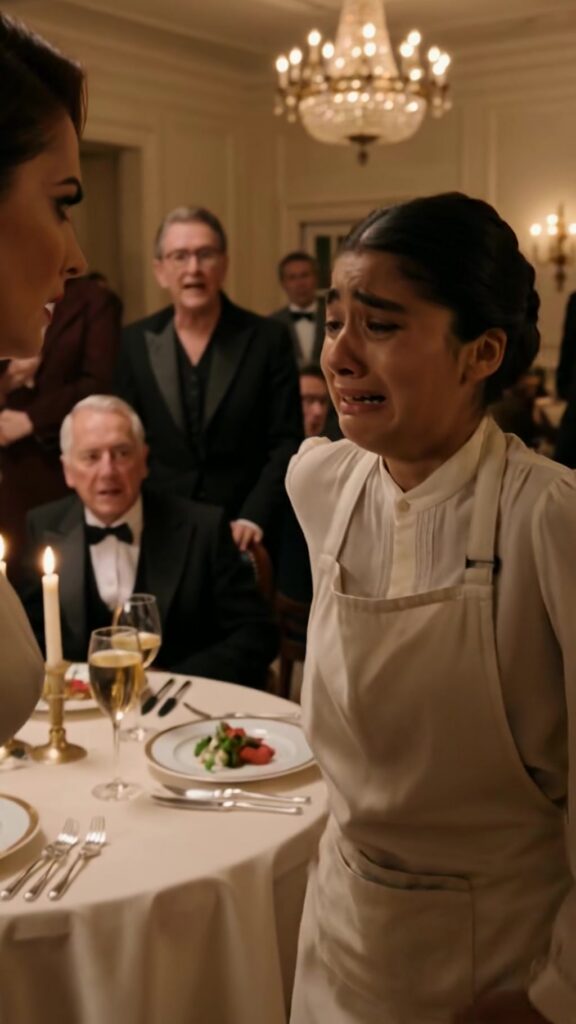
The chandeliers in Le Sable threw warm gold across linen tablecloths and crystal stems, as if light itself had been trained to behave. Conversations stayed politely low, laughter trimmed of teeth. Even the violinist, tucked beside a fern like a decorative thought, played as though the music had to pass a background check before it entered the room.
Serena Vale arrived the way storms do in places that pretend to have weather under control—without raising her voice, without hurrying, but with every head turning all the same. She wore a black dress the color of deep water and diamonds that caught attention like hooks. Beside her walked her husband, Adrian, all tailored calm, the kind of man who made other men adjust their cuffs as if they’d been warned.
They were halfway through the first course when the waitress came back to their table, carrying a tray that trembled despite her careful hands. She was younger than most servers here, hair pinned tight, cheeks pale. Her name tag read ELLIE. Serena watched her as Ellie refilled the wine, watched the way her gaze flickered toward Adrian—not flirtatious, not bold, but urgent, like someone trying to read a sign in the dark.
Adrian didn’t notice. Or he pretended not to. Serena’s jaw shifted once, a minute grinding of teeth behind lipstick. When Ellie returned again, this time with the next course, Serena set down her fork with a soft, intentional click.
“You,” Serena said, eyes fixed on Ellie’s face as if she’d seen it somewhere she didn’t want to remember. “How many times are you going to circle our table?”
Ellie opened her mouth. Whatever she meant to say fell out in a breath and disappeared.
Serena rose. The room did not get louder; it got sharper. The violinist’s bow slowed, like a hand uncertain whether to keep writing.
“Stay away from my husband,” Serena said, and before Ellie could step back, Serena’s palm snapped across Ellie’s cheek.
The crack split the air. The tray bucked and went weightless for a heartbeat. Glasses turned into falling stars, shattered across the marble floor. A single spoon spun, chiming until it stopped. At the nearest table, a phone lifted over a candle, its screen bright as a witness.
Ellie staggered, face blooming red where Serena’s ring had kissed her skin. She clutched at the edge of a chair to stay upright. Serena seized her by the wrist, nails pressing through fabric, and dragged her toward the Vales’ table as if the restaurant were a courtroom and Serena had decided to serve justice herself.
“Tell them,” Serena demanded, voice tight with something that wasn’t only anger. “Tell them why you keep showing up. Why you keep watching him.”
Adrian stood abruptly, chair scraping. “Serena, stop—” He sounded more embarrassed than alarmed, more worried about the audience than the act. “This is absurd.”
Ellie’s lips trembled. Tears rolled down, cutting tracks through the powder on her skin. Her free hand went to her apron, not in a gesture of defense, but like she was checking that something was still there, still real.
“I’m sorry,” Ellie whispered, her voice breaking on the apology. “I didn’t mean to ruin— I didn’t mean—” She sucked in a breath that shook. “I just needed him to look at me.”
Serena’s grip tightened. “Why?”
Ellie reached into her apron. The movement was small, almost childlike, and somehow it made the room hold its breath. She drew out a photograph, edges softened, corners rounded from being carried too long. It was faded, the kind of picture that had survived fire and rain and being opened a thousand times by trembling fingers.
Adrian snatched it before Ellie could even offer it properly. His irritation was automatic, a reflex, the way a man might respond to any intrusion on his polished life. He glanced at the photo, ready to dismiss it.
Then his face changed.
It wasn’t a slow shift. It was as if someone had pulled the color out from beneath his skin. His fingers went stiff around the paper. The muscle along his jaw jumped once, a glitch in an otherwise perfect portrait. He stared at the image until it seemed he’d forgotten how to blink.
In the photograph, a baby lay wrapped in a pale knitted blanket, thick and handmade, the weave uneven in a way no machine could imitate. The woman holding the baby had been partly torn away by time—only a shoulder, the curve of a jaw, a shadow of hair.
The violinist’s last note thinned and died. At the baby grand near the far wall, the elderly pianist—Mr. Hart, who had been playing here since Le Sable was new—let his hands fall from the keys. The silence he left behind was heavier than music. His eyes fixed on the photograph with the stunned precision of recognition.
“That blanket,” Mr. Hart said, his voice a frail thread that somehow reached every corner of the room. “I remember that blanket.”
Adrian’s knuckles whitened.
Mr. Hart stood slowly, as if his bones were made of brittle paper. “Years ago,” he continued, words scraping up from a place deep and old, “there was a night I never forgot. A man came here—before this was a palace, before the chandeliers. He was frantic. He had a baby, crying so softly it sounded like a kitten. The baby was wrapped in that exact knit. I held her while he made a call, while he paced like someone trying to outrun a nightmare.”
Serena’s hand fell away from Ellie’s wrist. The release was not mercy; it was shock. She looked at Adrian as though she were seeing him through glass.
“Adrian,” Serena said, voice suddenly small. “What is this?”
Adrian’s mouth opened. No sound came out. His gaze stayed locked on the picture as if it might bite him. Finally, hoarsely, he said, “That’s impossible.”
Ellie stepped forward. She was shaking so badly it seemed her bones might rattle apart. “It isn’t impossible,” she said, wiping her face with the back of her hand, smearing the tears instead of clearing them. “My mother kept this hidden in a tin under the floorboards. She told me not to trust anybody with it, not even the police.”
Adrian’s eyes flicked up at her. For the first time, he truly looked. The shape of her eyebrows. The slight tilt of her chin. The dimple that appeared when she tried not to cry. Something in his expression broke, and what showed through wasn’t charm or authority but raw, unpracticed fear.
“Your mother,” he said. “Who was your mother?”
Ellie swallowed hard. “Her name was Mara. She worked wherever she could—bars, kitchens, laundry rooms. She died last winter. Cancer.” The word hung like ash. “She told me to find my real father. She said he didn’t know. She said someone made sure he didn’t know.”
A murmur rose along the tables like wind testing shutters. Serena’s lips parted, then pressed together again so tightly the color drained from them. Her gaze snapped, not to Ellie, but to Adrian’s face, searching for the lie she wanted to find and couldn’t.
Mr. Hart moved closer, drawn by memory. “The man that night,” he said, eyes narrowed as if he could pull the past into focus by force, “he had a cut on his hand. Blood on his cuff. He kept saying, ‘She’s gone. They said she’s gone.’ But the baby—” He pointed to the blanket, to the tiny bundled shape. “The baby was alive.”
Adrian’s throat bobbed. His voice came out in a whisper that did not belong to the man who negotiated mergers and made rooms obey him. “My daughter died,” he said, as if reciting a sentence carved into him. “They told me she died in the hospital. They showed me… they showed me a paper.”
Ellie’s eyes shone with a fierce, bruised hope. “They lied,” she said. “My mother said someone paid for you to grieve and move on. She said the truth would ruin important people.”
Serena took a step back from the table. The diamonds at her throat glittered like ice. “Important people,” she repeated. Her voice trembled, not with jealousy now, but with a dawning horror that had nowhere to go. “Who?”
Ellie looked at Serena, and the glance was not triumphant. It was pleading. “I don’t know. I only know what she told me before she couldn’t speak anymore.” She reached into her apron again and pulled out a second item: a small hospital bracelet, yellowed with age, the ink nearly gone. She held it out with shaking fingers. “I’m not here for money. I’m not here to take anything. I just—” Her breath hitched. “I just didn’t want to be a ghost anymore.”
Adrian reached for the bracelet and stopped inches away, as if touching it might collapse the world he had built. His eyes brimmed, and he seemed startled by the sensation, like a man unaccustomed to tears. “What’s your birthday?” he asked.
Ellie answered. The date landed with the finality of a gavel.
Serena’s hand went to her own mouth, covering it too late. A soft sound escaped her—something between a gasp and a sob. The slap she’d delivered moments ago echoed now not in the room but in her eyes, in the sudden knowledge that she had struck a person who might have been standing in their family photographs all along.
Adrian’s shoulders sagged. “I named her Lila,” he said, the name coming out like prayer, like apology. “I— I never got to say it to her.” He looked at Ellie, and the distance between the restaurant’s polished surface and the raw center of his life vanished. “If you’re…” His voice cracked. “If you’re her, then I’ve been grieving the wrong grave.”
Ellie’s chin wobbled. “My whole life,” she said, “I thought I was lucky someone wanted me at all. I didn’t know I was missing a name.” She glanced around at the frozen diners, the lifted phone, the shattered glass sparkling like evidence. “I didn’t plan this. I tried to write. I tried to call. Your office— your security— they wouldn’t let me near you.” She looked back at Serena, eyes wet and honest. “So I got a job here. I thought if I could just stand close enough, you’d feel it. Like… like people say blood does.”
Serena lowered her hand. Her voice came out rough, stripped of polish. “And I thought you were hunting my marriage,” she said, each word cutting. “I thought you were a threat.” She stared at Ellie’s reddening cheek, at the mark she’d left. “God.”
Mr. Hart, trembling, picked his way around broken glass and set a cloth napkin gently over the shards as if covering a wound. “Sometimes,” he said quietly, “the world breaks so you can see what was hidden underneath.”
Adrian stepped around the table. He hesitated, then reached out and rested his hand lightly on Ellie’s shoulder, as though afraid she might vanish at contact. Ellie flinched from instinct, then stilled, eyes closing for one heartbeat.
In that charged hush, Le Sable was no longer a temple of money and manners. It was a room where time had finally been cornered. Outside, the city carried on, indifferent. Inside, a child who had been declared gone returned in the only way she could—through a photograph, a blanket, a slap that shattered glass and lies alike.
Serena looked at them both, the wife and the stranger and the man between them, and for the first time her perfect composure had nowhere to hide. “We will leave,” she said, not as an order but as a necessity. Her gaze flicked to Ellie. “And you’ll come too.”
Ellie’s eyes opened. “Why?”
Serena drew in a breath that tasted like shame. “Because,” she said, voice low, steadying itself on truth, “if someone stole a child once, they may not have finished stealing.”
Adrian tightened his hand on Ellie’s shoulder, and the three of them stood amid the ruins of a flawless evening—shattered glass, stopped music, and the sudden, terrifying possibility of a family rewritten.