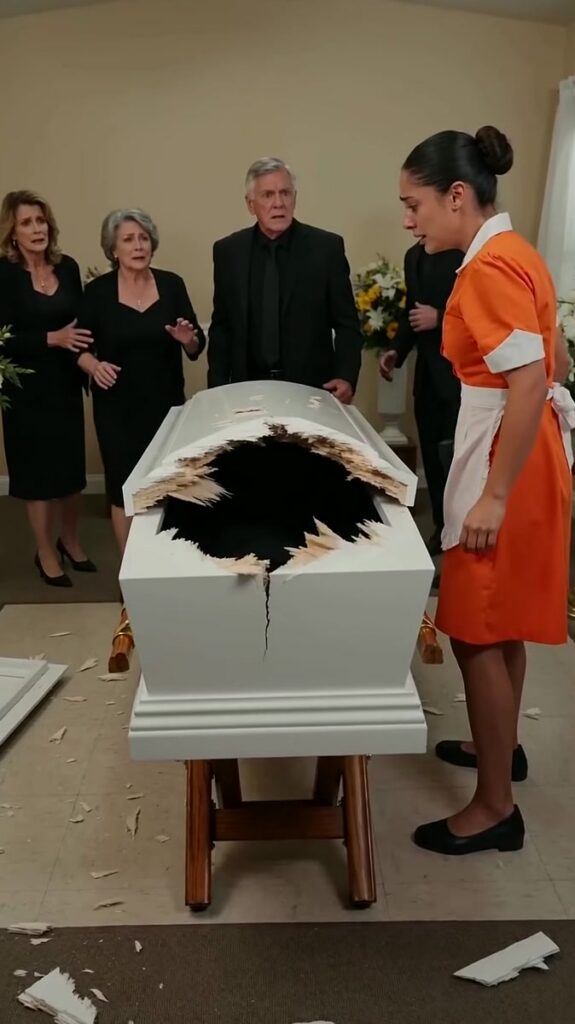
No one in the funeral parlor would ever forget the sound of the axe.
It was a flat, brutal note that didn’t belong among organ music and whispered prayers. It struck the room like a shout in a cathedral, splitting the air first, then the stunned faces, then the fragile illusion that death was orderly and polite. In the beige viewing chapel of Morrow & Sons, with its soft lamps and spotless carpet, grief had been arranged like décor. White lilies stood at attention. Condolences floated like dust. Even the sobbing had rhythm.
Until Lina Alvarez stepped out from the side corridor in an orange housekeeping uniform and swung a fireman’s axe as if she’d been training for this her whole life.
The blade bit into the pale wood of the casket lid. The crack was so sharp people flinched as if it had snapped their bones. A spray of splinters leapt upward; one skittered across the carpet and stopped at the toe of Richard Ashford’s polished shoe. Someone screamed—thin, high, and short, like a bird startled from sleep. Another mourner stumbled backward into a stand of flowers, sending petals down like confetti at the worst celebration imaginable.
Lina yanked the axe free. Her knuckles were white on the handle, her shoulders shaking. Tears ran down her cheeks, but her eyes were steady in a way terror sometimes makes them—fixed on a single point, refusing to look away.
“She isn’t gone,” Lina said, voice ragged, as if her throat had been filled with glass. “She’s in there. She’s still in there.”
Richard Ashford surged forward, anger cutting through the grief like a knife. He was a tall man, carefully tailored even for tragedy, and his face had the practiced solemnity of someone used to being watched. “Are you insane?” he snapped. “Put that down. This is a funeral.”
Lina’s lips trembled. “I heard her.”
That sentence landed heavier than the axe.
Emma Ashford’s sister, Margaret, had been seated with damp tissues crushed in her fist, her mascara dark along her lower lashes. She lifted her face as if waking from a nightmare into a worse one. “Don’t,” she whispered, barely audible. “Please don’t do this.”
Lina looked at them all—at the family friends, the business associates, the minister who had frozen mid-verse. “I cleaned her this morning,” she said. “I braided her hair the way she liked. And her hands… her hands were warm.”
Richard’s anger faltered. Not softened—something more dangerous. A crack appeared in it, and what seeped through wasn’t compassion but fear. His gaze slid to the jagged gap in the lid. He swallowed once, hard, as if he’d bitten something he hadn’t meant to chew.
Silence thickened. People stopped breathing properly. The air, scented with lilies and disinfectant, felt suddenly short of oxygen.
Then: a sound.
Not loud. Not clear. A faint, muffled thud, like a fist against a wall, coming from beneath the shattered wood.
Margaret made a noise that wasn’t quite a sob and wasn’t quite a laugh. She dropped to her knees, hands flying to the coffin’s edge. “Emma?” she breathed into the crack. “Oh God, Emma, can you hear me?”
Another weak scrape answered—barely there, but undeniable. The minister’s mouth opened and closed with no words. A man in the back crossed himself repeatedly, too fast, as if speed could ward off anything impossible.
Lina backed away as if the truth were a creature about to leap out. “I told you,” she cried, and the tears she’d been holding back became a flood. “I told you she was crying.”
Margaret clawed at the lid. Lina darted forward and, abandoning the axe, used her bare hands. Splinters bit into their palms. The lid gave with a sickening tear, opening a dark wedge into satin and shadow.
Emma Ashford lay inside.
Pale as winter. Lips cracked. A faint flutter at her throat that proved the impossible: breath. Her eyelashes trembled like moth wings. When air hit her face, her chest shuddered, a thin gasp dragging itself into being.
Margaret reached in, frantic. “Help me—someone help me—”
The room erupted. Two men rushed forward. Someone shouted for an ambulance. Chairs scraped. The steady organ music stuttered into silence as the pianist’s hands flew from the keys.
And still, amid the chaos, Emma’s eyes opened.
They didn’t seek her sister’s face. They didn’t lock onto Lina’s, though Lina’s sobbing filled the chapel like rain. Emma’s gaze, glassy and unfocused at first, slid across the room and found Richard.
Richard didn’t step closer. He stood as if the carpet had nailed him down.
Emma’s eyes sharpened by degrees, the way a lens adjusts. Recognition flickered, then something darker—alarm, urgency, the fierce intelligence people swear is absent in the dying. Her mouth moved, trying to shape words through dryness. Her hand, weak and shaking, lifted from the satin lining.
One finger extended toward Richard.
Richard’s face drained of color so fast it seemed almost theatrical. His jaw worked; his eyes darted to the doorway as if calculating distance.
“Emma, sweetheart,” he said, voice too soft, too controlled. “Don’t try to speak. You’re—”
Emma rasped, forcing sound through a throat that had been denied it. “Don’t… let him…” She coughed, a small, wet, broken sound. Her eyelids fluttered, struggling to stay open. She swallowed with visible pain, then pushed the rest out like a confession that had waited too long. “Don’t let him burn it.”
“Burn what?” Margaret pleaded, gripping her sister’s hand, trying to warm it with her own. “Emma, what did he do? What is he burning?”
Lina’s breath hitched. She stared at Richard as if finally seeing him without the wealth, without the suits, without the smooth condolences. She remembered, suddenly and vividly, the night a week before when she’d carried a tray to Emma’s study and found the fireplace lit out of season. Richard had been there alone, feeding sheets of paper into the flames. He’d smiled at Lina too quickly and said it was “old contracts,” nothing important, just cleaning house.
Cleaning house.
Now, as people crowded around the coffin, Richard stepped back—just one step, a cautious retreat. His hand slid into his pocket. The movement was small, but Lina’s eyes caught it: the outline of a phone. The way his thumb hovered, ready to call, to message, to set something in motion.
Lina moved without thinking. She picked up the axe again. Not to swing—God, never again—but to hold, a barrier between him and the door.
“You’re not leaving,” she said, voice shaking, loud enough to cut through the confusion. “Not until she tells us what you tried to erase.”
Richard’s expression tightened. “This is madness,” he said, though his eyes were sharp now, calculating. “You’re all in shock. Step aside.”
Emma’s fingers tightened around Margaret’s, a weak squeeze but deliberate. Her lips parted, trying for another word, but only a thin breath came. The paramedics hadn’t arrived yet; time had stretched, elastic and cruel.
Margaret looked up at Richard, and for the first time that day, grief changed in her face into something hard. “What did she mean?” she demanded. “What were you burning?”
Richard didn’t answer. He glanced toward the corridor leading to the preparation rooms, then toward the front doors, as if weighing which fire to run to first.
And in that suspended moment—the casket cracked open, Emma hauled back from a grave she’d never consented to, Lina standing with an axe she never wanted to lift—the chapel understood something wordless and terrible: this wasn’t a miracle that had interrupted a funeral.
It was an accusation.
The sound of the axe had not only split wood. It had split a story someone had been carefully arranging, line by line, flame by flame. And whatever Richard Ashford had tried to reduce to ash was still out there somewhere, waiting to be saved—or finished.
Outside, a siren began to rise in the distance, growing louder by the second, like a warning that had finally decided to arrive.