No one noticed the boy until he was already standing beside the richest table in the garden, which was sort of the point of gardens like this. Everything was designed to glide. Chairs scraped only politely. Laughter came out in measured bursts, like it had been rehearsed in the car. The umbrellas were pale and expensive and angled just so, turning sunlight into something you could sip.
The luncheon was a charity thing—at least that’s what the invitation said. A “summer giving fete,” which sounded like you were supposed to donate while wearing linen and pretending you loved goat cheese. The centerpieces were little bowls of white roses that smelled like money. Even the servers moved as if the air had rules.
At the head table sat Victor Hale, a man with a perfect jaw and the kind of confidence that made people laugh at his jokes before he finished them. He was known for speeches about grit, discipline, and building empires with bare hands—though his hands looked suspiciously uncallused. His name was on a foundation, on a wing of a museum, on a building downtown that swallowed the sky.
Victor was halfway through cutting something tiny and architectural on his plate when a shadow fell across the tablecloth. Not a polite, umbrella-filtered shadow. A real one. Someone too close. Victor glanced up as if the world had made a mistake.
A boy stood there. Maybe nine, maybe ten. Thin in a way that wasn’t a choice. Dirt on his knees, hair like it had been cut by someone who didn’t have time, shoes hanging on by hope. In both hands he held a wooden flute, worn smooth where fingers had lived on it.
For a heartbeat, nobody reacted. It was that rich-people lag where they assume someone else will handle the uncomfortable thing. A woman’s smile froze mid-performance. A man kept chewing like he could chew the situation away.
Victor’s expression pinched. “Hey,” he snapped, loud enough to travel. “Get him out of here.”
Two servers looked at each other, panicked, like they’d been asked to arrest a cloud. The boy didn’t move. He stared at the table, not the people—at the silver, the glassware, the bread basket so full it looked like a joke.
His voice, when it came, was small but practiced. “Please. I need money. My mom is sick.”
There it was. The messy thing. The thing gardens like this weren’t built to hold.
A hush spread outward, the way it does when everyone wants to look and nobody wants to be seen looking. Victor leaned back in his chair. That little cruel smile found its place, like it had been waiting all afternoon.
“Then earn it,” he said, and made sure the nearest tables heard. “Surprise us. Play something impressive and maybe I’ll give you a little something.”
A few laughs tried to exist, thin and nervous. They died when the boy’s face tightened, not in anger—more like recognition. Like he’d expected the world to be exactly this.
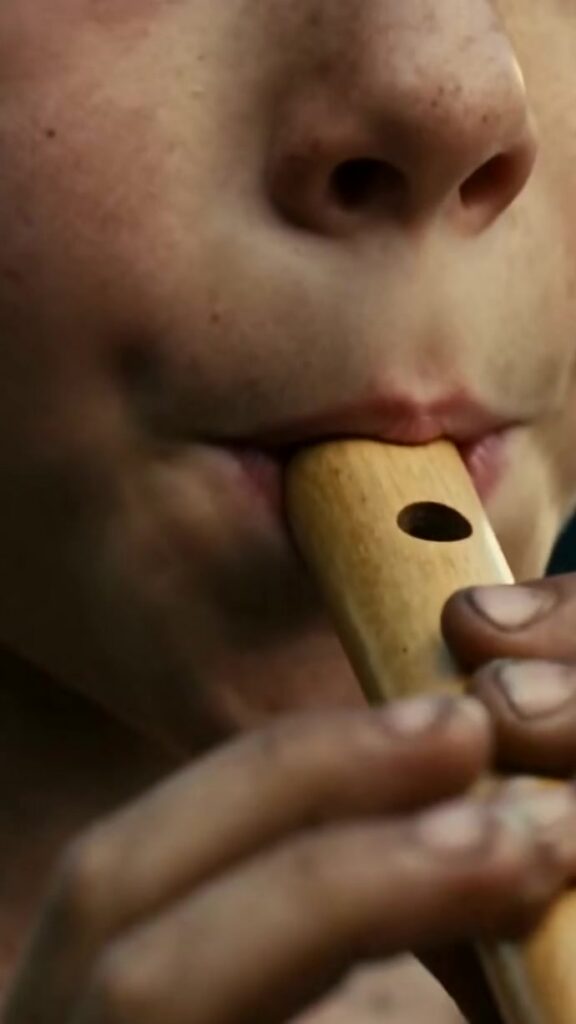
He raised the flute anyway. His hands shook so much that a woman in pearls winced, already imagining a squeal of wrong notes. But when he put the mouthpiece to his lips, the first sound that floated out wasn’t messy at all.
It was soft. Clean. Sad in a way that didn’t ask permission.
The melody drifted over white linen and polished forks like a ghost that knew where it belonged. It had an old-fashioned swing to it, like something someone would hum while washing dishes in a tiny kitchen. Not the kind of tune you’d hear in a garden with crystal glasses, yet it fit, like it had been hiding under the laughter the whole time.
People stopped eating. A fork hovered. A conversation broke off mid-syllable. Even the servers paused, trapped between tables with trays in hand. The music made the air thicker, as if it had weight.
Victor’s smugness faltered. His knife and fork rested on the plate. His eyes narrowed, not in judgment now, but in alarm.
Because he knew the song.
Not from the radio. Not from a movie. From a life he’d filed away and labeled finished.
The boy played like he was trying to hold something together that had been falling apart for years. The last note didn’t end so much as disappear, like it walked quietly out of the garden.
Silence landed hard. Someone cleared their throat and instantly regretted it.
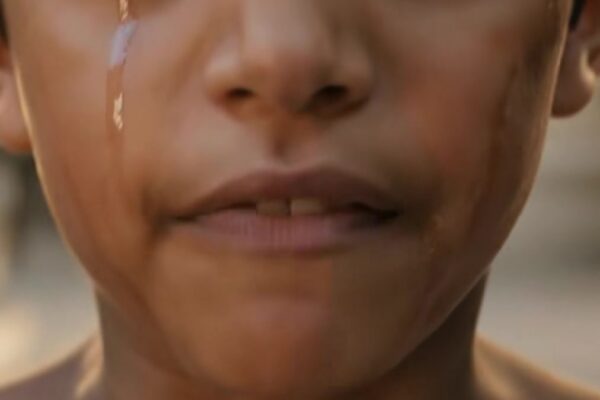
The boy lowered the flute. His cheeks were flushed, not from pride, but from the effort of standing there in front of all that wealth and not shrinking into the ground.
Then he reached into his pocket and pulled out a photograph. It was bent, the edges worn white. He held it out toward Victor with a trembling hand, like offering proof in a trial.
Victor took it without thinking. His fingers, usually steady on microphones and contracts, went stiff. He looked down.
The image showed a younger Victor—thinner, less polished—standing beside a woman with dark hair and a smile that looked like sunlight in a cheap apartment. Victor’s arm was around her. The woman’s head leaned into his shoulder as if the world had never taught her to guard her happiness.
On the back, in faded ink, four words were written in a looping hand: For our little miracle.
Victor’s face drained so quickly it was like someone had pulled a plug. His lips parted. Nothing came out.
“Where did you get this?” he managed, voice low now, as if loudness would break him.
The boy swallowed. His eyes shone, but he held them open stubbornly. “My mom kept it,” he said. “She said… you would recognize me.”
A woman at the adjacent table leaned forward, forgetting to pretend she wasn’t listening. A man’s jaw tightened. The garden, with all its soft umbrellas, suddenly felt too exposed.
Victor stared at the boy’s face like he was trying to solve a puzzle he’d once torn up. The boy had his eyes—gray-blue, too serious. The same stubborn curve to the mouth. The same tiny scar at the eyebrow, though Victor couldn’t remember if he’d ever had it too or if his mind was simply desperate to connect dots.
Victor pushed his chair back so hard it scraped the stone patio, a raw sound that didn’t belong among string lights and curated roses. He stood, swaying slightly, like the world had tilted.
The boy tightened his grip on the flute, knuckles pale. “Are you the man who left her?” he asked.
The question didn’t sound angry. It sounded exhausted. Like he’d been carrying it around in his chest and it had finally gotten too heavy.
Victor’s throat bobbed. He looked down at the photo again as if it might change. As if the ink might fade into something less true.
That’s when a folded paper slid free from the boy’s pocket, fluttering onto the immaculate tablecloth like a surrender flag. The top was stamped and official-looking. The kind of paper that can end a life without raising its voice.
Victor’s eyes snagged on the bold text: Emergency Surgery Deposit — Due Today.
He skimmed lower, heart suddenly beating loud enough that he could hear it over the distant fountain. Then he froze on the patient name.
Elena Hale.
Victor’s breath caught so sharply it sounded like a laugh trying to escape. His hand went to the edge of the table as if he needed it to remain upright.
Elena. Not a rumor. Not a memory. Not a chapter he could close with a donation and a speech. She was in a hospital, right now, under fluorescent lights, waiting for money that had to be paid today, not tomorrow, not after a board meeting, not after a moment of public redemption.
He looked at the boy again, and for the first time since the child had appeared, Victor didn’t look annoyed or embarrassed or entertained.
He looked afraid.
“What’s your name?” Victor asked, voice rough, stripped down to something almost human.
The boy hesitated, as if names were dangerous things. “Jonah,” he said. “My mom calls me Jonah.”
Victor’s eyes squeezed shut for a second. When he opened them, they were wet in a way he didn’t seem to understand. “She… she named you that?”
Jonah nodded once. “She said you didn’t stay long enough to argue.”
The words hit harder than any accusation. Around them, the garden had become a theater where nobody knew whether to keep watching. Plates sat untouched. Phones stayed in pockets because even the gossip-hungry sensed this wasn’t the kind of scene you could post without feeling like a monster.
Victor reached for the hospital paper with shaking fingers, careful not to smudge it like it was sacred. He stared at the amount due, and something ugly flickered across his face—anger, not at the boy, not at Elena, but at himself and the years he’d spent acting like leaving had been a clean decision instead of a wound he’d simply walked away from.
He swallowed. “Why didn’t she contact me?”
Jonah let out a sound that wasn’t quite a laugh. “She did,” he said. “A long time ago. She said you sent back the letter unopened.”
Victor flinched like he’d been slapped. His mind flashed to a penthouse mailbox, to an assistant who filtered his life for him, to a stack of envelopes he’d refused to touch because he was building a future and didn’t want the past to stain it.
He looked around at the richest table in the garden—his table—and it suddenly looked ridiculous. A stage set. A castle made of sugar.
Victor cleared his throat and spoke to Jonah, but it was also to the room, to the foundation banner fluttering nearby, to the version of himself who loved applause.
“You shouldn’t have had to play for this,” he said quietly. “Not for me. Not for anyone.”
He reached into his jacket, not for a token bill, not for a performative gesture, but for his phone. He tapped with frantic precision, then held it to his ear. “I need my driver,” he said when someone answered. “Now. And call my CFO. Tell him I’m authorizing a same-day transfer to—” He looked at the paper again. “—St. Brigid’s. Emergency deposit. Whatever they want.”
The garden was still silent, but it wasn’t the same silence. This one had movement inside it, like everyone’s perception was rearranging itself.
Victor lowered the phone and looked at Jonah. “Where’s your mom?”
Jonah blinked fast, like he didn’t trust hope. “At St. Brigid’s,” he said. “They said… they said if we don’t pay, they’ll—” His voice broke. He hugged the flute to his chest like it could hold him together.
Victor stepped around the table. Someone scooted back instinctively. Victor ignored them all. He crouched in front of Jonah, bringing his expensive suit down to garden level, to dirt and scuffed shoes and a boy who had learned too early how to ask for help and expect cruelty.
“Listen to me,” Victor said, each word careful, like he was building a bridge with his bare hands. “We’re going to her. Right now. And you’re not playing for anybody again unless you want to. Not to earn basic mercy.”
Jonah stared at him, unsure what to do with a promise that sounded real.
Victor held out his hand. It wasn’t grand. It wasn’t for the audience. It was simply there, open, waiting.
After a long moment, Jonah placed his small hand into Victor’s.
Somewhere behind them, a glass clinked, then stopped, as if even the garden didn’t dare pretend it was still just a luncheon. Victor led the boy away from the richest table, past the umbrellas and the careful laughter, toward the gate—and toward a hospital room where a woman named Elena was waiting to find out whether the man who left her would finally show up before it was too late.