No one noticed the girl at first, because weddings train people to look where they’re told. Eyes forward to the arch, to the silk ribbons, to the white aisle runner that made the grass seem newly invented. They looked at the groom—Calder Hale—standing straight as a vow, and at the bride—Elena Morrow—glowing with practiced calm. They listened for the music cue and watched the bridesmaids float into their assigned positions like pieces on a board.
The girl wasn’t a piece. She was a smudge at the far edge of the folding chairs, half hidden by hydrangea arrangements and a cluster of guests standing to get a better view. She wore a navy cardigan too big for her shoulders, and her hair had been braided in a hurry, the kind of braid you do when you can’t afford a second attempt. She held her hands together as if she might lose them.
The officiant cleared his throat. Someone laughed softly at a private joke. A photographer shifted closer, hunting the angle of perfection.
Then the girl began to run.
She cut through the aisle at an angle, not caring about the white runner or the careful symmetry. Her shoes slapped the fabric, snagged, freed themselves. A guest’s program fluttered to the ground. A bridesmaid’s bouquet swung wildly as she turned, startled. Whispers bubbled from the crowd—confusion first, then irritation, then the electric curiosity people pretend they don’t have.
But the girl didn’t slow. She ran straight at the groom as if he were the only landmark left in a world gone dark. She stopped close enough that his boutonniere trembled with the rush of her breath.
“My mom said I had to find you today,” she said.
Calder’s face held the polite firmness of a man who negotiates problems for a living. He glanced at Elena, then at the officiant, then back at the girl as if searching for the proper compartment in which to store her.
“Sweetheart,” he began, voice lowered, careful, “this isn’t the time—”
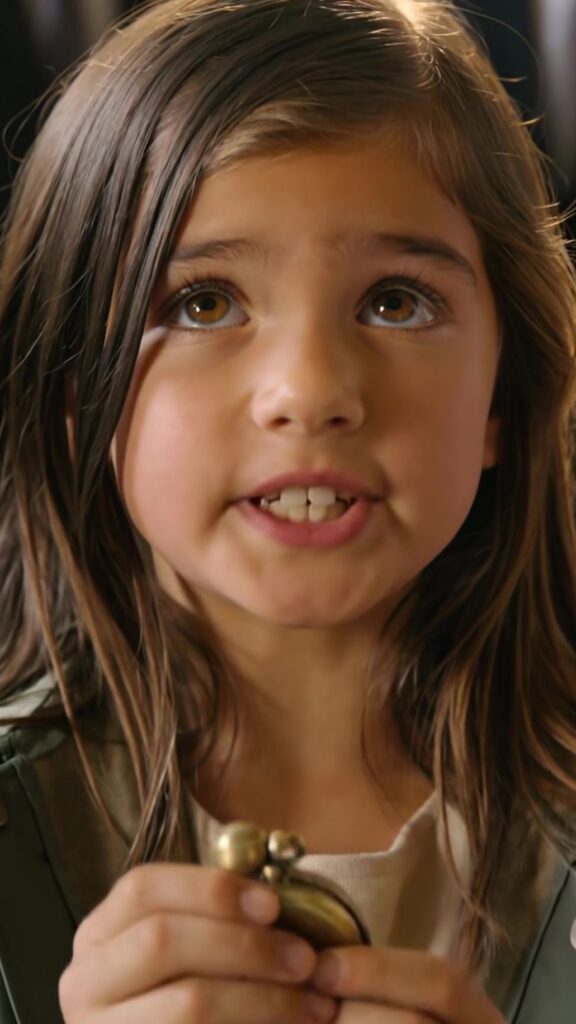
She shook her head once, hard enough to make the braid lash her neck. She reached into her cardigan pocket and pulled out something that caught the afternoon sun like a held breath: a locket, oval and tarnished, its hinge worn shiny from fingers opening and closing it a thousand times.
“She said once you see it,” the girl told him, “everything comes back.”
A hush spread outward, swallowing the string quartet mid-note. Elena’s smile faltered—not jealous, not yet, but uneasy, like the first tremor before a storm you’ve been denying on the horizon. She stepped forward a fraction. Calder’s jaw tightened. His gaze fixed on the locket as if it had teeth.
“Who is your mother?” he asked, and the question came out rawer than he intended.
The girl took one step closer. “Open it,” she said softly. “Then you’ll know what you tried to forget.”
Calder’s hands hovered. He didn’t want to touch it; everyone could see that. Yet he couldn’t not touch it either. He accepted it with two fingers, the way you lift something hot from a stove. The metal was cool, but his skin went pale around it. He pried it open.
The smile disappeared from his face so completely it looked as if it had been erased.
Inside, there was a photograph—faded at the edges, the paper softened by years. A younger Calder stared out, hair longer, eyes less guarded. Beside him, a woman with dark curls and a wide grin leaned into his shoulder as if she’d always belonged there. On the other side of the hinge, pressed into the velvet lining, was a thin strip of hospital bracelet, yellowed, the ink almost rubbed away. Still readable: BABY GIRL. LARK. Date. A surname Calder had not used in years.
His breath hitched, and something old and buried stirred in his eyes—grief, recognition, dread. He looked at the girl again, truly looked, and the shape of her face struck him with terrible clarity: the same curve of cheek, the same stubborn set to her chin. Not a stranger. A mirror held at the wrong time.
Elena’s hand found his arm. “Calder,” she whispered, and though she meant to steady him, the contact made him flinch. “What is this?”
The girl’s voice stayed steady, as if she’d rehearsed it on the bus ride, as if fear had been used up and only purpose remained. “Her name is Mara Quinn,” she said. “She lives—she lived—on Juniper Street. She told me you used to call her ‘Mars’ because you said she burned too bright.”
Calder swayed, just slightly. The garden blurred. He heard a decade ago in the way she said Mars. He smelled disinfectant and cheap coffee. He saw a hallway with peeling paint and men in dark coats who spoke in sentences that were commands disguised as offers.
“That name…” he murmured. The locket shook in his hand. “No. Mara—”
“She’s in the hospital,” the girl interrupted. “I’m Lark.” She lifted her chin the way someone does when they’re about to jump. “And she said you’d pretend you don’t remember because it’s easier than knowing what you left.”
All around them, people were frozen in their finery. The officiant stood with his book open and forgotten, like an actor whose stage had been stolen. Somewhere, a glass clinked once against another, an accident that sounded like a gavel.
Elena’s eyes were on Calder, sharp now, searching. “You have a child?” she asked, and the words were not loud, but they carried. “Calder, tell me the truth.”
His throat worked. He stared at the hospital bracelet as if it could answer for him. “I didn’t know,” he said, though the lie tasted familiar. “I—Mara said—she said she wasn’t keeping—”
Lark’s expression didn’t change. “She said you promised you’d come back after the hearing,” she replied. “After you testified. After you helped them put someone away. She said you walked out of the courthouse and never came back, like you fell through the cracks.”
The word testified sliced the afternoon cleanly in two. Calder’s eyes darted, not to Elena, but to the edge of the lawn, to the security hired for the event, to the parked cars beyond the hedges. There were other ghosts there—names he had changed, addresses he had abandoned, a life he had rebuilt with careful, expensive quiet.
He bent toward Lark, voice low, urgent. “Who knows you’re here?” he asked. “Did anyone follow you?”
Lark hesitated, then opened her clenched fist. A folded paper, damp from being held too tightly, lay in her palm. A train ticket stub. A scribbled note in an adult hand: If he refuses, show him the locket. If he lies, tell him the name of the judge. If he runs, remind him he already did once.
Calder shut his eyes for a beat, and when he opened them, they were wet. “Mara…” he whispered, not as a name but as an apology.
Elena stepped back as if the air around him had changed density. “Calder,” she said again, and her voice shook now, anger and fear braided together. “Is any of this true?”
He looked at his bride—the woman he had chosen to be his future—and for the first time all day, the mask slipped completely. “I was twenty-two,” he said hoarsely. “I thought doing the right thing would save people. I thought it would save her. They told me to disappear. They told me it was the only way. And I let them.”
The guests watched as if watching might make it make sense. The sunlight stayed bright and indifferent. Calder reached out and set the locket gently back into Lark’s hands, as if returning something sacred.
“Where is she?” he asked.
“St. Brigid’s,” Lark replied. “Room 614. She said you’d try to make it about danger. She said you’d talk yourself into leaving again. So she made me come. She made me walk in here and stop everything.” Her voice cracked at last, thin as breaking ice. “She said if you were ever going to choose us, you had to choose us in front of everyone.”
Calder’s gaze swept the wedding—the arch, the chairs, the witnesses he’d wanted for a different kind of promise. He looked at Elena, and the hurt there was so immediate it stole his breath. “I’m sorry,” he said, and it was the worst kind of truth, the kind that doesn’t undo what it breaks.
Elena’s eyes glistened but did not spill. “Go,” she said quietly. “If you stay, you’ll only be here in body. And if you leave… at least you’ll be honest for once.”
Calder nodded as if accepting a sentence. He took off his boutonniere and set it on the officiant’s book. Then he turned to Lark and held out his hand.
For a second, she stared at it, suspicious of softness. Then she slid her small fingers into his, her grip stronger than expected. Together they walked down the aisle that had been meant for someone else’s entrance, past stunned faces and trembling floral arrangements, past the white runner that now bore the marks of her shoes like proof that she had been real.
At the edge of the lawn, Calder paused and looked back once. Elena stood alone near the arch, her dress stirring in the breeze like a flag at half-mast. He wanted to say something that would lessen the damage, but there are no words that make betrayal smaller.
He faced forward again. Lark’s locket was tucked in her fist, pressed against her heartbeat. The future waited, not clean, not celebratory, but undeniable. And for the first time in years, Calder Hale stopped running.