No one paid attention to the little boy at first. Not in the way people didn’t notice a billboard or a flashing sale sign—those still tugged at their eyes. This was different. He existed in the gap between errands and impatience, where faces turned into moving walls and compassion became an inconvenience.
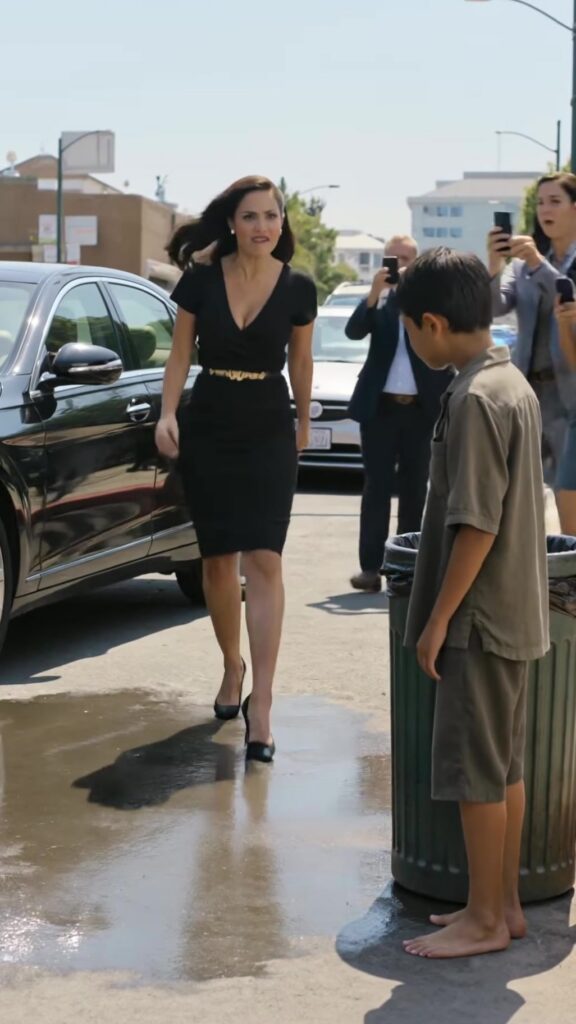
He stood beside a dented trash bin that overflowed with greasy cartons and wilted flowers, barefoot on pavement hot enough to sting. A smear of soot ran along his cheek, and his shirt clung to him as if it had been dipped in the city’s breath and left to dry. Every now and then a gust of wind lifted the sour smell of the gutter and wrapped it around him like a second skin.
Cars streamed by in impatient bursts. Horns snapped at one another like angry dogs. A bus exhaled diesel, and pedestrians spilled off the curb and back again, phones pressed to ears, bags swinging, eyes fixed on their next appointment.
The boy did not flinch from any of it. His attention was pinned to the far end of the street, where the traffic thickened into a slow, glossy knot. Through the tinted chaos he watched for one thing: a black luxury sedan, polished so dark it reflected the sky in a warped sheen.
He had been waiting a long time. Long enough to learn the rhythm of the lights, the impatient surge when the signal turned green, and the way the city briefly softened at noon when shadows hid in the narrow spaces between buildings. He had practiced what he would do the way other children practiced spelling words.
Beside him sat a plastic bucket, the kind used for mopping. It looked harmless, the way a stone looks harmless until it’s thrown. The water inside was not clear. It was a heavy, grayish soup he’d gathered from the alley drain and the puddle behind the butcher’s shop. It held scraps of leaf and grit, and it smelled of rot and metal.
He told himself it didn’t matter what it smelled like. He told himself the stink was part of the message.
When the black sedan finally turned the corner, it arrived like a private eclipse, cutting across sunlight with its quiet authority. Even trapped in traffic, it moved with certainty, inching forward as if the road owed it space. The windows were sealed and shaded, the wheels too clean for this street, the chrome bright as a blade.
The boy’s fingers tightened around the bucket handle. For a moment his throat closed and he tasted fear. It was not fear of punishment. It was fear that the car would pass and he would remain a ghost, and that the secret in his ribs would keep burning without ever touching the world.
He stepped off the curb.
Drivers shouted. A cyclist swerved. Someone laughed, thinking it was a stunt, a silly child stepping too close to traffic for attention. Another person muttered something ugly and walked faster.
The boy did not look at them. He walked straight to the sedan, stopping at the front passenger door. He raised the bucket with both hands. The muscles in his thin arms shook. Then he threw the filthy water with every bit of strength his small body could summon.
The splash hit like a slap. Gray water sheeted over the pristine paint, smeared across the window, and dripped in thick rivulets down the door. A clump of leaf slid slowly as if savoring the insult. The street seemed to inhale all at once.
Everything froze. Conversations snapped off mid-syllable. A woman gasped loudly enough to be heard above the horns. The air filled with the faint chorus of phones being lifted—camera apps opening, lenses zooming. A man in a suit stopped with his coffee halfway to his mouth, staring as if the world had suddenly rewritten itself.
The sedan stopped instantly, tires squeaking on the hot road. A heartbeat later, the door swung open with sharp precision.
She stepped out like she had been carved from authority. Elegant, composed, draped in pale fabric that didn’t belong to this street. Her hair was pinned back, and her sunglasses hid her eyes until she yanked them off with a controlled fury. High heels clicked on the pavement as she rounded on the boy.
“Are you insane?” she snapped, voice cutting through the crowd. “Do you know what you’ve done?”
The boy didn’t flinch. He stood still, dirty water dripping from his own wrists now, not from fear but from the aftermath of the throw. Tears traced clean lines down his face, carving brief paths through the grime. He looked far too small to stand against her anger, and yet something in his posture made people hesitate before calling him foolish.
He swallowed. His voice came out thin but steady. “You destroyed my family.”
Her fury paused, not softened—interrupted, like a song skipping. For an instant she looked past him rather than at him, as if his words had pulled her into another room inside her own mind. The color drained from her face.
The crowd leaned forward, the way people do when they sense a story unfolding in public. A vendor stopped fanning his grill. A child clutched her mother’s hand. Even the traffic noise seemed to dim, as if the street itself wanted to listen.
“What did you say?” the woman asked, but the edge was different now. Not anger. Recognition, or the fear of it.
The boy lifted his chin. His eyes were too old for him. “The night of the fire. The warehouse by the river. My father worked there. My mother was inside looking for him.” He blinked hard, and more tears spilled. “They said it was an accident. But it wasn’t. You know it wasn’t.”
A murmur rippled through the watchers. Someone whispered, “Warehouse fire,” like it was a headline returning from the dead. A man’s brow furrowed as if he remembered seeing footage years ago—smoke over water, sirens, interviews where officials spoke carefully and never said the word “fault.”
The woman’s mouth opened, then closed. Her hands clenched and unclenched at her sides, knuckles whitening. She glanced toward her driver, who had begun to step out, but one look from her stopped him. Her gaze returned to the boy, sharper now, searching his face the way someone searches for proof.
“Your name,” she said quietly.
He hesitated as if his name was the last possession he had, and he didn’t want to give it away. “Eli.”
Something in her expression cracked. It wasn’t pity. It was something more complicated and far more dangerous: the look of a person who has been cornered by truth.
She took a step closer. The crowd tensed, expecting her to grab him, to slap him, to make an example out of him. Phones steadied, hungry for violence.
Instead, she leaned down until her perfume cut through the stink of the street, and she spoke so softly people had to strain to catch it. Her voice shook once, then steadied into steel.
“Eli,” she whispered, “I didn’t destroy your family.” Her eyes glinted with something like dread. “I tried to save it. But the man who ordered that fire—” She paused, and her gaze flicked to the glass towers rising at the end of the avenue, as if one of them could hear. “—he’s watching.”
The boy’s breath hitched. “You’re lying.”
“If I were lying,” she said, and there was a terrible clarity in her tone, “you’d already be on the ground, and everyone would be too busy filming to stop it.”
The street held its breath again. Even those too far away to hear the words felt the shift, the way a crowd senses a cliff edge.
She straightened, masking her face back into something the public could understand. Then, as if scolding him again for show, she snapped, “Get in the car.”
People erupted into whispers. Someone laughed nervously. Someone else said, “No, don’t,” as if the boy could hear them over the pounding in his own ears.
Eli didn’t move. He looked at the black sedan, at the tinted windows, at the possibility of disappearing inside it forever. He looked back at the woman and saw, beneath the elegance, a strain that looked like long-held fear.
“Why should I?” he asked, voice trembling now despite his efforts. “So you can pay me to be quiet?”
Her jaw tightened. “So I can show you who really did it,” she said. “And so you can stay alive long enough to prove it.”
Somewhere behind them, a siren began to wail—distant at first, then closer, growing in a way that felt inevitable. The crowd’s phones continued recording, but the mood had changed. This was no longer a prank, no longer a spoiled rich woman confronted by a reckless child.
This was a door opening into a story that had been buried.
Eli’s hands curled into fists at his sides. His heart hammered with the weight of every hungry night, every unanswered question, every official report that used gentle words to hide a brutal truth. He stepped closer to the car, not because he trusted her, but because he had run out of places to stand still.
As he reached for the open door, the woman leaned toward him again, her voice barely a thread. “Listen carefully,” she whispered. “You weren’t invisible to me. You never were. But if they realize what you are…”
He stared at her. “What I am?”
Her eyes held his with a fierce, frightened intensity. “The last witness,” she said. “And the only one they couldn’t buy.”
The siren drew nearer. The crowd surged and shifted, hungry for the next moment. Eli climbed into the black sedan, and the door closed behind him with a final, echoing thud—like the lid of a box being sealed, or the first note of a confession finally about to be sung.