The city had a way of looking straight through people. It did it with the same casual efficiency it used to change lights at intersections—green, yellow, red—without ever pausing to wonder who was crossing and why. In that glare of glass towers and exhaust, the boy became a smudge at the edge of a picture no one intended to keep.
He stood beside a trash bin that overflowed with the bones of other people’s lives: crushed cups, greasy wrappers, an abandoned heel snapped clean. His feet were bare on the hot pavement. The grime on his skin wasn’t just dirt; it was history layered on like paint—days of sleeping where the wind didn’t reach, of washing with rain that smelled faintly of metal, of learning what the city gave for free and what it took back with interest.
Cars screamed past, their tires gnawing at the asphalt. A delivery rider swerved and cursed. A woman in a suit stepped around him as if he were a puddle, eyes fixed ahead as though attention were a currency she couldn’t afford to spend.
He wasn’t begging. His hands weren’t out. His gaze wasn’t pleading, or even angry in the way strangers expected anger to look. It was steadier than that. Waiting didn’t require expression, only endurance.
In his grip was a plastic bucket, the kind construction crews used for mortar, now filled with something the city had been kind enough to provide: filthy water scummed with oil, flecked with grit, smelling faintly of rot. It sloshed when the ground trembled. He held it like it weighed more than it should, like it contained something heavier than liquid.
He had picked this corner days ago, studying it as if it were a map. Three lanes narrowed into two at the light. Cameras perched on poles. A café’s glass front reflected everything like a mirror that never blinked. If you needed to be seen, there were worse stages.
And then the car came.
It didn’t just drive; it sliced. A black luxury sedan, glossy as a raven’s wing, slid through the traffic with the quiet arrogance of wealth. Windows tinted. Bodywork immaculate. The sort of vehicle that assumed consequences were for other people.
The boy’s breath snagged. The city’s noise dimmed around him, not because it actually grew quieter but because his mind narrowed to a tunnel, and at the end of it was that car. He had seen it before. On television. On banners outside charities that fed photographers more than they fed the hungry. Parked under hotel awnings like a seal of importance.
His hands trembled. Not fear—fear was familiar, manageable. This was something else, like the trembling of an overstrained wire before it snaps.
The driver eased toward the red light.
One breath. Another. The boy stepped off the curb.
Someone shouted, not at him exactly, but at the idea of inconvenience. He didn’t hear the words. The bucket rose, heavy with his whole plan.
Then—
The water flew.
It didn’t pour; it exploded. A sheet of greasy brown slapped across the hood and windshield, ran in thick ropes down the sleek doors, spattered the chrome. For a heartbeat, the black car looked wounded, as if its perfect surface could bleed.
The intersection seized up as though the city itself had been caught in the act of staring. Brakes squealed. Horns froze mid-blare. A cyclist wobbled and put a foot down. People turned. Phones lifted with the reflex of an era that believed nothing was real unless recorded.
The boy stood with the empty bucket hanging at his side. The bucket dripped. His chest rose and fell too fast, but his eyes didn’t move. He watched the car the way someone watches a door they’re certain will open.
For a moment nothing happened. Then the rear door clicked.
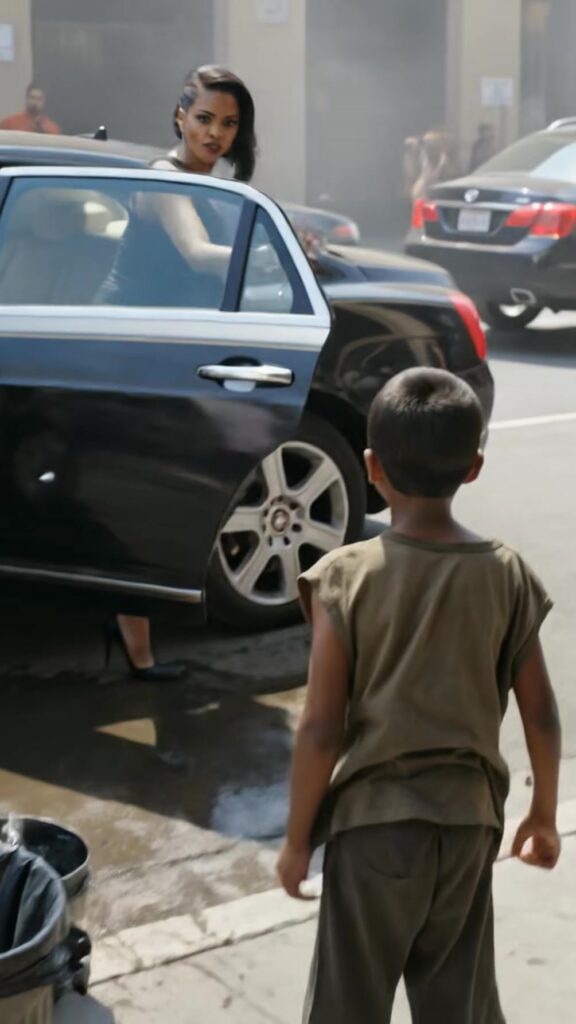
It opened with deliberate slowness, like a warning. A heel touched down—sharp, expensive—followed by another. The woman who stepped out didn’t rush. She unfolded herself into the street with practiced control, as if she owned not only the car but the space around it.
She wore a pale coat that could not have been bought off a rack, hair pinned into an immaculate shape that didn’t acknowledge wind. Her face was sculpted by wealth and fatigue, the kind of fatigue that comes not from physical labor but from carrying an empire of expectations. Two men in dark suits moved as if they were attached to her shadow.
Rage sharpened her features when she saw the mess. Her gaze cut through the water streaks, through the onlookers, and landed on the boy like a verdict.
“What have you done?” she demanded, each word a measured strike. It wasn’t a question; it was an accusation that assumed the right to be answered.
The crowd leaned in, hungry for spectacle. Someone murmured, “Who is that?” Another whispered her name, a name that lived on billboards and charity galas and court documents the public never quite understood.
The boy didn’t flinch. He could feel the heat of attention on his skin like sunburn. It was new to be the center of anything, but he had chosen it, and choice made it bearable.
His lips parted. For an instant, nothing came out, only a trembling breath that tasted like exhaust. Then his voice, cracked and thin, forced itself up from a place deeper than hunger.
“You destroyed my family.”
It wasn’t loud, but it cut the air. It made the nearest onlookers blink, as if the script had changed.
The woman froze. Not the theatrical pause of someone playing for cameras—this was involuntary, a glitch in her composure. The men behind her shifted, uncertain. Her eyes searched the boy’s face as though it were an old photograph she didn’t want to recognize.
The boy felt the world pull tight around that gaze. He could smell the dirty water drying on the car, could hear the distant wail of a siren that might have been meant for him. But the woman’s expression—something fractured there, something that had been held in place by money and denial—became the only sound.
She took a step closer. The crowd’s phones tilted, tracking her like satellites.
“What did you say?” Her voice was lower now, no less sharp, but threaded with something else. Doubt. Fear. The smallest tremor of memory.
The boy swallowed. He remembered a different street, years ago, when his mother still smelled like soap and his father still came home with flour dust on his sleeves. He remembered the night the storefront burned too quickly, the police who asked the wrong questions, the papers his parents were made to sign, the eviction notice that arrived like a death certificate. He remembered a name on the company letterhead. Her name.
“I know who you are,” he said. “And I know what you did.”
The woman’s nostrils flared. Her gaze flicked, quick as a blade, to the cameras pointed at her. The two men in suits shifted again, ready to move him, to end this scene. But she lifted a hand, stopping them with a small, absolute gesture.
She stepped in until she was close enough that only the boy could hear her next words. The crowd strained forward, but the city’s noise swallowed the sound. Her lips moved. Her voice was a whisper, and yet it struck him like a slap.
Whatever she said—his name, perhaps, or a detail no stranger could know—drained the blood from his face. Shock widened his eyes. Fear followed, a cold bloom under his ribs. Recognition, sharp and unwanted, snapped into place.
His fingers tightened around the empty bucket until the plastic creaked. The woman’s gaze held him, not with rage anymore but with something that looked dangerously like pity—or calculation.
Behind them, traffic trembled in suspended impatience. The phones kept filming. The city, finally, was looking.
And the boy realized he had not just forced himself into view.
He had stepped into a story she had spent years burying.
The woman’s whisper ended. She straightened, masking whatever had broken across her face with a new expression—smooth, public, unreadable. She glanced at the men behind her, and they moved with renewed purpose, not toward the boy, but to block the cameras’ angles, to clear a path.
The boy stood rooted, the bucket dangling from his hand, his heart pounding loud enough to drown out the horns. He had wanted to be seen. He had wanted an answer.
Now he had one—and it terrified him.
The light changed. The city began to move again, but the moment didn’t release him. In the black car’s dripping reflection, he saw himself not as invisible trash beside a bin, but as a figure caught in the crosshairs of something vast.
As the woman turned, she let her gaze touch him one last time—an unspoken warning wrapped in silk.
The boy didn’t chase her. He didn’t speak again. He only watched, understanding too late that being noticed was never the same as being safe.
And somewhere under the city’s roar, he heard the promise hidden in her whispered words: this wasn’t over. It was beginning.