No one stopped for him. Not when he stepped off the curb barefoot, not when he stood in the strip of churned gray between two lanes where horns and exhaust turned the air into a bruise. The city didn’t do stillness. It did speed, schedules, delivery vans, late meetings, rattling buses. It did loud.
And yet there he was—still as a signpost that hadn’t been installed properly, a child with dirty ankles and hair the color of wet ash. His shirt clung to him in streaks, as if the rain had tried to wash him clean and given up halfway. He wasn’t holding out his hand. He wasn’t crying. He wasn’t even watching the people. He stared straight ahead as if he were waiting for something that had promised to arrive and never did.
Men in suits swerved around him without changing pace. A woman dragging a rolling suitcase jerked it aside so the wheels didn’t bump his heel. A courier on a bicycle yelled, then laughed when the boy didn’t flinch. The boy’s eyes stayed open and dry, like he’d already spent whatever tears were in him years ago.
In the windows of passing cars, he flickered and vanished. Glimpsed for a second, dismissed forever. A child in the median became scenery. The city was good at that—turning people into background.
He wore one thing that didn’t match the rest: a watch, strapped to his wrist with a cracked leather band. It looked ancient and wrong on him, the kind of watch you’d see in a photograph of someone’s grandfather. Its face was cloudy. Its hands had stopped at an exact time—8:17. The glass was spidered as if it had taken a blow and decided to remember it.
He didn’t glance at it. He didn’t need to. Whatever he was waiting for wasn’t measured by minutes.
Across the lane, traffic thickened and thinned like a living thing. The roar of engines rose, fell, rose again. The boy didn’t move. A siren wailed somewhere far off, swallowed by the buildings. A gust of wind carried the smell of fried food, gasoline, and something metallic, like a coin held in the mouth too long.
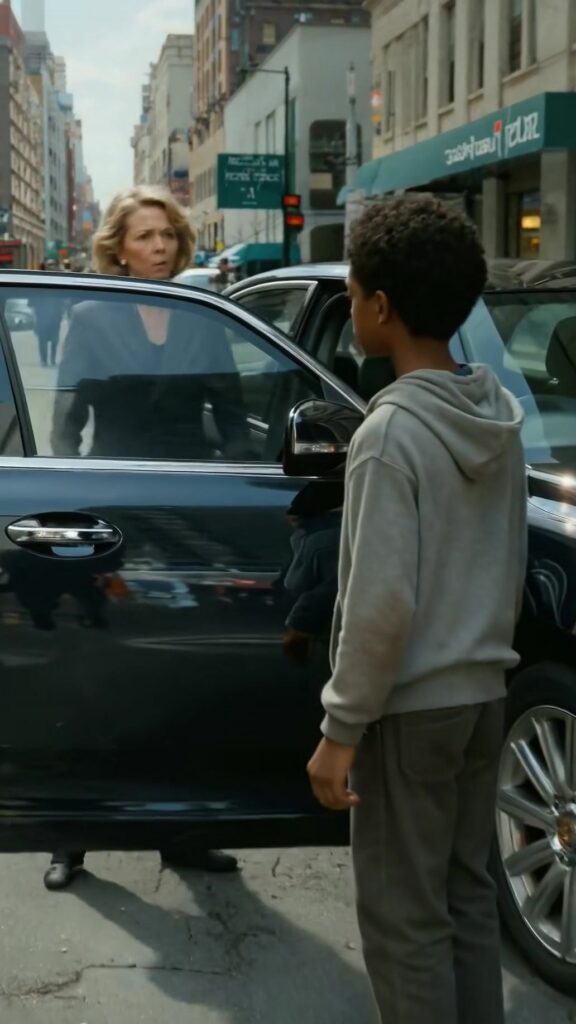
A black luxury sedan glided toward him, its paint reflecting the city like a polished bruise. It should have passed like everything else. It should have flowed around him without consequence. Instead, its tires shrieked. It halted so abruptly the world seemed to tilt forward with it.
For one stunned moment, the street held its breath.
The boy stepped closer and tapped the hood with his palm. Not with anger—almost with ceremony. A single, muted thump that traveled through metal and into every heart that happened to be listening.
The driver’s door flew open.
A woman stepped out as if the car had ejected her. She was dressed in tailored black, coat sharp at the shoulders, hair pinned back with ruthless precision. Her heels clicked against the asphalt like punctuation. The kind of person people moved out of the way for without thinking. The kind who had never had to stand still in the middle of a street to be seen.
Her face was already arranged into irritation, a practiced mask she could put on before the feeling even arrived. “What are you doing?” she demanded, voice cutting through the stunned hush. The air was suddenly too quiet around her, as if even the engines had decided to listen.
The boy didn’t answer.
He looked at her—straight into her eyes, not at her clothes, not at her car, not at the authority she wore like perfume. His gaze was not pleading. It was not accusing. It was something worse: recognition.
The woman’s expression tightened, ready to harden into anger, but it paused—just for a fraction—as if it had stumbled over a memory in the dark.
The boy’s hand lifted. It trembled, not from fear of her, but from effort, like the act of raising it required crossing an invisible boundary. He turned his wrist so she could see what he held against the air: the old broken watch.
Her breath caught. The irritation drained from her face so fast it left it pale, almost transparent. Shock flooded in behind it, then fear, then something deeper, older—something with roots.
Her lips moved, the sound hardly more than a scrape. “No.”
She took a step closer, and for the first time her eyes did not flick around for witnesses or threats. They locked onto the watch like it was a weapon and a relic. “Where did you get that?” Her voice shook. The city noise began to seep back in at the edges—someone honked impatiently, someone yelled—but around them the air stayed dense, charged.
The boy opened his mouth as if to speak, then closed it again. The silence between them felt rehearsed, the kind that happens when words are too late.
The woman’s hands—hands with manicured nails and a bracelet that cost more than the boy’s whole year of meals—hovered, not daring to touch. Her throat bobbed as she swallowed. “That’s… mine,” she whispered, and it sounded like a confession ripped out of her.
The boy finally spoke, but his voice was soft, sandpapered, as if he hadn’t used it in a long time. “It was his.”
Her eyes flinched. “Who—”
He didn’t say a name. He didn’t have to. The watch did it for him. In the woman’s mind, a door opened that she had nailed shut years ago.
She saw a different street—narrower, darker, wet with rain. A night with headlights sweeping past and not stopping. A phone buzzing in her hand as she stared at the screen, letting it ring out because she was angry, because she was tired, because she thought tomorrow was guaranteed.
She saw a man standing at an intersection, holding a small box, watching cars rush by. She remembered the watch on his wrist, the one she’d bought him when they were still pretending love was enough to survive ambition. She remembered his last message: Just five minutes. Please.
She remembered choosing not to stop.
Her knees threatened to fold. She grabbed the edge of the hood for balance. “He’s…” She couldn’t finish the sentence. Her voice broke on the possibility.
The boy’s stare didn’t soften. It didn’t need to. It was simply there, unwavering, like the time on the watch that refused to move on. “He waited,” the boy said. “He waited a long time.”
“Where is he?” The woman’s words came out jagged. “Where did you—where is he?”
The boy glanced past her, toward the endless stream of people who had begun to edge around the stopped car, annoyed at the delay, curious for a second, then forgetting again. “He’s not here,” the boy said, and each syllable landed heavy. “Not like this.”
The woman made a sound that wasn’t quite a sob and wasn’t quite a laugh—something in between that meant the body didn’t know which kind of collapse it was having. She stared at the boy as if looking for a trick, a scam, anything to make this less real.
“Then you are—” she began, but her voice failed.
The boy’s fingers tightened around the watch. He held it up, not offering it, not yet. “I’m the reason it stopped,” he said quietly. “He pushed me out of the way.”
The woman’s mouth fell open. She backed away a half step as if struck. Around them, horns resumed in earnest, angry now, the impatient chorus of a world that couldn’t understand why two strangers were holding time hostage in the middle of a street.
The boy continued, his tone steady, almost detached, as if he were reciting something he’d carried for too long. “I was small. Smaller than I am now. He grabbed me—like this—” The boy mimed a hand closing on an arm. “I remember his hand. I remember the smell of rain on his coat. I remember him shouting at the cars to stop.”
The woman’s face crumpled. She covered her mouth with one hand, eyes shining with sudden wetness. “I didn’t know,” she said, and it sounded like she was trying to say it to herself, to rewrite history in real time. “I didn’t—”
“You did,” the boy said, not cruelly. Simply. “You had his watch. You know what time it was.”
Her gaze snapped to the watch again. 8:17. A time that had once been ordinary, now a wound that never closed.
The boy’s shoulders lifted with a breath. The first sign of emotion cracked through him—fatigue, maybe, or grief finally finding a way out. “I came back every day,” he said. “I thought someone would… someone would have seen. Someone would have stopped.”
The woman’s eyes flicked to the people passing. None of them stopped. Not really. A few stared, then hurried on, afraid of involvement, afraid of being late.
“But you didn’t come,” the boy finished, and the simplicity of it was devastating.
The woman’s hand reached out at last, trembling. “Give it to me,” she whispered, then shook her head as if the demand disgusted her. “No—don’t. I don’t deserve…”
The boy studied her, as if weighing a choice. Then, slowly, he unbuckled the cracked strap. The watch came free with a soft click. He placed it on the hood of her car, exactly where he had tapped before, like setting down evidence at an altar.
“You stopped now,” he said.
“I stopped because—” she began.
“No,” the boy interrupted, and his voice, for the first time, carried something like authority. “You stopped because you finally had to.”
She stared at him, cheeks wet now, mascara threatening the edges of her control. The engines around them growled, the city pressing in, demanding movement. A driver shouted obscenities from behind, but the words slid off her. She had lived her life in motion, believing speed made her safe. In that moment, stillness was the only honest thing left.
“What’s your name?” she asked.
The boy hesitated. He looked down at his bare feet, at the oil-smeared asphalt. “It doesn’t matter,” he said, but his voice softened. “He called me ‘kid.’ He told me to run.”
“And you didn’t?”
“I did.” The boy’s eyes lifted again, cutting clean through her. “But I came back.”
Something in her face shifted—something human breaking through the polished shell. She looked at the watch, at the stopped hands, at the fracture lines in its glass. Then she looked at the boy as if seeing the cost of her choices embodied in someone she had never met.
She inhaled, shaky. “Get in the car,” she said.
The boy didn’t move.
“Please,” she added, and the word sounded unfamiliar in her mouth.
For a moment, it seemed like he might refuse, like he might choose to remain in the median forever, a quiet accusation the world could step around. Then his shoulders sagged, a child’s posture returning as exhaustion overtook whatever had kept him upright.
He walked to the open door. Before he climbed in, he glanced back at the street—at the rushing people, at the cars sliding by, at the life that never slowed. His expression was unreadable.
The woman picked up the watch and closed her fingers around it as if it were a hand she could hold onto across years. She didn’t put it on. She couldn’t. She just held it, feeling the cold metal, the stopped time.
As she slid into the driver’s seat, she looked once more at the boy beside her. “Where are we going?” she asked, voice hushed.
The boy stared forward through the windshield, out at the city that had ignored him until it couldn’t. “Somewhere,” he said, “where you don’t drive past.”
She turned the key. The engine purred, obedient. The car eased into motion, not fast—careful, as if speed itself had become something she no longer trusted. Behind them, the horns flared again, the river of life resuming its reckless flow.
But the watch stayed on her palm, heavy and silent. And for the first time in years, she let herself feel how loud quiet could be when you finally stop.