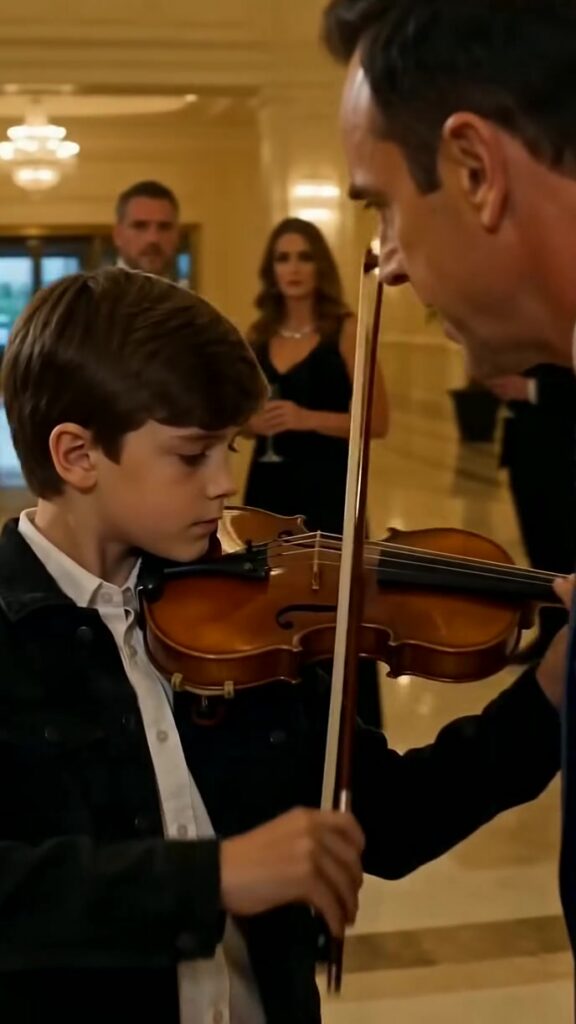
“Play something, kid.”
The words landed with a neat little laugh, the kind polished people used when they wanted to be cruel without getting their hands dirty. It rolled through the hotel’s lobby—golden, mirrored, perfumed with lilies and expensive cologne—and came back to the speaker as an echo that made him grin wider.
Victor Halden stood in the center of it all as if he’d been poured there: tailored suit, lacquered hair, a glass of amber that caught the chandelier light like a captured sunset. Around him, guests in satin and cufflinks shifted, chuckled, lifted their phones half an inch and thought better of it. The Halden Foundation’s annual gala was supposed to begin in the ballroom upstairs. But the lobby had become its own stage—because Victor liked his charity with an audience.
The boy didn’t look up immediately. He stood by the fountain where coins glinted beneath the water, his violin case open on the marble. He was too young to have shoulders that stiff, too thin to wear that kind of stillness so naturally. Dark hair fell into his eyes. His jacket had been cleaned too many times and not recently enough. Yet the violin itself—dark wood, old varnish, a scar of wear near the chinrest—looked as if it had lived more lives than everyone in the room combined.
Victor tipped his glass toward him, a toast to his own joke. “We’ve got donors to impress,” he said, voice loud enough to fill the lobby. “Give us something cheerful.”
A few guests laughed again. Someone murmured, “How adorable.” Someone else whispered, “Probably planted.”
The boy’s fingers moved, and the room misread it as nervousness. He opened the case all the way and lifted the violin with care that bordered on reverence. He didn’t rush. He didn’t fidget. He raised it under his jaw with a slow deliberation that felt like a ritual.
The lobby did not quiet all at once. It thinned of sound the way a tide pulls back—first the chuckles, then the little conversations, then the clink of ice as glasses were steadied, then the last stubborn whisper that died when it realized it was alone.
The bow touched the strings.
The first note came out sharp and clean, not loud but impossibly present, as if it had been hiding inside the marble and now had permission to speak. It cut through perfume and laughter and money with a blade’s certainty. Heads turned. Chins lifted. Victor’s grin faltered for the smallest fraction of a second before he tried to reclaim it.
The boy played again. A melody unfolded, not a tune meant to charm but a line that carried weight—like a confession with no place to go. It was unfamiliar and yet it landed in the listeners as if it belonged to them, as if it had been waiting behind their ribs.
Victor’s smile began to slip.
He knew music. Not in the way people claimed to know it—background at dinners, string quartets hired like furniture—but in the way a man knew something he’d stolen and hidden. His mouth parted. The glass in his hand stopped halfway to his lips.
“No,” he breathed, and the word fell out of him by accident.
The boy’s bow moved with increasing certainty. The melody deepened, turning darker, taking on a shape that seemed to push at the walls of the lobby. It sounded like a lullaby remembered too late. It sounded like winter. It sounded like a door closing softly so no one could claim they heard it.
Victor stepped forward without meaning to. His shoes crossed the edge of the fountain’s circle. His heartbeat, loud in his own ears, tried to drown out the violin and failed. The guests watched him, then watched the boy. The air held itself tight.
“That melody…” Victor’s voice cracked as if he were suddenly very old. He swallowed. “…it was never published.”
The boy didn’t glance at him. His eyes stayed on nothing and everything at once, fixed past the chandelier, past the glass doors, as if the music required him to stare into a distance only he could see. The notes climbed, pressed higher, and something in the crowd shifted from amusement to unease.
A woman near the concierge desk pressed her hand over her mouth. An older man who’d been bragging about art acquisitions lowered his phone. A server stood frozen with a tray of flutes, champagne trembling in the rims.
Victor turned his head sharply toward the woman beside him—Evelyn Halden, immaculate in silver, diamonds at her throat like ice. She had been smiling in that practiced way she wore for cameras, for donors, for the staff. But as the melody rose, her eyes tightened. Her hands, clasped at her waist, gripped each other too hard.
“Stop,” Victor whispered, though he didn’t speak to the boy so much as to the past. “Stop playing that.”
The boy played as if he had not heard.
The song reached a part that was not merely music. It was a signature. It was a particular bend of a note that only one composer used, an idiosyncrasy that had once been laughed at in conservatory halls, then admired, then whispered about with envy. Victor knew it because he had heard it in a small apartment years ago, in a room smelling of tea and cheap varnish, while a woman played with eyes closed—alive, brilliant, furious.
He had promised her everything. He had given her a ring he did not own in any honest sense. He had left with her music in a folder under his arm and her faith hanging like a coat on a hook behind the door.
The final notes approached with a dreadful calm. The melody slowed, thickened, and then delivered its last sound like a verdict spoken aloud. The note hung for a heartbeat longer than it should have, vibrating in the chandelier crystals, trembling on the skin of every listener. Then the bow lifted.
Silence slammed down. Not polite silence. Not the kind that waited for applause. This was a silence that arrived like a shut door, a sudden darkness, an interruption so complete the lobby seemed to tilt.
The boy lowered the violin. He did it gently, as though setting down something living. Then he lifted his eyes for the first time and looked directly at Victor Halden.
His gaze was calm. Steady. Not triumphant. Not pleading. Simply certain.
“Then ask your wife,” he said, voice clear enough to carry without being raised, “why my mother died with your ring.”
The words did not echo; they didn’t need to. They shattered the room all on their own.
Victor’s head snapped toward Evelyn too fast, as if his body moved before his mind could choose mercy. Her face—trained for galas, for interviews, for grief performed at podiums—failed her. Fear rose through her expression naked and real. Her lips parted. Her pupils widened. For one terrible second she looked not like a benefactor but like someone cornered.
Guests stared as if the chandeliers had gone out. The fountain burbled, obscene in its normalcy. Somewhere a glass slipped from fingers and hit the marble with a small, bright crack that sounded indecently cheerful.
Victor’s voice came out quiet, wrecked, as though the air itself had grown heavy. “What did you do?”
Evelyn’s throat worked. She tried to smile. It twitched and died. She opened her mouth—and the world leaned forward with her, hungry for the truth it had been paying to avoid.
“Victor, I—”
A sharp chime cut her off.
The concierge’s phone rang. A flash went off from somewhere near the entrance—someone’s camera, too eager, too late. The spell snapped, not broken but interrupted, like a record needle dragged across vinyl.
Victor blinked as if waking. Evelyn recovered half a breath of poise, enough to straighten her shoulders. The guests, released from paralysis, began to move—small steps, murmurs blooming, phones rising like a field of metallic flowers.
The boy reached into his violin case and pulled out a folded envelope. He placed it on the edge of the fountain where Victor could see it without touching it. On the front, in careful handwriting, was Victor’s name. Beneath it, a date from sixteen years ago. The ink looked fresh, but the paper looked as though it had been carried a long way.
Victor stared at it as if it might bite.
“You don’t get to laugh anymore,” the boy said. His voice didn’t shake. It didn’t have to. “Not tonight.”
Then he turned, slid the violin into its case, and closed it with a soft click that sounded louder than any applause. He walked out through the revolving doors into the city’s cold light, leaving behind a lobby full of people who suddenly remembered they had consciences.
Victor did not follow. He could not. His eyes stayed on the envelope like a man watching the edge of a cliff. Evelyn’s hand reached for his arm, and he flinched away as if her touch burned.
Outside, the boy paused on the sidewalk and looked up at the hotel’s glowing facade. For a moment he allowed himself a single, controlled inhale, as though he’d been underwater and had finally surfaced.
In his pocket, something small and metallic pressed against his palm—a ring, warm from his skin. Not Victor’s ring. His mother’s.
The melody he’d played still lived in the lobby, trapped in the ears of everyone who’d heard it. It would follow Victor into interviews and meetings, into sleepless nights when the silence grew too loud. It would be hummed by strangers who couldn’t explain why their throat tightened when they tried.
And somewhere, in the break between one breath and the next, the truth waited—no longer buried, no longer patient, already rising.