Rain lacquered the sidewalk in a skin of glass, turning the city into a smear of color. The fast-food sign above the corner restaurant hummed in red and electric blue, its glow breaking into a thousand fractured reflections on the street. Cars hissed past. People hurried under umbrellas, their laughter and ringtones threading the night like loose wire. It was ordinary—noisy, impatient, forgettable—until the air seemed to tense, as if a hand had closed around the world’s throat.
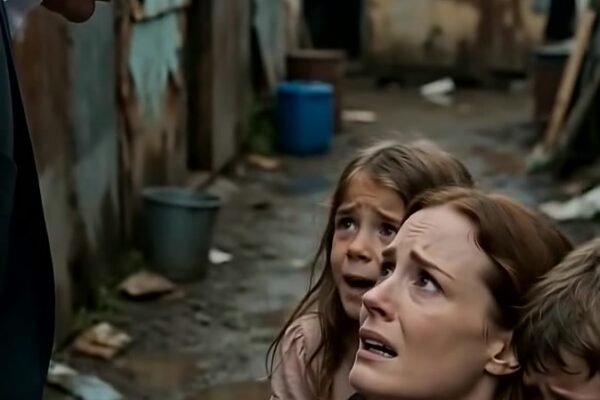
Near the entrance, a little girl stood with her shoulders tucked inward, as though she could fold herself into invisibility. She clutched a small paper bag to her chest. It wasn’t the grip of a beggar demanding attention; it was the careful hold of someone guarding a fragile thing. Her hoodie hung too long over her hands. Rain had darkened her hair into damp strings that framed a face that tried not to look hungry. She kept glancing toward the street, then back to the restaurant door, as if she was waiting for permission to exist.
Inside, the bell over the counter rang again and again. Orders were called. Grease and sugar floated out each time the door opened. Finally, it swung wide and spilled out a cluster of young people dressed for a different world—clean shoes, sharp coats, bright laughter. In the middle strode a young man with a voice that seemed trained to carry. He had the easy swagger of someone whose mistakes were paid for by someone else. His friends orbited him, chuckling at every word, watching him as if he was the only source of light.
His eyes snagged on the girl like a hook. He slowed, then smiled—not the kind that warms, but the kind that tests how far it can go before it breaks something. He stepped closer, and the circle of friends drifted with him. “What’ve we got here?” he said, loud enough that strangers could hear. The girl’s fingers tightened around the bag. She didn’t answer. That silence seemed to irritate him, as if it denied him his role in the scene he’d decided to perform.
Without warning, he reached out and snatched the paper bag from her hands. The motion was quick and careless, like plucking a napkin off a table. The girl’s mouth parted in a small, startled sound. He opened the bag and peeked inside, then tipped his head toward his friends with a grin. “Cold fries? Lucky you.” Before she could lunge for it, he inverted the bag. Food slid out in wet clumps, slapped onto the pavement, and immediately soaked in rainwater and street grime.
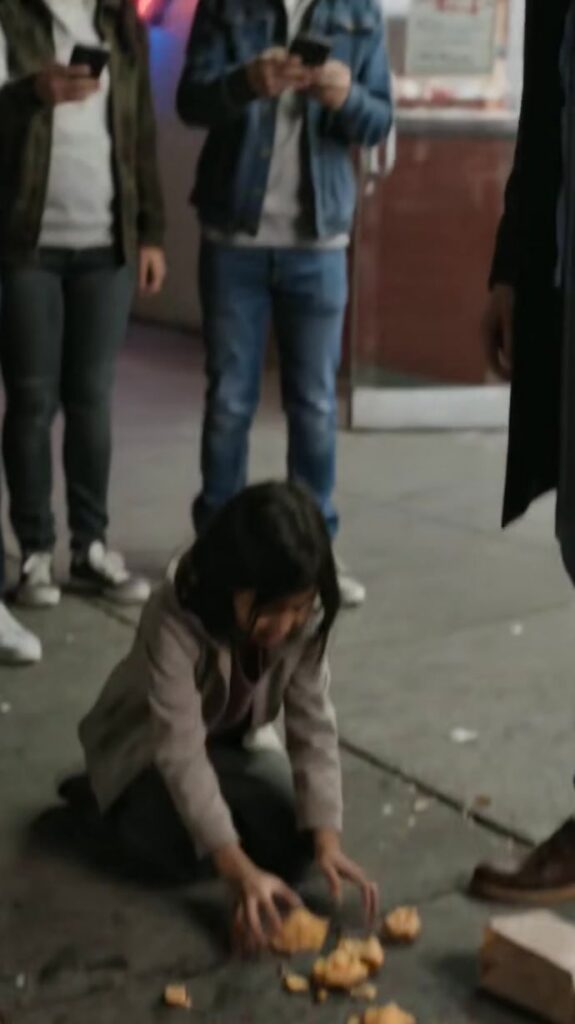
“If you want it that bad,” he said, raising his voice with theatrical amusement, “go on. The sidewalk’s serving tonight.” Someone laughed too high and too sharp. Then the laugh died. The street quieted in a way that didn’t match the traffic. A few people stopped walking. A woman under a clear umbrella lifted her phone, the screen bright in the dark. Another followed. The ring of cameras formed like a silent jury.
The girl dropped to her knees as though pulled by a string. Panic erased whatever pride she’d been holding. She scooped at the food with trembling hands, trying to separate edible pieces from the black water pooling in the cracks of the sidewalk. Her breathing came in quick, thin pulls. “No—please,” she whispered, the words breaking apart. “Please.” She wasn’t crying loudly. It was worse than that—she was crying like she couldn’t afford noise.
As she reached for the last piece, something slipped from the overturned bag and rolled away, spinning in a small circle before the rain nudged it onward. A child’s inhaler. A medicine bottle with a torn label. They knocked lightly against the toe of the young man’s polished shoe and came to rest there, as if the street had delivered evidence directly to him. His grin faltered. He stared at the items, and in that brief pause he looked less like a king and more like a boy who hadn’t expected consequences to have weight.
“That’s for my brother,” the girl said, her voice ragged. She didn’t look up. She kept scraping food from the pavement, hands slick with rain. “He… he can’t swallow his pills unless he eats. If he takes them on an empty stomach, he throws up and—” She swallowed, as if the rest of the sentence hurt. “He’s waiting. I told him I’d come back fast.”
The friends behind the young man shifted, their laughter gone, their faces suddenly unsure of where to land. The phones remained raised, recording in unblinking rectangles. The young man’s throat bobbed. He looked at the girl’s bent head, the wet strands of hair, the too-large hoodie. For the first time, he seemed to notice she wasn’t acting for anyone. She was racing a clock no one else could hear.
The restaurant door banged open hard enough to rattle the glass. An older woman burst out into the rain wearing a work apron and nonslip shoes, her hair pinned back hastily. She scanned the knot of people and the glimmer of screens, her face tightening with alarm. Then her eyes found the girl on the ground. The woman stopped so abruptly her breath caught. The color drained from her cheeks. She took a step forward, then another, like approaching a memory that might bite.
“No,” she whispered, so softly it almost vanished under the rainfall. She crouched, ignoring the wet, her hands hovering over the girl’s shoulders without touching. “Those eyes…” Her voice trembled. “I’ve seen those eyes.” The girl flinched, as if she expected scolding, and tried to hide the ruined food behind her arms. The older woman shook her head, staring as if the child had risen out of the pavement itself. “They’re my daughter’s eyes,” she said, and on the last word her voice cracked open.
The young man turned toward the woman, confusion sharpening into unease. “What are you talking about?” he demanded, but the bravado had drained. The woman looked up at him, recognition blooming on her face with frightening speed. She stood, rain dripping from her lashes, and her gaze cut through him. “Your family,” she said, each syllable weighted, “put out posters ten years ago.”
A murmur rolled through the crowd. Someone—an older man holding a shopping bag—stared at the young man, then at the girl, and his eyes widened. He lifted a trembling finger, pointing not at the child but at the young man’s face, as if comparing features in the air. Then he shouted a name, loud enough to snap the street back to life: “Evan Hale!”
The young man went pale. The name hit him like a slap that carried history in its palm. A few phones swung to capture his reaction; the lenses moved like predators sensing blood. The woman’s jaw tightened. “Hale,” she repeated, voice steady now, as if steadiness was all she had left. “Your father used to come here for coffee at midnight when he couldn’t sleep. He told me about the sister who vanished. He told me he searched until it ruined him.” She looked down at the girl. “And now she’s here, on her knees, collecting dirt-soaked fries while his son watches.”
Evan’s lips parted, but no sound came. He stared at the child as if she’d transformed into a photograph he’d seen but never understood. The girl finally lifted her head. Her face was streaked with rain and tears, and in her expression there was no recognition—only fear, urgency, and exhaustion too old for her body. “I have to go,” she whispered. “He’ll be scared.”
For a second Evan didn’t move, as if his limbs had forgotten their purpose. Then, slowly, he crouched. Not to take something, but to return it. He reached for the inhaler and the medicine bottle, placing them carefully into the bag. His hands shook. He pulled out his phone, not for a video, but for a call, his thumb hovering as though the numbers were burning him. “What’s his name?” he asked, voice low. The girl blinked. “Milo,” she said, swallowing hard. “He’s at the shelter by the bridge.”
Evan looked up at the older woman. Rain ran down his face, erasing the last of his polished certainty. “Stay with her,” he said, and there was something pleading in the command. He stood and stepped back from his friends, back from the circle of cameras. When he spoke into the phone, his voice was hoarse. “Dad,” he said, and the street listened. “I think… I think I found her.”
The crowd’s phones wavered, not from excitement now, but from the shock of witnessing a cruelty flip into a revelation. The little girl clutched the bag again, but it wasn’t filled with food anymore—it was filled with time, with breath, with a brother’s fragile chance to swallow and keep going. The older woman wrapped her apron around the girl’s shoulders like a blanket and pulled her close. Evan took one step toward them, then stopped, as if afraid to touch the past. Behind them, the neon sign buzzed and reflected off the wet pavement, its light shimmering like a warning and a promise at once.