The station had the personality of a storm: loud, impatient, and everywhere at once. It was five forty-three, the hour when the city tried to fold itself into metal tubes and vanish underground. The ceiling speakers chopped the air with announcements that no one listened to. Wet umbrellas bumped shoulders. Shoes slapped the tile in a frantic percussion. Rain raked the glass walls, a steady tapping like knuckles against a locked door.
In the middle of it all, Mara stood perfectly still.
She looked as though she’d stepped out of a magazine and walked straight into a disaster. Her coat was tailored, the color of bruised plum. Her eyeliner had blurred at one corner, not enough for strangers to notice unless they were looking for fractures. Her mouth held the shape of a smile that had forgotten why it existed.
Her hands were locked around her phone. Not like a habit. Like a weapon. Like an exhibit she’d been carrying in her pocket for years.
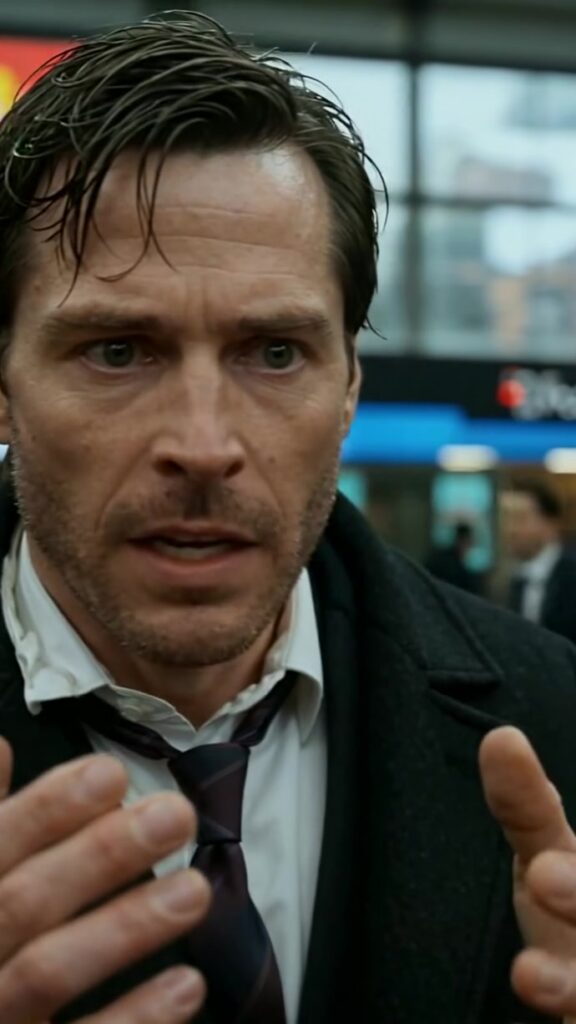
Across from her, a man in a black wool coat hovered on the edge of flight. Adrian’s hair was cut with the precision of someone who paid to look unbothered. He wasn’t unbothered. His breath came in shallow bursts, fogging in the cold draft that rushed through each time the platform doors opened.
At first, the crowd flowed around them—commuters were experts at ignoring the human. Then something in Mara’s stillness snagged attention, like a thread catching on a nail. People slowed. A woman with a stroller stopped. A teenager lifted his gaze from his screen, then lifted the screen itself.
Mara raised her phone to chest height. Her voice didn’t have to climb over the noise. It cut through it.
“Don’t take another step,” she said.
Adrian’s lips pulled into something that tried to be a laugh. “You want to do this here? In front of… everyone?” His eyes searched the platform, then the staircase, then the far end where security usually stood. It was as if he was mapping exits on a burning floor plan.
Mara didn’t blink. “The place doesn’t matter. You already made a spectacle out of my life.”
The air tightened. Even the station seemed to hold its breath between announcements. A ring of people formed at a polite distance, pretending they were just waiting for the next train while their cameras woke up and their recording icons glowed.
Adrian stepped closer, lowering his voice as if secrecy could be negotiated into existence. “What do you want from me?”
Mara’s thumb hovered a moment, the smallest hesitation—grief, or fear, or the last scrap of wanting to be wrong. Then she pressed play.
A scratchy recording seeped from the speaker, the sound of a room with a cheap fan and someone breathing too hard. A voice, distorted by distance and time, spoke with a tone that belonged to a man used to giving orders: “…don’t tell her. If she finds out, everything collapses.”
Adrian’s face emptied as if someone had pulled a plug in his neck. The color drained fast, leaving only the sharp edges. “No,” he whispered, and the single syllable carried the weight of a confession. “You can’t have that.”
Mara’s throat worked. She swallowed once, deliberate. “So it wasn’t in my head,” she said. The station noise surged back for half a second—the loudest silence she’d ever heard, because it proved the world still moved while she’d been frozen for years.
She tapped again.
This recording was clearer. Two voices this time, one of them Adrian’s, unmistakable with its practiced calm. A name surfaced in the conversation, and it hit the listeners the way a dropped glass hits tile: sharp, final, impossible to ignore.
Adrian’s hand shot out toward the phone.
Mara moved first. Not with speed—she didn’t need it—but with certainty. She stepped back just enough to break his reach and said, loud enough for the nearest circle to hear, “And I know who was with you that night.”
He stopped mid-motion. His fingers hung in the air as if the tendons had been cut. His eyes widened, not in anger now but in raw terror, as if she’d named a ghost standing behind him.
The ring of commuters went still. Even the rain sounded louder.
Adrian’s mouth opened. Nothing came out at first. His gaze skittered from Mara to the crowd, as if he could bargain with their presence. “You don’t understand,” he finally managed, voice hoarse. “You don’t know what you’re playing with.”
Mara’s laugh was small and terrible. “I didn’t know I was playing,” she said. “I thought I was living.”
She didn’t look down at her phone when she spoke the name. She watched him. It was the only way to see truth happen in real time.
“Elena,” Mara said.
The sound of it did something to him. Adrian flinched as if the name had struck his cheek. Someone in the crowd inhaled sharply. A few people glanced at one another, trying to place it—office gossip, news headlines, a supervisor on the wall of some corporate tower. Mara knew they might not recognize it. The point wasn’t fame. The point was proximity.
“Don’t,” Adrian said, a plea wearing the clothes of a warning. “Mara, please.”
“Please,” she echoed, and her eyes brightened with held-back tears. “You used that word, too. You said it when you asked me to trust you. You said it when you asked me to sign things I didn’t understand. You said it when my brother disappeared and you stood in my kitchen and promised you’d help.”
At the mention of her brother, the crowd shifted again. The circle tightened by a step. Camera lenses steadied.
“I did help,” Adrian snapped, then checked himself too late. “I tried to.”
Mara tilted her head. “You tried to help by telling someone to keep me in the dark?”
He glanced toward the stairs again. No security. No convenient rescue. Only commuters and their bright, hungry screens.
Mara lifted her phone a little higher, letting those nearest see the file names—timestamps, short labels, a chain of saved moments. “You thought I’d never have proof,” she said. “You thought you could erase a person by filing him under ‘unfortunate incident.’”
Adrian’s voice broke. “You don’t know how high it goes.”
“I know exactly how high it goes,” Mara answered, and for the first time the tremor in her voice wasn’t weakness; it was rage finding its spine. “That’s why I didn’t come alone.”
She nodded once, almost imperceptibly, toward the edge of the platform.
A woman in a hooded raincoat stepped out of the crowd. She didn’t carry a phone held like a spectator. She carried a badge in one hand, unobtrusive but undeniable, and a small recorder in the other. Two men flanked her—plain clothes, the kind who blend until they want to be seen.
Adrian’s shoulders sagged before anyone even spoke. His body recognized authority the way a dog recognizes thunder.
“Adrian Voss?” the woman asked. Her voice was calm, practiced. “Detective Han. We need you to come with us.”
Adrian tried to smile again, but it collapsed halfway. “This is insane. You’re trusting her—”
“We’re trusting the evidence,” Han replied. She glanced at Mara, and there was no pity there, only acknowledgement. “And the fact that you just attempted to grab the device containing it.”
One of the men gently took Adrian by the elbow. Adrian turned his head to Mara as if he could burn her with a last look. “If you do this,” he hissed, “you don’t get him back.”
Mara’s eyes flooded, but she didn’t let the tears fall. “I never had him back,” she said. “You took that when you decided my grief was collateral.”
As Adrian was guided away, the station noise returned like a tide—announcements, footsteps, the restless shuffle of a city that didn’t pause for justice. Yet something had shifted in the space where Mara stood. People lowered their phones slowly, uncertain now whether to keep watching or to look away in shame.
Detective Han leaned in. “We’ll need the original files,” she said, softer. “And anything else you have.”
Mara nodded, her grip still white-knuckled. “There’s more,” she whispered. “Not just him. Not just Elena.”
Han’s expression tightened. “I guessed.”
Mara looked through the glass wall at the rain. Each droplet on the pane caught the station lights and turned them into fractured stars. For years she’d imagined this moment as thunder, as a door slamming. Instead it was the steady, relentless sound of water: proof that time had kept moving even when she couldn’t.
A train roared into the station, wind whipping coats and hair. The crowd surged instinctively toward the opening doors. Mara remained where she was for a heartbeat longer, listening to the last echo of Adrian’s footsteps disappearing up the stairs.
Then she exhaled, as if she’d been holding her breath since the night her brother never came home, and stepped forward into the rush—no longer frozen, no longer silent, carrying the storm she’d finally released into the open.