She judged him the second he walked in, and the worst part was how efficient it felt—like a little mental stamp slammed down before he’d even made it past the revolving door.
The Avalon Hotel did that to people. The place was basically a museum that served lattes: polished marble floors you could see your face in, gold light dripping from chandeliers like honey, and an atmosphere so quiet it made you hear your own thoughts. Somewhere near the bar, a pianist was playing soft, expensive-sounding notes, the kind that made you sit up straighter without realizing you’d slouched.
Lena had been behind that desk for nine months, which in hotel time was long enough to learn the choreography. The rich guests glided. The staff floated. The problem people… they telegraphed themselves early. They always did. You just had to be paying attention.
She was paying attention.
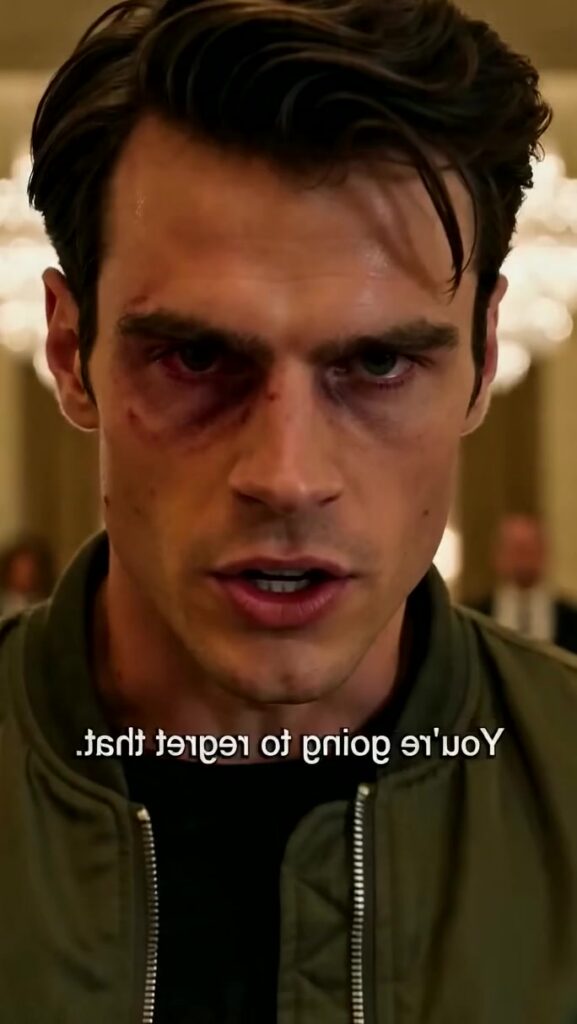
The man who walked in didn’t fit the scene. Not because of his face—handsome in a worn, complicated way—but because of the green bomber jacket. It looked like it had lived through weather. It had creases in the arms and a tiny stain near the zipper that no dry cleaner would ever fully erase. He wore jeans that weren’t ripped, but they weren’t trying. His boots had a scuff on one toe, like he’d kicked something heavy recently and won.
But he walked like he owned the marble. No hurry. No hesitation. Not that performative confidence rich men sometimes wore like cologne—this was quieter. Unbothered. Like the lobby was just another room he’d been in a thousand times.
Lena’s fingers tightened around the pen on the counter. Her eyes flicked to the left, where her manager, Todd, had taped a little note inside the desk cabinet last week: “If you feel unsafe, act first. We back you.” Underlined twice. Todd was all about liability, and Lena knew exactly why. Two months ago, a guy had wandered in, asked for “the bathroom,” and tried to steal a guest’s purse near the lounge. Todd had gotten chewed out by corporate. Since then, he’d been obsessed with the words “proactive security posture.”
The man in the bomber jacket approached, slow and steady. His gaze didn’t dart around, didn’t linger on the chandeliers, didn’t scan for cameras like the sketchy ones did. He looked… bored. As if he’d already decided what he wanted and he was waiting for the world to catch up.
And Lena decided, in the instant his shadow touched the front edge of her desk: not a guest. Not important. Potential trouble.
She didn’t like that she’d decided it so quickly, but her body didn’t ask permission from her conscience. Her hand dipped under the counter where the small canister sat—standard issue, lemon-scented pepper spray, bright label, easy grip. The hotel called it “personal safety spray” because “pepper” sounded aggressive on an inventory list.
The man opened his mouth, just slightly, as if to say “Excuse—”
Lena pressed the trigger.
A sharp hiss cut through the lobby like a match strike. A fine mist hit him full in the face, and for a fraction of a second, the world stopped. Even the pianist’s fingers froze mid-chord. The last note hung in the air, wrong and unfinished, like someone had left a sentence halfway spoken.
The man stumbled back half a step, not dramatic, more surprised than hurt. His hands came up, palms open, reflexive, not fighting. His eyes squeezed shut. He inhaled and then coughed once, hard, like he’d swallowed a betrayal.
Lena’s own breath came short and hot. The spray’s lemon tang drifted up to her nose and made her eyes water too. She hadn’t meant to hit him that squarely. She’d meant to warn, to deter, to—
Her voice burst out before her thoughts could form. “Security! Get this dirty bum out of here!”
It sounded louder than she’d intended, too sharp, too public. A woman in a silk wrap dress by the lounge clutched her clutch tighter. A man with a watch that probably had its own insurance policy leaned forward, entertained and appalled at the same time. Behind the front desk, the bellhop’s face went pale like he’d watched the opening scene of a disaster movie and knew what came next.
The man didn’t panic. That was the second thing that felt wrong.
Most people, sprayed in the face in a luxury hotel lobby, would either collapse into anger or chaos. They’d yell, curse, swing, run. This man did none of that. He stood there, breathing through it, head tilted slightly down, shoulders loose. He swiped his sleeve across his eyes once, slow, almost careful. When he looked up again, his eyelids were red, but the gaze behind them was clear and very awake.
His expression shifted in stages, like a weather front rolling in.
Calm.
Then something tighter.
Then dangerous—not in a wild way, not in a “he’s about to throw a punch” way. In a contained way. Like the moment before a judge reads a sentence. Like the instant a door locks and you realize you’re on the wrong side of it.
Lena felt the skin on her arms prickle. She hated herself for that too. Fear made her feel righteous, and she didn’t want to be righteous. She wanted to be right.
Two security guards rushed from the hallway near the elevators, their shoes squeaking slightly on the marble because even their tread wasn’t supposed to interrupt the illusion of perfection. They were big, matching suits, matching earpieces, matching “this is handled” expressions.
“Sir,” one of them said, already reaching for the man’s elbow. “You need to leave.”
The man lifted a hand—not to stop them, not aggressively. Just a small, patient gesture. “Don’t touch me.” His voice was hoarse from the spray, but the words landed cleanly. “I’m here for the General Manager.”
Lena scoffed before she could stop herself. “Of course you are.”
The man’s eyes moved to her. For a second, Lena saw herself the way he must’ve been seeing her: the pressed blazer, the name tag that said LENA in neat black letters, the practiced smile she wore like armor. She tried to hold his stare, tried not to flinch.
He reached into the inside pocket of the bomber jacket. Both guards tensed instantly. One took a step closer, hand hovering near his belt.
“Don’t,” Lena snapped. She didn’t even know what she meant. Don’t pull a weapon. Don’t make this worse. Don’t make me the kind of person who does this and is somehow still wrong.
The man ignored her, moving with deliberate slowness. He pulled out a slim leather wallet and opened it, holding it up at chest height where everyone could see he wasn’t lunging for anything. He slid out a card—not a credit card, not an ID. A thick, matte-black card with an embossed crest that caught the chandelier light like a warning.
“Show her,” he said to the guards, and his tone made it sound less like a request and more like he was tired of repeating obvious instructions to people paid to be competent.
The nearest guard took the card, read it, and his whole posture changed. The professional stiffness melted into something that looked, uncomfortably, like respect. He handed it back with two hands, as if it were fragile.
Lena’s stomach dropped. “What is that?” she asked, and her voice came out smaller than she wanted.
The man slid the card away, eyes never leaving hers. “It means I’ve been paying your hotel’s bills for longer than you’ve had that name tag.” He paused, letting the silence do work. “It also means your manager is expecting me.”
One guard leaned toward Lena, speaking low, urgent. “Miss, he’s on the approved list. He’s… he’s the owner’s rep.”
Lena blinked. The lobby seemed to tilt slightly, like the marble had become water. She glanced around and suddenly felt the weight of every frozen gaze, every quiet judgment bouncing off the walls and landing on her.
The pianist, sensing the shift in the air, tentatively resumed playing, but the notes sounded uneasy now.
Lena tried to swallow, but her throat was dry. “I—I didn’t know,” she said, and it sounded pathetic to her own ears.
The man took one step closer to the desk. Not threatening. Just close enough that she could see the redness around his eyes, the way he was forcing himself to blink through pain. He smelled faintly of rain and something metallic, like a subway platform at night. Not dirty. Not careless. Just… real.
“That’s the thing about judging,” he said quietly. “It always feels like knowing.”
He leaned forward a fraction, and Lena’s pulse kicked. “Call Todd,” he said, voice still hoarse but steady. “Tell him I’m here. And tell him we need to talk about your ‘act first’ policy.”
Lena’s hand hovered over the phone. Her fingers trembled, and she hated that too. She wanted to rewind time. She wanted to make her brain wait half a second longer before it stamped him with a label. She wanted to unspray the air, unshout the words, unfreeze the lobby.
But time, like money in a place like this, didn’t flow backward.
She pressed the button to call the manager.
And behind the man in the green bomber jacket, the revolving door spun again, letting in a soft rush of city air—cool, ordinary, indifferent—like the outside world had been waiting patiently for the Avalon to remember it existed.
The man’s eyes stayed on Lena as the call rang, and in that gaze she saw something worse than anger.
She saw consequences.