The street had a way of teaching hunger to speak without words. It spoke from the cracked curb stones where three boys perched with their knees drawn up, from the soot-smeared brick that held the day’s heat long after the sun slid behind the factory stacks. It spoke from the woman’s hands most of all—thin hands that trembled as if the air itself were heavy, hands that broke a loaf into pieces too small to satisfy anyone, and yet offered each crumb as if it were an inheritance.
Her name was Mara Venn, though almost nobody in that part of the city used last names anymore. The apron around her waist was stained with old oil and newer soup. She had been somebody’s cook once, in a brighter kitchen where herbs were tied in bundles and knives were sharp. Now her kitchen was a dented pot balanced on two bricks, a tiny fire fed by broken pallets, and an alley that smelled of dust and rust.
The boys ate in a hurry that looked like pain. They were brothers by circumstance, not blood—Dax with a bruise blooming purple under one eye, Len who kept glancing down the street as if expecting trouble to arrive on time, and little Sorrel, who couldn’t have been more than eight, swallowing without chewing as though he feared the bread might vanish if he paused.
Mara watched them and smiled. It was the kind of smile that tried to be a wall. She lifted her empty tin plate, turned it slightly in her palms as if it still held stew, and pretended to lick the last of it clean. The gesture was almost theatrical; the boys were too practiced at watching adults to be fooled by it.
“Eat,” she told them, voice soft. “Your bodies need it more than mine.”
Her stomach answered with a sharp, humiliating twist. She swallowed against an empty throat and tasted nothing but the old smoke of the fire.
Sorrel looked at her with eyes too large for his face. He slowed, holding his piece of bread like it was suddenly precious in a different way. “Aren’t you—” he began.
“Full,” Mara cut in, quickly, brightening her smile. “I’m full as a barrel. Go on.”
Len knew better. Len always knew better. He ate anyway, because hunger was a tyrant that punished pride. Dax tore his share in half and offered it back, but Mara shook her head without letting her expression change. She would not negotiate with their pity. She would not take food from hands that still shook from cold nights.
She had learned the hardest thing in the famine years wasn’t starving. It was acting like you weren’t, because the moment a child saw your need, they started to believe the world was unfixable. Mara wasn’t sure the world could be fixed, but she could at least keep it from breaking again right in front of them.
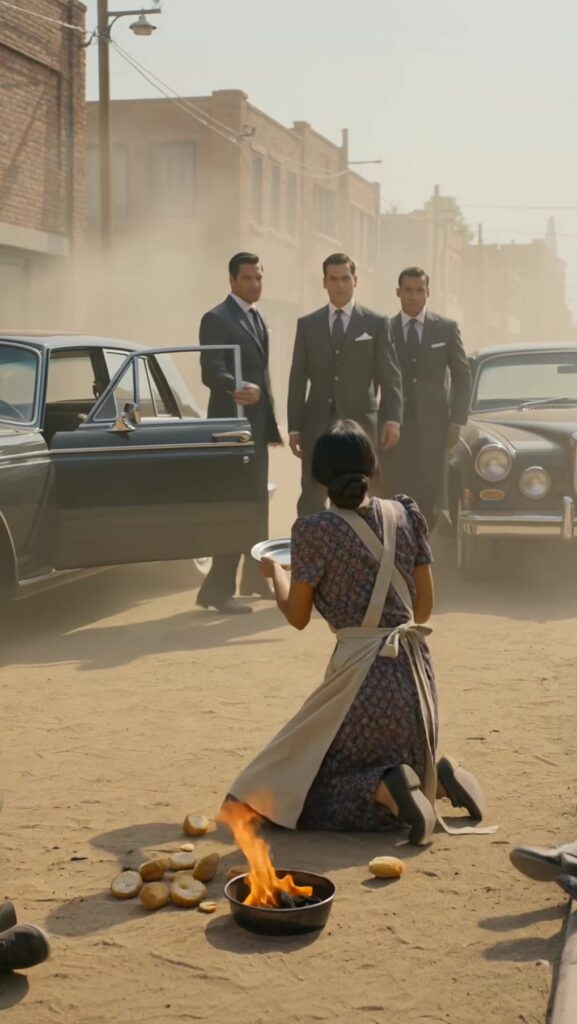
The air changed before the sound arrived. Even the sparrows on the telephone wire went still. Then engines tore through the narrow street—too smooth, too deep, the growl of money—and two black vintage cars rolled into the dust like predators on polished paws. They stopped hard enough that grit leapt from the ground and hung in the sunlight.
Every head turned. In Mara’s chest, something clenched in a reflex older than reason. Poor people did not wonder why rich cars came; they wondered which form the harm would take.
Three men stepped out. Dark suits, clean shoes, hair cut with precision. They moved shoulder to shoulder, their pace unhurried, their faces set in a calm that felt sharper than anger. The street seemed to shrink around them.
The boys froze mid-bite. Dax’s hand drifted instinctively toward Sorrel’s shoulder as if he could shelter him with a touch. Len’s eyes found the quickest escape route, then abandoned it as useless; the men had already claimed the space.
Mara rose with the empty plate still in her hands. Her fingers tightened around the rim until her knuckles whitened. She forced her voice to be steady. “Can I help you?”
The man in the center stopped close enough that she could see the faint silver of a scar near his jaw. His gaze dropped to the plate, then lifted to her face with a careful slowness, as though he didn’t trust what he saw.
For a moment he couldn’t speak. The silence stretched and grew heavy with the boys’ fear, with Mara’s pounding pulse, with the hiss of the little fire.
Then the man said, so quietly it seemed meant for only her, “You already did.”
Mara frowned. Confusion dulled the edge of her fear but didn’t remove it. “I don’t know you,” she replied. Her voice wavered at the end. “If you’re looking for—there’s nothing here.”
His composure cracked in a single blink. “There was a day,” he said, and his voice broke on the words like a branch snapping under snow. “A day when this street looked worse than this. When we were smaller than your stove and meaner than our own bones. You knelt by a fire like that one and you fed us.”
Mara’s throat tightened. Memory arrived as scent before image—smoke and stale flour, the bitterness of burnt crust. She had fed many children. She had fed men who later stole from her. She had fed strangers and called it survival’s smallest religion. “I’ve… I’ve fed boys before,” she whispered. “I’m sorry. I don’t—”
The men on either side stepped past her and opened the trunk of the nearest car. The lid rose like a curtain in a theater, and for an instant Mara forgot to breathe.
Sacks of rice and beans were stacked neatly. Crates of canned meat and dried fruit, bundles of blankets, jars of honey. Gift boxes tied with dark ribbon. Wooden cases stamped with foreign lettering. And beneath them, wrapped in plain brown paper as if shameful, were stacks of money—more than Mara had seen in her entire life, so much it looked unreal.
Sorrel made a small sound, part gasp and part sob. Dax’s jaw dropped. Len stared as if the world had just revealed a hidden doorway.
Mara took one step back. The plate in her hands tilted and caught the light. “This isn’t for me,” she said, instantly. “You’ve got the wrong—”
“It’s for you,” the man in the center insisted. His eyes shone, and it startled Mara to see grief on such a polished face. “And for them. And for anyone you choose.”
She looked at him again, at the shape of his eyes, the set of his mouth. Something in her chest shifted, not quite recognition, more like the ache of a door she had nailed shut.
The youngest man—barely past thirty, with hands that looked like they had once been rough—reached inside his coat. He drew out a folded piece of cloth, yellowed with age, and held it up as carefully as if it were a relic. His fingers trembled.
It was a scrap of fabric, worn thin, with a faded pattern of blue flowers that Mara knew like her own skin. She used to tear old dresses into squares, wash them, and wrap bread so it stayed soft through the night.
“Do you remember,” the youngest man whispered, and the whisper cut through the street like a blade, “what you wrapped the bread in that day?”
Mara’s knees weakened. The plate slipped a fraction in her grasp and she caught it automatically, even as the world tilted. She remembered a certain morning—rain making mud of the gutters, her own stomach burning, three little thieves caught behind the bakery with eyes hard from hunger. She remembered breaking her last loaf and thinking, I will not let them learn cruelty from starvation.
She remembered tearing her sister’s dress into pieces while her sister still lived upstairs and still sang sometimes. Blue flowers, cheap fabric, but clean.
Her gaze returned to the man in the center. Past the suit, past the scar, she saw a boy with hollow cheeks staring at her hands. She saw him swallowing tears while pretending he didn’t care. She saw him press that cloth into his pocket like it was proof that someone, somewhere, had once chosen kindness over fear.
“We kept it,” the center man said, voice thick now. “All these years. We told ourselves if we ever got out, if we ever became the kind of men who could drive back instead of run… we would come back for you. Not to repay you. We can’t.”
He swallowed hard. “But to make sure you never have to lie about being full again.”
Mara stared at the cloth, and something in her chest broke open. It wasn’t only relief. It was grief for every night she had listened to her own stomach and wondered if kindness was just another way to die. It was anger at a world that made a woman choose between truth and hope. It was shame, too, for the parts of her that had stopped believing strangers could return as anything but trouble.
She drew in a breath that tasted like smoke and dust and possibility. The boys were watching her with a reverence that frightened her more than the cars had.
“Names,” Mara managed, because she needed something solid. “Tell me your names.”
The center man placed a hand over his heart. “Tomas,” he said. “This is Eli. And this is Rook.”
“And you were—” Mara began, but her voice collapsed.
Tomas nodded once, slow. “We were hungry,” he said. “We were worse than hungry.” His eyes flicked to the boys on the curb. “We were them.”
Mara looked at the sacks of food, the money, the blankets, then at Sorrel’s thin wrists, at Dax’s bruised face, at Len’s wary eyes. She tightened her grip on the empty plate until it steadied her. Somewhere behind her ribs, hunger still lived, but it no longer had the final word.
“Then,” she whispered, and her smile this time was not a wall but a doorway, “help me feed them. Not just today. Help me feed this street.”
Tomas’s eyes filled. Eli unfolded the cloth and held it out like a promise returned. Rook turned toward the open trunk and began lifting sacks down with reverent care, as if each one weighed less than the moment itself.
The little fire snapped. Dust floated in the sunlight. And Mara, who had learned to survive on crumbs and lies, stood at the center of a street that had finally decided to remember.