The bell above the street café door did that cheery ding that always sounded like a lie. It was a Tuesday, which meant the lunch crowd was thin and the air smelled like roasted beans and wet pavement. I was halfway through an iced americano, pretending I wasn’t eavesdropping on strangers, when the whole place got cut in two by a sharp voice.
“You think I’m stupid?”
Everyone looked up at once, like we were all connected by the same string.
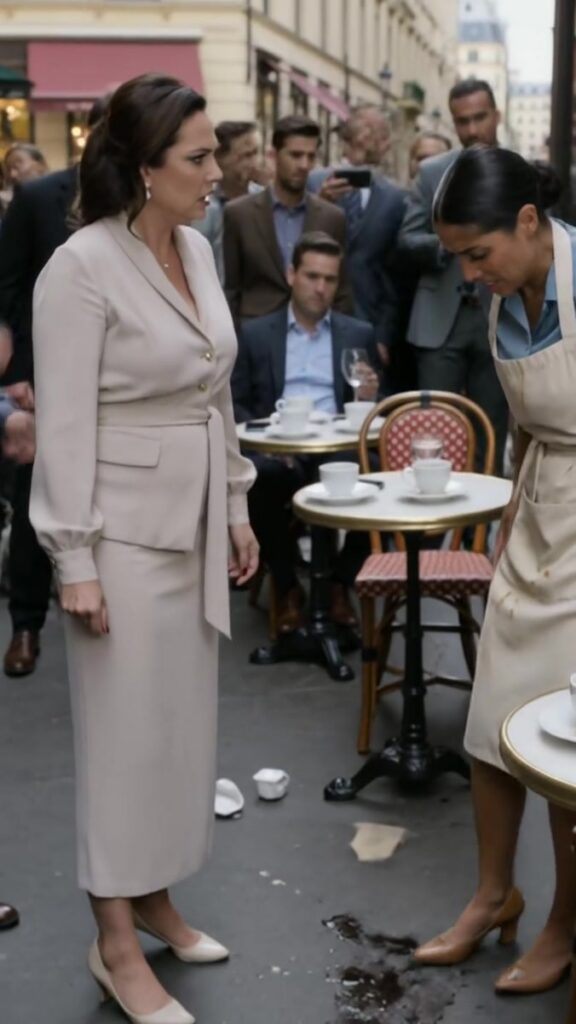
A woman in a cream coat stood by the register, the kind of coat that looked allergic to public transportation. Her hair was glossy and immovable, her heels made tiny angry taps on the tile. Across from her was a waitress—young, exhausted-looking, with her hair tied up in a messy bun that had surrendered to the shift hours ago.
“Ma’am,” the waitress said, trying for calm, “I’m telling you, I didn’t charge you twice. It’s a pending hold. It’ll drop off—”
“Don’t talk to me like I’m some gullible tourist.” The woman shoved her phone toward the girl’s face. “I have receipts.”
The manager wasn’t anywhere. The barista behind the counter looked like he’d rather set himself on fire than intervene. And the rest of us did what we always do: we watched.
The waitress’s hands trembled, but she kept them at her sides. “I can get the manager,” she offered.
That should’ve ended it. That’s the civilized exit ramp. But the rich woman wasn’t here for an exit ramp. She was here for a spectacle.
She snatched a full cup of coffee from a nearby tray—someone’s order, probably—and without even hesitating, flung it.
The coffee hit the waitress like a slap you could smell. A brown wave over her hairline, her cheek, her collarbone. She cried out and stumbled back into a table, knocking a stack of saucers into a clattering mess. Hot liquid dripped down her apron and onto the floor, steaming for a second before the air swallowed it.
The café went quiet in the way a room goes quiet when everyone’s brain is trying to decide if this is real or some kind of performance. Then the phones came out. Not all at once, but enough. Screens rose like little shields.
“That’s what happens when you lie to me!” the woman shouted, breathing hard like she’d just won something.
The waitress just stood there, stunned and blinking, her mouth open like she’d forgotten how to close it. Her face was red—not only from the heat. She looked humiliated down to the bones. She clutched the front of her apron with both hands, not the way someone does when they’re cold, but like she was protecting something pressed against her chest.
And then something slid out from the fold of fabric and dropped onto the tile with a soft, stupid little paper sound.
An envelope. Sealed. Off-white, thick stock. It looked out of place in this café like a swan in a bathtub.
It landed near my table, and before I could decide whether to pick it up, the guy at the next table—late thirties, office-casual, kind eyes—leaned down and grabbed it. He turned it over once, twice, reading the name on the front.
The waitress saw it and made a noise that wasn’t quite a word. “No,” she whispered. Then louder: “Please don’t. Please don’t open that.”
The rich woman’s mouth curled like she’d been handed a dessert menu. “Oh, now she’s scared,” she said, too loudly, for the benefit of every phone camera. “Go on. Read it. Let everyone hear her little secret.”
At a table behind the rich woman sat an elegant man—tailored suit, silver watch, the kind of calm face that had practiced not reacting. I’d noticed him earlier because he looked like he didn’t belong in this neighborhood café, like he’d taken a wrong turn out of a boardroom. He’d been staring into his espresso as if it had insulted him.
Now his head lifted. Slowly. Like he’d felt the envelope’s presence before he even saw it.
The office-casual guy hesitated. You could see the debate flicker across his face: privacy versus pressure, decency versus the pull of a room full of watchers. In the end, the woman’s smugness tipped him over. He slid a finger under the flap and opened it.
The waitress looked like she might faint. She reached out, then stopped herself, like she knew grabbing it would look like guilt. Tears gathered anyway, rolling down through coffee streaks.
The guy unfolded the letter and began to read, his lips moving silently at first. He got through maybe three lines before his expression changed. His brows knit. His eyes widened. It wasn’t shock like gossip shock; it was shock like the ground had moved.
He looked up, not at the waitress, not at the woman still standing tall in her expensive coat, but past her—toward the elegant man in the suit.
“Sir,” the guy said, voice suddenly careful, “are you… Daniel Hargrove?”
The elegant man went pale. Not dramatic pale—more like the color quietly drained out of him. He stood up so slowly the chair barely scraped.
The rich woman whipped around. “Excuse me? Daniel?” She sounded annoyed to be interrupted, like the main character had wandered off script.
The guy swallowed. “This wasn’t written to expose her,” he said, holding the letter like it weighed something. “It’s… it’s a confession.”
The waitress made a broken sound and covered her face with both hands.
“A confession about what?” the rich woman demanded. She took a step toward the letter, reaching, but the guy pulled it slightly back without meaning to, like a reflex.
The elegant man’s voice came out low. “Where did you get that?” he asked, not to the guy—directly to the waitress.
She shook her head hard, tears flying. “I didn’t want anyone to see it,” she managed. “I didn’t know what to do with it. It came in the mail at the café. No return address. I… I kept it because it had your name. I thought—”
“Thought what?” the rich woman snapped, turning to the waitress like a predator remembering the point of the hunt. “Thought you could use it to get money? Thought you could blackmail him?”
The guy cleared his throat, uncomfortable. “Ma’am,” he said, “the letter is signed.” He paused, eyes flicking over the ink again like he couldn’t believe it. “It says, ‘—Evelyn.’”
That name hit the room like another splash of coffee, except cold. The elegant man’s eyes shut for a moment, like he’d been punched in the chest.
The rich woman’s face tightened. “Don’t be ridiculous,” she said. “Evelyn is dead.”
“I know,” the guy replied, and his voice dropped to a near whisper that somehow everyone still heard. “That’s why I’m shaking. Because this—this was written by your dead wife.”
All the phones stayed up, but the recording suddenly felt wrong, like we’d all trespassed into something sacred by accident.
Daniel—if that was him—reached for the letter with a hand that didn’t quite stop trembling. The rich woman grabbed his arm. “Daniel, don’t. This is obviously some scam. She’s trying to humiliate us—”
He didn’t even look at her. His attention was locked on the folded paper. When he spoke, it wasn’t to the room. It was to the air, like he was talking to someone who wasn’t there anymore.
“Evelyn wrote me letters all the time,” he said quietly. “Even when we were in the same house. She said it helped her say things without being interrupted.”
The waitress wiped her face with the back of her hand, leaving a streak of coffee behind. “I didn’t open it,” she said. “I swear I didn’t. I just… I kept thinking if I gave it to you, it would make everything explode. And if I threw it away… it felt like killing her twice.”
Daniel unfolded the letter again and read aloud, voice unsteady but clear enough that the room leaned in despite itself.
“‘If you’re reading this, it means I finally did the thing I was too afraid to do while I was alive,’” he read. “‘I’m sorry I let everyone believe the clean version of my story. The truth is, I chose the wrong people to trust. And I dragged you into my silence.’”
The rich woman’s jaw clenched. “Stop reading,” she hissed. “Daniel, stop. This is private.”
Daniel didn’t stop.
“‘I need you to know I wasn’t sick the way they told you,’” he continued, and his throat tightened on the words. “‘I was tired. I was cornered. I signed papers I shouldn’t have signed. I let myself be convinced it would all be easier if I disappeared.’”
A murmur rippled through the café. Someone behind me whispered, “Oh my god.”
Daniel’s eyes glistened. He blinked hard and kept reading, like if he paused he’d never start again.
“‘There’s a woman named Mara at the street café on Juniper,’” he read, and the waitress flinched like she’d been hit again. “‘She saw more than she was supposed to see the night you came looking for me. She’s not your enemy. She’s the only person who tried to ask me if I was okay.’”
Mara. The waitress. Suddenly she wasn’t just “the girl” anymore. She was a person named in a dead woman’s handwriting.
The rich woman made a small, strangled laugh. “This is insane,” she said. “Daniel, tell them. Tell them it’s fake.”
But Daniel’s stare had gone distant, fixed on something only he could see. “This is her handwriting,” he murmured.
He read the last lines, voice breaking now. “‘Please don’t punish Mara for being in the wrong place at the wrong time. I already did. I let them threaten her job so she wouldn’t speak up. I let them turn her into the easiest target. I’m sorry. I’m sorry. I’m sorry.’”
The café didn’t just freeze. It softened. Like the whole room exhaled at once.
Mara slid down to sit on the floor, not caring about the coffee puddles, and cried like she’d been holding her breath for months. Daniel knelt beside her without thinking, setting the letter carefully on the table like it was fragile glass.
The rich woman stood there with her hands half-raised, caught between anger and disbelief. “You’re telling me,” she said slowly, “that she wrote this… and sent it here?”
Daniel looked up at her, and the look on his face wasn’t rage. It was something worse: clarity.
“I’m telling you,” he said, “that we’ve been humiliating the wrong person.”
No one cheered. No one clapped. That would’ve been too easy. People lowered their phones one by one, suddenly ashamed of their own curiosity.
The manager finally appeared, flustered and apologizing, but the apology floated uselessly in the air. Daniel took off his suit jacket and gently draped it over Mara’s shoulders, covering the stained apron she’d been clutching like armor.
“You’re coming with me,” he told her, not in a commanding way, but in the way someone speaks when they’ve decided to do the right thing even if it’s inconvenient. “We’re going to the police. And to my attorney. And we’re going to find out exactly what Evelyn meant.”
Mara looked up through tears. “I didn’t want to ruin anyone,” she whispered.
Daniel shook his head. “You didn’t,” he said. “They did. And I let them.”
The rich woman’s face hardened. “Daniel,” she warned, like his name was a leash.
He stood, letter in hand, and for the first time he looked at her like he was seeing her fully. “You threw coffee at a stranger because you felt embarrassed about a bank notification,” he said, voice flat. “Whatever you think you’re protecting, it isn’t you.”
He offered Mara his hand. She took it, standing shakily. The café watched them walk out together—one in a ruined uniform, one in a suit, both looking like they’d just stepped into a different life.
After the door closed, the rich woman remained in the center of the room, surrounded by spilled coffee and broken cups and silence. No one looked at her with fear anymore. They looked at her like she was small.
And that, more than any video, seemed to be the thing she couldn’t stand.
I sat back down, my americano melting, and couldn’t stop thinking about the envelope—how a piece of paper could fall out of an apron and tip a whole room from cruelty into truth.
Mara was meant to be humiliated. That had been the plan.
But the letter had other ideas.