Everybody on Maple Street knew the little corner outside Benny’s Liquor as the place where bad ideas went to stretch their legs. People bought scratch-offs there. People fought there. People promised they were done with all that, then showed up the next day with the same look on their face and a new lie ready to go.
So when I saw a kid with a bicycle and a cardboard sign tied to the handlebars, my first thought wasn’t charity. It was: someone’s running a hustle.
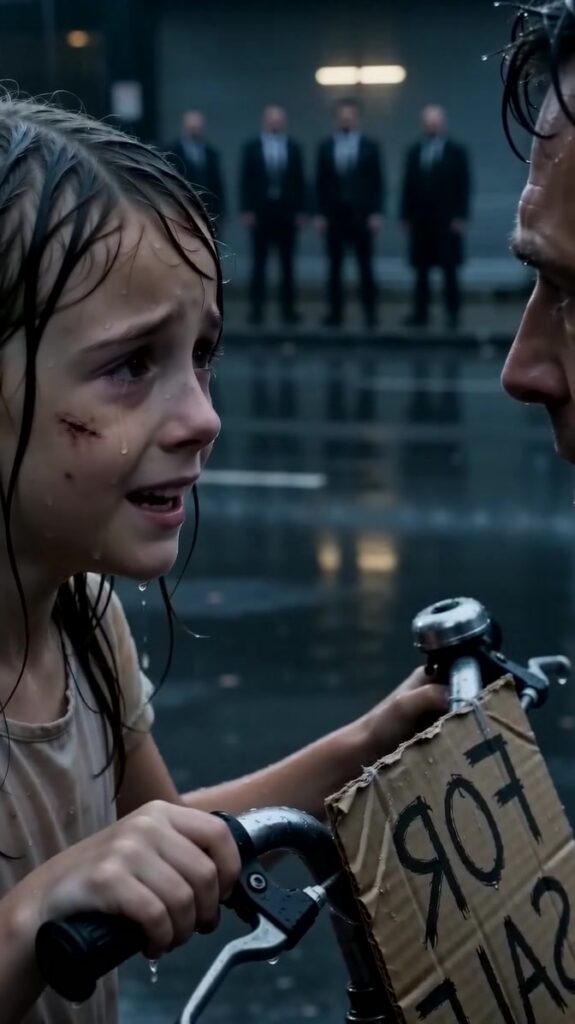
It was raining hard enough to make the streetlights look smeared. The kid—maybe twelve, maybe older in the way kids get older when life is rude—stood half under the awning, half in the open. Her hoodie was too thin for that kind of wet. The sign said the simple thing people say when they want money without explaining: FOR SALE.
But she wasn’t holding the bike like a person trying to sell a bike. She had both hands wrapped around the grips like the bicycle might float away if she blinked. She kept shifting her body so the frame stayed between her and the sidewalk behind her, as if she was guarding it. Or as if the bike was guarding her.
I’d stopped at Benny’s because I’d forgotten I was out of coffee and my apartment suddenly felt like a place where time had stopped. I was on my way to grab the cheapest bag I could find and pretend it tasted fine. A normal errand. The kind that makes you believe you’re a decent adult.
Then I noticed the men.
Four of them, hanging by the side of the shop like they’d been planted there and forgotten. Not buying anything. Not talking much. Just watching the kid in that slow, patient way some people watch a clock when they’ve got nothing else to do. One of them had a ball cap pulled low and a jacket that looked like it had been slept in. Another kept his hands in his pockets like he didn’t want to accidentally look involved.
The kid glanced their way, just once, and the look on her face was quick and controlled, like she’d practiced not showing panic. She turned back to the street immediately, eyes scanning the passing cars and pedestrians like she was counting down seconds.
I told myself I shouldn’t get involved. I told myself she probably had an older brother around. I told myself if she needed help, she’d ask somebody official.
And then I did the thing that keeps happening to me lately: I ignored all my good advice and walked over anyway.
Up close she smelled like wet pavement and that sour old fabric smell you get when clothes never get fully dry. There was a scratch on her cheek, red and new. Her hands were filthy, as if she’d been digging through something. She kept her chin tucked, but her eyes lifted just enough to see who I was.
“How much?” I asked, nodding at the bike. It was a decent-looking old cruiser, faded teal, chain a little rusty but not dead. Somebody had once loved it enough to keep the tires inflated.
Her mouth opened, closed again. She tried to look businesslike and failed. “Would you… buy my bike?” she said, like the words didn’t fit together.
I crouched to her level without thinking. The second I did, her shoulders flinched. Not a dramatic flinch—just a tiny recoil like her body had learned that grown-ups leaning in meant something unpleasant.
“Hey,” I said quickly, softening my voice. “It’s okay. I’m not… I’m just asking. Are you out here by yourself?”
She stared at the sidewalk, lips pressed together. Her lashes were wet from rain and maybe something else. “I’m not supposed to talk,” she muttered.
Behind us, one of the men laughed at something that hadn’t been said. It was a sharp sound, like snapping a twig.
The kid’s fingers tightened on the grips until her knuckles went pale.
“Who’s ‘not supposed’?” I asked.
She tried to answer and couldn’t. You could see the words jam in her throat. Finally she whispered, “My mom… she hasn’t eaten. Like, for real. Days. I tried stuff. I tried asking. I tried…” She swallowed hard. “This is all I have left.”
It wasn’t the kind of line kids come up with when they’re hustling. It was too raw, too embarrassed. And it landed in my chest like a weight.
“Okay,” I said. “Okay. How much do you need?”
Her eyes flicked toward the men again. One of them shifted his stance and took a casual step closer, like a dog pretending it’s not stalking.
I followed her glance, and the air suddenly felt colder than the rain. “Those guys with you?” I asked quietly.
She didn’t nod. She didn’t shake her head. She just looked like she’d been asked to choose between two kinds of danger.
I stood up just a little, enough to see over the bike. That’s when I noticed something under the seat: a strip of white cloth, threaded tight, knotted in an ugly hurry. Not a ribbon. Not decoration. It looked like something used to bind.
The kid saw me see it. Her expression changed fast—like shame got yanked out and replaced with something sharper. Fear, clean and bright.
She leaned in so close I could barely hear her over the rain. “Please,” she whispered. “Just buy it. Before they come closer.”
“Buy the bike,” I repeated, playing dumb on purpose.
Her breath hitched. “Buy me time,” she corrected, almost silently. “If you’re talking to me, they wait. They said… if I don’t bring money, I don’t get to go back.”
My mouth went dry. I glanced at the men again and forced my face to stay boring. My phone was in my coat pocket. I didn’t want to reach for it and turn this into a scene that got the kid punished.
“Alright,” I said, louder. Casual. “I can do that. But I don’t carry much cash. Let’s do something else. You like hot chocolate?”
Her eyes widened, confused. “What?”
“Hot chocolate,” I repeated, smiling like we were just two normal people in the rain. “My treat. We can talk inside. You can tell me about the bike, and I’ll decide.”
The men started moving before she could answer, like they were on a string. The one in the cap angled toward us.
I stepped to the side so my body blocked the kid, and I called out with a friendly wave. “Hey!” I said, like we were neighbors. “This your daughter? She’s got a nice bike.”
They froze for half a beat, caught between pretending they didn’t know her and claiming her. That hesitation was everything.
The kid’s hand slid down to the cloth under the seat. Not to pull it out—just to touch it, like it reminded her she was trapped. Her eyes met mine for a second. In that look I saw a kid who had tried every safe option and run out.
I took a risk. I bent down again and, in one smooth motion, slipped my business card from my wallet and tucked it into her sleeve. It had my name and the number for the small nonprofit I worked with, the one that did housing referrals and emergency help. I’d always felt a little silly carrying the card. Like I was pretending I could fix things.
“Here’s the deal,” I said, loud enough for the men to hear. “I’ll give you two hundred for the bike. But I need a receipt. My boss is weird about stuff like that.” I laughed, like the concept was ridiculous. “So we’re going to step inside where it’s dry, and you’re going to write your name and I’m going to write mine. Okay?”
The men were close now. I could smell cigarette smoke and damp wool. The one with the ball cap looked at my coat, my shoes, my face, measuring how much trouble I could become.
I held his gaze and smiled like I had nothing to hide and everything to lose, which was usually how authority looked in this neighborhood. “You guys want anything?” I asked, friendly, dumb. “Benny’s got that terrible coffee.”
He didn’t answer. His eyes slid to the kid, then to the bike, then back to me. His jaw worked once. He decided, in that moment, whether I was a threat.
And then a car rolled up to the curb—an actual police cruiser, slow and bored, making its usual loop. Maybe it was luck. Maybe it was the universe throwing a single coin into the fountain.
The men backed off like they’d never been there. One of them lifted his hands in a fake stretch and drifted away. Another turned toward the alley and disappeared into the rain.
The kid didn’t move. She just stood there shaking, not from cold but from the sudden drop of pressure. Her fingers still clung to the grips like the bike was a life raft.
“Come on,” I said quietly, lowering my voice again. “We’re going inside. You’re going to drink something warm. And then we’re going to call someone who can help your mom and get you somewhere safe.”
She looked at the retreating shapes of the men, then at the police car, then at my face. “Why?” she asked, like it was a trick question.
I didn’t give her a heroic answer. I didn’t say anything about angels or fate. I just shrugged, because casual was the only thing that didn’t scare her.
“Because I was going to buy coffee anyway,” I said. “And because you’re holding that bike like it’s the last good thing you remember.”
Her grip finally loosened, just a fraction. She swallowed, nodding once as if agreeing to a deal she didn’t fully trust.
As we walked toward the door, the cardboard sign bumped softly against the handlebars, tapping out a small rhythm in the rain.
FOR SALE, it said.
But now I knew the truth: she hadn’t been trying to sell a bicycle. She’d been trying to find out if kindness was still a real thing—before the street decided it wasn’t.