The alley felt wrong the way a room feels wrong after a fight—when the air still holds words that were never forgiven. On Maple Street, Saturday market noise should have spilled everywhere: the fruit seller arguing with a customer, the clang of baskets, the teasing chorus from the buskers near the fountain. But the narrow cut between the bakery and the shuttered tailor shop swallowed sound as if the city itself refused to listen.
Lena tried to ignore it. She kept her son’s small hand tucked in hers, guiding him around puddles and broken cobblestone. The grocery bags tugged at her wrists. Flour dust clung to the bakery wall like pale ash, and a torn poster flapped and smacked weakly at the bricks: MISSING—JULIAN MARRETT—AGE 7. The paper had faded under sun and rain, the face blurred into soft features that could have belonged to any child.
Except Lena knew that face. She had memorized it the way you memorize a prayer you’re afraid to say out loud.
“Mom,” Eli said, tugging, voice soft with the careful politeness he used when he didn’t want to be told no. “Look.”
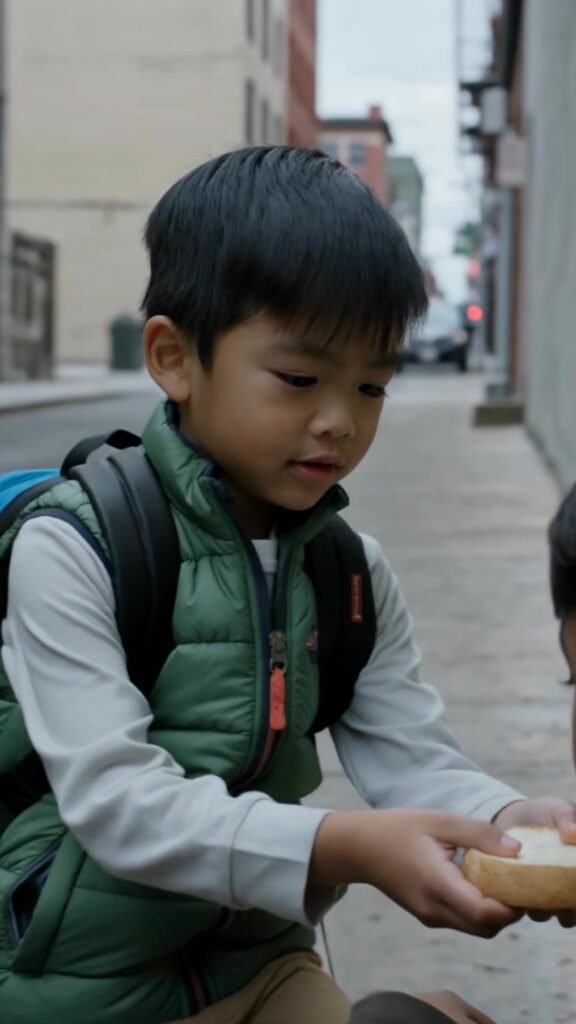
He had torn off a piece of crusty bread from the loaf she’d bought. He held it with both hands, solemn as if he carried something fragile. Ahead, in the mouth of the alley, a shape lay slumped against the bricks—too small to be an adult, too still to be merely resting.
“We shouldn’t,” Lena began. She heard how thin her voice sounded. She told herself she was being sensible. The alley had a history: fights, needles, a man once found there with his face turned to the wall. “Eli, come.”
But Eli’s heart moved faster than caution. He stepped closer, the bread out like an offering, his sneakers scuffing grit. “Are you hungry?” he asked the figure.
No answer came—only the dry hush of the alley. The market noise behind them seemed to hit an invisible barrier and die. Even the bakery’s sweet smell faded, replaced by damp stone and something metallic.
Lena’s stomach tightened. She could not shake the sensation that the alley was watching them. She took a step forward, then stopped herself as if the air had thickened. The figure’s face was turned away, hair matted in a dark halo.
Then a voice cut through, low and sharp. Not Eli’s. Not hers.
“Stop.”
It wasn’t shouted. It didn’t need to be. It dropped into the space between them like a weight.
Lena’s whole body reacted before her mind. She grabbed Eli by the back of his jacket and yanked him toward her, hard enough that he stumbled. His hands jerked open. The bread fell and landed on the stones between them, exactly on the seam where the sunlight stopped and the shadow began.
It looked like a line drawn on the ground. A boundary. A dare.
Lena held Eli against her thigh, fingers digging through fabric. The silence returned, thicker now, as if the alley resented being disturbed. She could hear her own pulse thudding in her ears.
Seconds stretched. One. Two. Three.
The child-shaped figure moved.
Slowly—too slowly, like a puppet remembering its strings—it lifted its head. The face that turned toward them was smeared with dirt, lips cracked, cheeks hollow. Eyes too large in a too-small face. A bruise purpled one temple. Another shadow of bruising ringed the wrist that clutched its own knee.
But it was the eyes that made Lena’s breath vanish.
They were gray-green, like river water in winter. A color she had not seen in years except in photographs. They locked onto hers with the aching certainty of recognition.
Lena’s hands went cold. The grocery bags slipped, forgotten, bumping her shins. Something rose inside her chest, not hope—hope was too fragile—something more violent, like an animal pounding against its cage.
The child’s lips parted, and the sound that came out was raw, scraped from a throat that had been used for silence.
“Mom…?”
The word hit Lena like a shove. She staggered back a half-step without moving her feet, as if the stones beneath her had tilted.
She had imagined this moment in a thousand different ways: Julian returning at the door with police behind him, Julian calling her name from a playground, Julian older and angry. She had dreamed of it so often that she had trained herself not to believe any of it. Yet here it was—this alley, this wrongness, this voice she knew better than her own.
“No,” she whispered, because her mind could not hold the shape of yes. Eli clung to her coat, confused, eyes darting between her and the stranger-child.
The boy in the shadows swallowed. His gaze did not leave Lena’s face. “You… you have the scar,” he said, as if proving something to himself. “Here.” He lifted a trembling hand and traced the air near his left eyebrow, then pointed to Lena’s chin.
Lena’s breath hitched. The scar on her chin was small, pale, a crescent from a bicycle crash when she was ten. Only Julian would remember her telling him the story while he sat on the counter kicking his feet, demanding she repeat how she’d tried to impress a girl and failed.
Her knees weakened. She pressed a hand to the wall to steady herself. “Julian,” she said, and the name broke open in her mouth, spilling years of restraint.
The boy’s face crumpled and hardened at once, like paper crumpled then smoothed. “I tried,” he rasped. “I tried to come back. I didn’t know where—” He winced, as if the sentence hurt. He glanced down at the bread lying between shadow and sun. “They said you moved. They said you didn’t want me.”
“Who said that?” Lena’s voice rose on the last word. Her vision tunneled. She saw, overlaid on this bruised face, the seven-year-old she had lost: freckles across the nose, missing front tooth, the way he’d laughed with his entire body. She remembered the day he vanished, the carnival crowds, the moment her hand grasped empty air.
Eli whispered, “Mom, who is he?”
Lena didn’t answer because she could not breathe enough for two lives at once. She kept her eyes on Julian—if she looked away, the alley might steal him back.
Julian’s gaze flicked to Eli. Pain sharpened his expression. “Is that… is that your—” He couldn’t finish. He stared at Eli like the sight physically wounded him.
Lena felt guilt flare, bright and ugly. She had learned to live again. She had dared to have another child. She had done what people told her she must do—move forward—while something inside her stayed nailed to the past.
“He’s your brother,” Lena said hoarsely.
Eli’s eyes widened, not with joy but with a child’s instinctive fear of the impossible. He tightened his grip on Lena’s coat.
Julian swallowed hard. His hands curled into fists, then opened. “I didn’t want to come here,” he whispered. “I didn’t. But I saw you at the market last week. I thought I was… seeing things.” He blinked rapidly, tears not quite forming. “I followed you today. I didn’t know how to say it. I thought if I said it, you’d look at me like—like I was a ghost.”
Lena forced her legs to move. One step, then another, until she reached the edge of shadow. The bread lay at her feet like a sacrificed peace offering. She stopped with her toes almost touching it, as if the line truly mattered.
Julian flinched, the instinctive recoil of someone used to hands that didn’t comfort.
Lena’s throat tightened. She remembered every poster, every police report, every stranger’s pity. She remembered the letter that came a year after his disappearance—no return address, just a clipped note: STOP LOOKING. She had shown it to the police; they had shrugged. She had read it until the paper softened at the folds, until the ink felt like it was embedded under her skin.
“Julian,” she said again, slower, as if her voice could build a bridge. “Baby, come into the light.”
He looked at the strip of sun as if it were dangerous. “I don’t… I don’t know if I’m allowed,” he murmured.
Allowed. The word sliced through her. She saw, in her mind, doors closing, hands pulling him back, rules enforced. The alley’s silence suddenly felt like the pause before an explosion.
“You’re allowed,” Lena said, voice shaking with fury and love. “You are mine. You always were.”
She nudged the bread aside with her shoe, breaking the boundary, and stepped fully into shadow. Her heart hammered so hard she thought it might bruise her ribs. She sank to her knees in the grit, ignoring the wetness soaking into her jeans, and opened her arms.
Julian stared at her outstretched hands as if they were a trap. Then his face twisted, and he made a sound halfway between a sob and a laugh. He lunged forward, not gracefully, not like a reunion in a movie, but with the desperate momentum of someone falling.
Lena caught him. He was lighter than he should have been, all bone and trembling heat. He smelled of cold nights and old sweat and something medicinal. His arms wrapped around her with fierce, shaking strength.
She pressed her face into his hair. “I’m here,” she whispered into him, over and over. “I’m here. I’m here.”
Eli hovered, uncertain. Lena reached one arm back and pulled him closer too, anchoring him against her side. “This is your brother,” she said, voice thick. “He came back.”
Eli looked down at Julian’s hunched shoulders, the bruises, the way his body seemed braced for punishment even in embrace. Slowly, Eli extended his small hand and touched Julian’s sleeve, then held on.
From somewhere deeper in the alley, there came a faint scrape—a sound like a shoe against stone. Lena’s head snapped up.
In the far darkness, beyond where the bricks narrowed, a shape shifted—tall, lingering. A presence more felt than seen. The alley’s wrongness concentrated there, a gravity that wanted to pull Julian away.
Lena tightened her hold. She rose, Julian clinging to her like he might dissolve. “We’re leaving,” she said, not to Julian, not to Eli, but to the darkness itself.
The figure did not step forward. It did not need to. The air held a warning, the same kind as the voice that had said stop. Lena’s skin prickled. Her mind raced through possibilities—police, neighbors, anyone. She could not fight a shadow with bare hands.
She kept her body between Julian and the mouth of the alley, guiding them backward toward sunlight, toward noise, toward witnesses. Eli stayed pressed against her. Julian’s breath came in ragged bursts.
As they crossed into the market’s bright chaos, sound rushed back in: laughter, bargaining, a busker’s guitar. It was almost obscene how normal it all was.
Lena did not look back until they were several steps away. The alley lay behind them, empty at first glance—just bricks and damp and a discarded crust of bread kicked aside.
Then, at the edge of shadow, she saw it: a handprint smeared dark on the wall, as if someone had pressed a palm there and left something behind. It looked less like dirt and more like a bruise on the building itself.
Julian shuddered. “Don’t,” he whispered, reading her glance. “Don’t look at it.”
Lena forced her eyes forward. Her arms ached from holding him, but she did not loosen. She had spent years searching for him in every street and face and dream. Now that she had him, she understood the true shape of the battle.
Finding Julian had been only the first step.
Keeping him would require crossing every boundary anyone tried to draw between them—no matter who waited in the dark to say stop.
She lifted her chin and walked into the crowd, carrying both her sons as if the weight of them was the only thing keeping her anchored to the world.