The bakery smelled of warm bread, vanilla cream, and fresh strawberries. It was the kind of smell that grabbed you by the collar and dragged you back to every birthday you ever had, even the ones you pretended you didn’t care about. Warm air puffed out each time the door opened, and the bell over it did a cheerful little jingle like it had never heard bad news in its life.
Inside, everything glowed. Cakes sat in glass cases under honey-colored lights, each one so glossy it looked unreal, like someone had painted sugar into the shape of joy. Mothers leaned in with serious faces, comparing fillings as if they were negotiating peace treaties. Kids bounced on their toes, pointing at star cookies and sprinkle-dusted cupcakes, leaving little foggy circles of breath on the display.
Right in the middle of all that brightness stood an old woman in a sun-faded coat that had seen too many winters. Her hair was tucked under a knit cap, and her shoes were scuffed at the toes. She held the hand of a tiny girl who wore a sweatshirt with glittery unicorns and sneakers that blinked when she walked. The girl’s eyes tracked every cake like she was watching fireworks.
She stopped in front of a pink cake topped with white buttercream roses, the kind that looked soft enough to be real petals. She tilted her head and whispered, like she was afraid the cake might hear her. “Grandma… do princesses get cakes like this when they turn six?”
The old woman’s face changed so fast it startled even her. Her mouth trembled like she’d almost smiled and then remembered she wasn’t allowed. Her eyes shined, and for a second she looked as if she might say something brave, something sweet, something that would make the girl’s chest lift with hope.
But a sharp voice cut across the bakery before she could find the words. “Hey. Don’t camp out in front of the glass.” A young employee in a stiff apron snapped her gum and flicked her eyes over them, taking in the coat, the shoes, the nervous posture. “If you’re not buying, you’re blocking people.”
The air didn’t just get quiet; it rearranged. Conversations slowed. Someone stopped stirring their coffee at the little tasting bar. A dad at the register paused mid-count, coins resting on his palm like he’d forgotten what numbers were. The little girl flinched and slid behind her grandmother’s skirt, fingers clinging tight like the fabric was a life raft.
The old woman lowered her head, polite out of habit more than choice. “She was only looking,” she said, voice soft like worn cotton. The employee huffed a laugh. “Then look quicker and move. This isn’t a museum.” The words hit the room with a blunt thud, the kind that leaves bruises you can’t see.
The old woman’s hand started to shake. Not fury—something older, something that had been practiced. The kind of trembling you get when you’ve been made small so many times your body does it automatically. The girl peeked out, cheeks hot, and stared at her sneakers like they had personally offended someone.
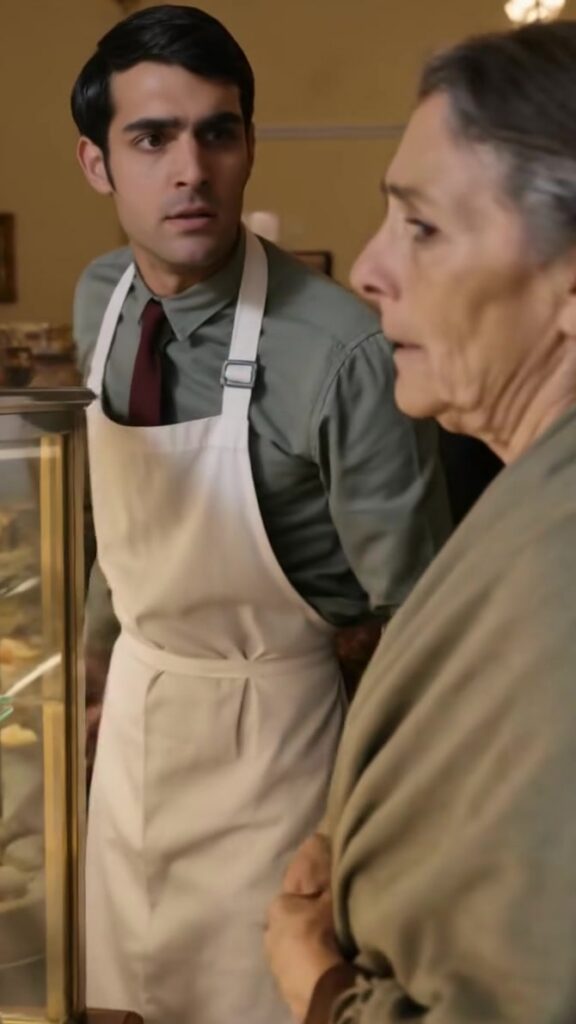
From the back, a door swung open. A man came out carrying a white cake box tied with twine, his sleeves dusted with flour. He looked like he belonged to the place the way an anchor belongs to a ship. He heard the last sentence, stopped dead, and let his gaze jump from the employee to the child to the old woman’s trembling fingers.
Something changed in his expression, like a memory had grabbed him by the throat. He stepped closer slowly, eyes narrowing the way people do when they’re reading a sign in the distance. “Hold on,” he said, almost under his breath. “I… I know you.”
The employee’s mouth opened, ready with a defense, but the manager didn’t look at her. He was staring at the old woman’s hands. “Those fingers,” he said, voice roughening. “My mother used to talk about them like they were magic. She said nobody in this city could pipe roses the way her teacher could.” His eyes lifted to the woman’s face, and he looked both hopeful and afraid. “Are you… Mara?”
The old woman blinked, thrown off balance by hearing her name said like it mattered. “That bakery is gone,” she murmured. “It’s been gone for years.”
His grip tightened on the cake box until the twine creaked. “My mother never stopped mentioning you,” he said, words tumbling out. “She said you disappeared the night of the fire. One day you were there, correcting her frosting swirls, and the next—” He swallowed. “She thought you were dead.”
At the word fire, the old woman’s face cracked. Not in a dramatic way, not like in movies—more like a wall that had been holding water back finally giving up. She shut her eyes for a second, and when she opened them, they were flooded. The little girl looked up, confused, a soft frown pulling at her eyebrows.
“Grandma,” the girl asked, voice tiny but steady, “what fire?”
Mara’s throat bobbed. She crouched down so she was eye-level with the child, even though her knees clearly hated it. She brushed a thumb across the girl’s cheek, wiping away nothing—just the idea of shame. “It was a long time ago,” she started, then stopped because the child deserved more than a dodge.
The manager shifted his weight, guilty now, like he’d opened a door that had been locked for a reason. The employee stood frozen behind the counter, face drained, suddenly very aware that a whole room had heard her.
Mara took a breath that sounded like it came from somewhere deep. “I used to bake,” she said to her granddaughter. “All day. All night sometimes. I made cakes for weddings, for graduations, for birthdays… for kids who wanted to feel like royalty. That shop was my whole world.” She smiled faintly. “I could make buttercream roses in my sleep.”
The girl’s eyes got huge. “Like the ones on the pink cake?”
“Like those,” Mara said. Then her smile wobbled. “There was a fire. It took the shop, and it took… it took more than that.” She glanced at the manager, then back at the child. “Your mom worked with me. She was brave and stubborn and always licking frosting off the spoon when she thought I wasn’t looking.”
The girl’s mouth fell open. “Mom baked?”
Mara nodded, eyes shining. “She did. And that night—” Her voice caught, and she pressed her lips together hard, as if holding in a scream that had been trying to get out for six years. “That night, she pushed people out. She got trapped. I tried to go back in, but someone pulled me away. Afterward, I couldn’t stay in that neighborhood. I couldn’t even stand the smell of smoke without shaking.”
The little girl stared at her, absorbing it in pieces. “So… Mom didn’t leave us?” she asked, the question so careful it hurt to hear.
Mara’s shoulders sagged with the weight of it. “No, baby,” she whispered. “She didn’t leave. She loved you before she even met you. She talked about you like you were already real.” She touched the child’s chest lightly. “Like you were waiting right here.”
The manager cleared his throat, eyes wet. “My mom would want you to know,” he said, “she kept one of your piping tips. Like a lucky charm. She said you taught her that cake isn’t just sugar. It’s proof people are worth celebrating.” He looked at the pink cake in the case, then at the child. “What’s your name?”
“Lina,” the girl said, voice small.
He nodded once, decision made. “Lina, pick the cake you want.”
Mara started to protest on reflex—no, we can’t, we’re just looking, thank you but—every old habit rising like a wall. But the manager lifted a hand gently. “Not charity,” he said, as if he could read her thoughts. “A thank you. And… an apology for what just happened.” His eyes flicked to the employee, and his tone went steel. “Go take five. In the back. Now.”
The employee disappeared without a word.
Lina’s gaze slid back to the pink cake with the white roses. She looked at her grandma, like she needed permission to want something. Mara swallowed, then nodded, tears slipping down without embarrassment now. “Princesses get cakes,” Mara told her. “And so do you.”
When the manager lifted the cake box from the case, the whole bakery seemed to breathe again. A woman near the cookie shelf dabbed her eyes and pretended she had something in them. The dad at the register quietly dropped a few extra bills into the tip jar. Someone’s kid, bold again, pointed at the glitter cookies and resumed the eternal argument of childhood: which treat looked the happiest.
Mara took the box carefully, like it was fragile in a way frosting couldn’t explain. Lina held her other hand, bouncing now, the humiliation rinsing away in a sudden wave of excitement. As they turned toward the door, Lina asked, “Grandma… can you teach me to make roses like that?”
Mara paused with her hand on the handle, the bell waiting above them. She looked down at Lina’s face—hopeful, fearless again—and felt something in her chest loosen for the first time in years. “Yeah,” she said, voice steady. “I think it’s time.”
They stepped out into the street with the cake hugged between them, carrying not just dessert but a story finally told. And behind them, the bakery kept smelling like warm bread, vanilla cream, and fresh strawberries—like the past and the future had agreed, for once, to share the same air.