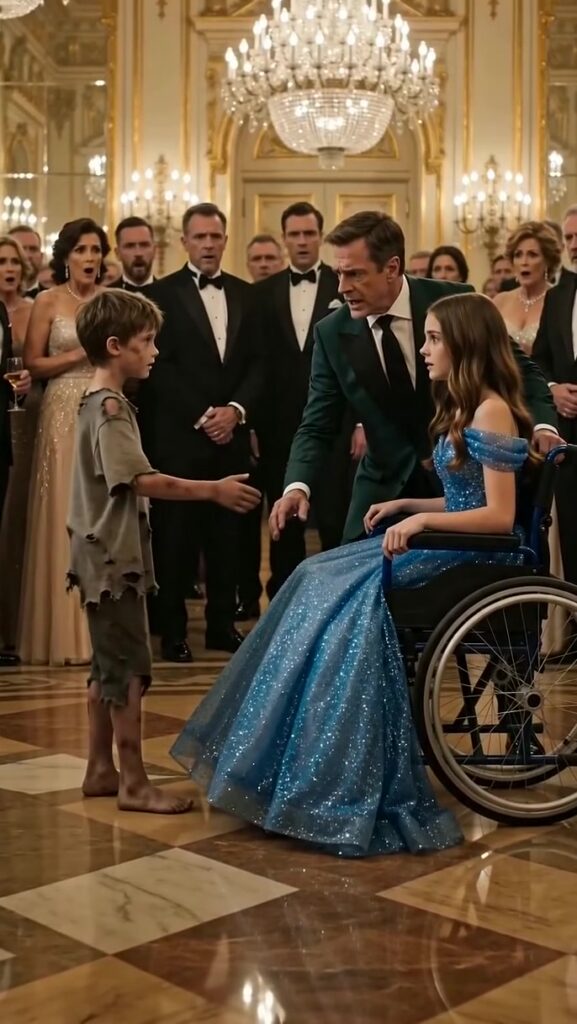
The ballroom had been designed to convince people they were witnessing history. Architects had treated it like a stage rather than a room—vaulted ceiling painted with scenes of angels who looked bored, columns veined with imported stone, chandeliers so heavy they seemed capable of dragging heaven down by their chains. Light spilled through cut crystal in honeyed shards, and every inch of the marble floor carried a polished reflection of the guests like a second, quieter crowd beneath their feet.
Tonight’s charity gala was, in truth, another performance. The wealthy arrived draped in black and jewel tones, their laughter calibrated, their compliments sharpened like knives with velvet handles. They drifted in a loose ring around the open center of the floor, where a single wheelchair waited like an altar. The chair was sleek, its metal hidden beneath ribbons and flowers, as though the truth should be dressed up for photographs.
In it sat Elowen Carrow, only daughter of the man who owned half the city’s riverfront and most of its patience. She wore a gown the color of deep water when the sun is almost gone—beaded, shimmering, star-flecked. The dress made her look like a story someone else had written and placed carefully in the middle of the room. Her hands rested lightly on the chair’s arms. A diamond at her throat rose and fell with her breathing, the most visible motion she allowed herself.
Her father, Lysander Carrow, stood behind her like an iron-backed throne. He moved through the crowd with the practiced grace of a man accustomed to doors opening before him. When people leaned down to speak to Elowen—soft voices, sympathetic smiles—he watched their eyes more than their words, measuring pity as if it were a debt. He had paid for her education, her surgeries, her therapies, her silence. He had paid for this night, too: the orchestra, the catering, the press. The spectacle was meant to prove something—about resilience, about generosity, about love. It was not meant to invite risk.
Then the doors at the far end of the hall opened in a way they were not supposed to. No herald announced a name. No attendant smoothed the arrival with excuses. A gust of cold air pushed in, and with it came a boy—barefoot, thin, his shirt and trousers little more than tired fabric clinging to him. Dirt smudged his ankles. His hair was dark and unruly, as though he’d been running from wind itself.
Conversation didn’t stop at once. It stuttered, bumped into itself, then fell off a cliff. Faces turned. A woman’s champagne flute paused halfway to her lips. Men who were used to being seen made themselves briefly invisible. The boy did not hesitate. He walked as if he had been invited, as if the marble belonged to him as much as it belonged to the chandeliers. Each step left a faint, shameful mark, and yet the room, built for spectacle, seemed to lean toward him as though recognizing a new kind of show.
He moved straight for Elowen. Not for the tables heavy with silver. Not for the musicians. Not for the wide-eyed cluster of donors. He threaded through them as if their money made them weightless, and he stopped before the wheelchair with the calm certainty of someone arriving at an appointment.
Lysander reacted on instinct, stepping forward, his arm coming up like a gate. “You’re lost,” he said, but the words were a courtesy; his tone was a warning. The boy’s eyes didn’t flicker to him. They stayed on Elowen, steady and unafraid, as though she were not fragile glass but a person who had been waiting too long to be addressed plainly.
“Let me have this dance,” the boy said.
A ripple went through the ring of guests—offense, amusement, the hungry thrill of a scandal about to be born. Lysander’s jaw tightened. “You have no right even to stand this close,” he replied. “Do you know who she is?”
The boy’s voice lowered, not out of submission but out of focus. “I know she hears the music,” he said, and his gaze softened. “And I know she’s tired of watching everyone else move.”
Elowen’s expression changed in a way the room could barely catch, like a candle flame shifting when a door opens. Her fingers curled slightly against the chair’s arm. For years, people had spoken over her—doctors to her father, patrons to the photographers, guests to each other. They had praised her courage without ever asking what courage cost. But this boy spoke as if her wanting mattered, as if her body did not erase her right to desire.
Lysander felt that shift like a blade touching skin. His protective anger was tangled with terror. “What do you expect to do?” he demanded. “You can’t—”
“I can help her stand,” the boy said, and the word stand landed in the hall like a dropped glass, sharp and impossible to ignore.
The orchestra faltered, a violinist dragging a note too long before stopping altogether. One of the donors made a sound that might have been a laugh, but it died in his throat. Lysander stared at the boy as if at an insult to physics, to medicine, to every specialist he had bribed, begged, and sued. “That’s not funny,” he said, but his voice had lost its certainty. Beneath the chandeliers, hope did not glow—it flared, reckless and dangerous.
The boy extended his hand toward Elowen, palm up, fingers relaxed. “If you want to,” he told her. Not her father. Not the room. Her. “If you don’t, I’ll leave, and you can go back to being admired from a safe distance.”
Elowen looked at Lysander. For a moment, the father she loved and the cage he built were the same shape. Then she looked at the boy, at his bare feet on the polished stone, at the way he stood without apology in a place built to exclude him. Something in her eyes gathered like stormwater.
Her hand lifted from the wheelchair’s armrest. Beads on her sleeve caught the light and threw it back in tiny stars. The room leaned in. Lysander’s throat worked, but no sound came. He could not order her hand down without exposing the truth: that the spectacle he curated had always been about his control, not her dignity.
Elowen’s fingers touched the boy’s. The contact was gentle, almost nothing. And yet it changed the air. The boy’s grip was warm, steady, as if he held not a porcelain doll but a partner. He stepped closer, lowering his head until his voice could belong only to her. “When you try,” he said, “don’t listen for permission. Listen for the music. The music won’t lie to you.”
Elowen drew in a breath that shook. She shifted forward, and the chair creaked in protest as her weight moved to her feet. Lysander started to reach out, not sure whether he meant to catch her or stop her. The guests held their breath, trapped between wanting a miracle and fearing the mess it would make of their tidy narratives.
The boy tightened his hold. “Now,” he murmured, a word like a drumbeat. “Up.”
Elowen’s palms pressed against the armrests. Her shoulders tensed, muscles waking with reluctant memory. She pushed—harder than she had in years, harder than the therapists had coaxed, because this time it wasn’t an exercise. It was a decision. Her gown shifted, beads whispering against fabric. Her knees trembled like thin branches in wind.
And then, in the chandelier-sweet light, she rose from the wheelchair—not cleanly, not without pain, but undeniably. One foot found the marble. Then the other. She stood, swaying, held by the boy’s hand and her own fierce will. Somewhere in the crowd, someone sobbed. Somewhere else, someone whispered a prayer, though they didn’t know to whom.
Lysander’s face drained of color, not from anger now but from a sudden, humiliating revelation: that the daughter he had turned into a symbol had been a person all along, and the only thing between her and the center of the floor had never been the chair alone.
Elowen lifted her chin. Her eyes shone, not with gratitude but with defiance, as if she were daring the ballroom to contain her. The boy guided her one slow step at a time, and when the orchestra found its courage again, the first notes trembled into the air like something newly born. In the room built for spectacle, the most astonishing sight was not that she stood. It was that she chose to move.