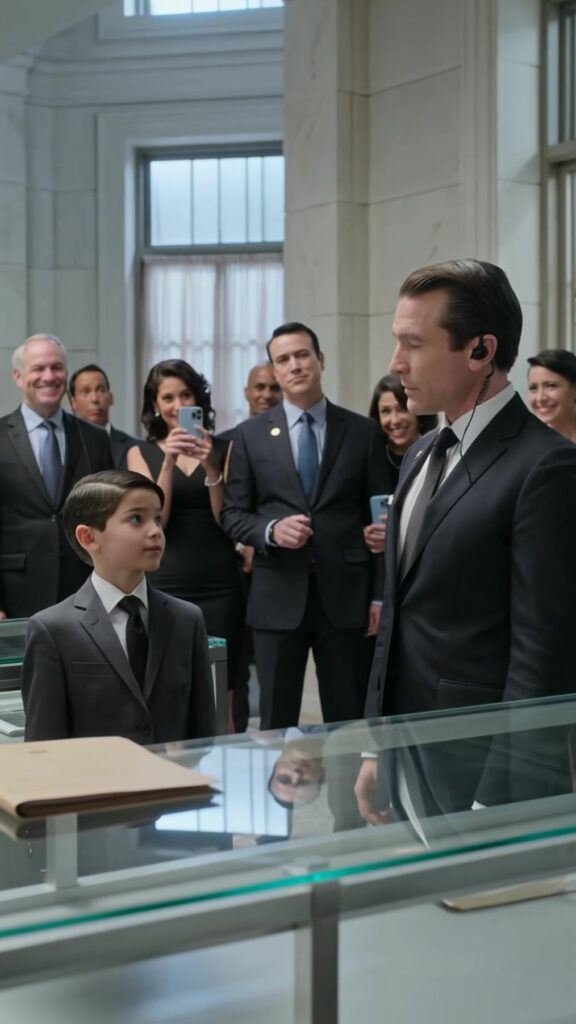
The bank’s VIP lounge was silent in the peculiar way only wealth can afford—sound swallowed by velvet upholstery, footsteps softened by thick carpet, conversation reduced to careful murmurs that never rose higher than the clink of a spoon against porcelain. Behind smoked glass, the city roared, but inside, time seemed to move on felt pads.
A chandelier like frozen rain hung above a long counter of polished glass and pale stone. In its reflection, elegant customers sat angled toward one another like chess pieces. A woman in pearls scanned market news on a tablet. A man with cufflinks that caught the light too eagerly leaned over a leather portfolio. A private banker moved between them with a tray of espresso, face blankly attentive.
When the boy walked in, the room did not react at first. He was too plain, too ordinary to register against the expensive hush. His jacket was clean but worn at the cuffs, his shoes scuffed, his hair combed as if with habit rather than help. He held a folder under his arm like a school assignment.
The security guard at the door straightened. The guard’s gaze slid over the boy, searching for an accompanying adult, a badge, a reason. Seeing none, he stepped forward—then hesitated as the boy continued without a stutter, eyes fixed on the counter.
The boy set the folder down. Not gently. Not politely. He brought it down with a flat crack against the glass that snapped through the quiet like a gunshot without the smoke.
Every head turned. Even the chandelier seemed to listen.
“I want to check my balance,” the boy said, calmly, as if ordering a coffee.
For a breath, no one answered. Then the lounge broke into amused noise—soft at first, then spreading with the ease of contagion. Someone actually laughed out loud, surprised by their own audacity. A few phones lifted as if by instinct, their owners eager to preserve this small spectacle to pass along later.
The manager emerged from a doorway behind the counter with the practiced expression of a man who could dissolve problems with a smile. He was tall, silver-haired, and dressed in a suit that looked like it had never known a crease. His nameplate gleamed, its letters sharp as teeth.
He glanced at the boy’s folder, then at his shoes. The smile came, thin and cold.
“This lounge is for important customers,” he said, voice polite enough to be cruel. “You’re in the wrong place.”
More laughter. A woman near the window covered her mouth, but her eyes glittered. The manager’s gaze flicked to the guard with a subtle command.
The boy did not flinch. “My grandfather opened this account,” he said. “He died last week.”
The words were plain. No tremor. No attempt to tug sympathy. That steadiness did something the laughter couldn’t handle; it snagged on the air, lost momentum, and fell quieter. A few customers looked away, as if suddenly embarrassed by their own entertainment.
The manager’s smile didn’t soften. If anything, it sharpened, as though grief were a weakness he could exploit.
“I’m sorry for your loss,” he said, in the same tone he might use for a delayed flight. “But we have procedures. Accounts like that—if they even exist—are handled through estate channels.”
“Please,” the boy said. “Just check.”
The security guard moved closer, heavy steps muffled by carpet. He was large, with a neck like a pillar. He did not touch the boy, but his shadow fell across the folder like a warning.
At the edge of the room, a banker cleared his throat, perhaps to remind everyone of decorum. The manager, feeling the eyes of his VIP clients, chose to end it quickly. He leaned over the counter and reached for his terminal, the screen angled away from the lounge as if secrecy itself were a luxury.
“Fine,” he said, rolling his eyes. “Let’s check your… balance.”
He took the folder, opened it with two fingers, and slid out a single sheet: an account number, handwritten in careful ink; a death certificate copy; and a letter, sealed with wax, as if from a century that still believed in seals. The manager’s expression tightened at the old-fashioned flourish. He typed the account number anyway.
Slowly, at first. A dutiful performance.
Then faster.
His posture changed. Something in the screen held him. The manager’s brows drew together as if the letters were refusing to make sense. He tapped again, checked a digit, corrected it, reentered. His fingers moved with the impatience of a man certain the world should obey him.
Then he stopped.
The color drained from his face with such suddenness it looked like a trick of the light. The lounge, sensing a shift, fell quiet again—not the comfortable hush from before, but a silence that pressed down. Even the phones lowered, their owners startled by the manager’s stillness.
“That’s not possible,” he whispered, forgetting to keep his voice smooth.
He refreshed the page. Again. His hands trembled, barely, but enough that the mouse clicked twice. He leaned closer until his breath fogged the corner of the screen’s privacy filter.
Behind the counter, a junior teller looked up. The manager snapped his head toward her without speaking, and she shrank back like a flame starved of oxygen.
He refreshed the page a third time. His lips parted as if he needed more air than the room was willing to give. The silence in the lounge thickened, turning every customer into a witness against their will.
“Who are you?” the manager asked, and his voice had lost its edge. It was not curiosity now. It was fear.
The boy held the manager’s gaze steadily. His eyes were the calm kind that didn’t ask permission.
“My name is Elias Ward,” he said. “My grandfather was Silas Ward.”
One of the older patrons stiffened. Another leaned forward, sudden recognition pulling at his features. The name moved through the lounge like a current, waking the room from its complacency.
The manager swallowed. “That can’t be.” He said it more to himself than to anyone else. “Silas Ward…”
“Built half the rail lines in this state,” Elias said softly. “Then sold them. Then disappeared.”
The folder still sat on the counter, open like an accusation. The manager’s eyes darted from the screen to the letter with the wax seal. He reached for it as if it were hot. His fingers hovered, then broke the seal.
He read. His face altered with every line, as though the words were pulling the skin tighter over his bones. When he finished, his mouth worked soundlessly for a moment before he managed to speak.
“This letter… it authorizes—” He looked up, and his eyes were glossy. “It authorizes immediate access. It authorizes… oversight.”
Elias nodded once. “My grandfather didn’t trust people who smiled too easily,” he said.
The manager’s gaze flicked around the lounge, suddenly aware of his audience not as a source of power, but as a jury. His voice dropped. “The balance on this account is…” He hesitated, as if the number might summon something. “It’s far beyond—”
“I know it’s large,” Elias said. “I don’t need you to say it out loud.”
The manager’s throat bobbed. “There are internal protections,” he said quickly, as if clawing back control. “Legal requirements—”
Elias leaned forward slightly, and the security guard, who had looked invincible moments earlier, found himself taking a step back without realizing it.
“My grandfather also left a directive,” Elias said. “A condition. If anyone ever tried to deny his family basic service—if anyone used ‘importance’ as a gate—then the account would trigger an audit of every transaction linked to this branch over the past twenty years.”
The manager’s face turned gray.
“And,” Elias continued, voice still even, “it would notify certain people. Regulators. Journalists. Partners. The kind of people who don’t enjoy surprises.”
In the lounge, someone shifted in their seat. A phone slid quietly back into a pocket. A woman with pearls stared at her lap as if it had suddenly become fascinating.
The manager’s hands trembled more openly now. He stared at Elias as if the boy had pulled back a curtain and revealed a cliff edge under the plush carpet.
“What do you want?” the manager asked, and it sounded like surrender.
Elias looked around the lounge—the careful suits, the curated quiet, the people who had laughed when they thought the story would be small. Then he returned his gaze to the manager.
“I want what I asked for,” he said. “My balance.” He paused. “And I want the staff here to stop deciding who matters before they’ve even checked the name.”
The manager nodded too quickly. “Of course,” he said hoarsely. “Of course. We can—”
“Also,” Elias added, “I’d like to speak with whoever oversees this branch. Not you.”
Those three words landed heavier than the folder had.
The manager opened his mouth, then closed it. He turned toward the back offices as if walking into a storm he could no longer avoid. The guard stood frozen, no longer sure who he was meant to protect.
Elias remained at the counter, hands resting lightly on the folder. He did not smile. He did not gloat. He simply waited, calm as a verdict, while the VIP lounge—once so confident in its quiet—sat in a new kind of silence, listening to the sound of power changing hands.