The birthday party looked perfect. White balloons drifted on nearly invisible strings above linen-draped tables. A hedge-maze of clipped green walls held back the wind, so the laughter arrived softened, as if the garden itself had been trained to behave. Crystal caught the sun and flung it back in clean, expensive flashes. If you stood at the wrought-iron gate and squinted, it could have been a magazine spread: privilege rendered in pastel.
At the center, beneath an arch braided with pale roses, stood the birthday girl. Amelia Marrow was nine that day, dressed in a chalk-colored frock with a sash that looked like it had never been folded. She wore dark glasses even though the sky was bright enough to hurt. Her hands rested at her sides, too still for a child, as if she were an ornament placed there to complete the scene. Beside her rose a cake as tall as her shoulder, iced in white and sugared flowers. There were candles waiting, but no one had dared light them yet. The adults seemed afraid of smoke.
Amelia’s mother—Serena—glided among guests with the sort of smile that made people lower their voices. She accepted compliments the way others accepted oxygen. Her husband, Hugh, stood close to the long gift table, checking a watch that cost more than the gardener’s truck. Every now and then, his gaze slid to Amelia. It was a practiced glance, quick and uneasy, the glance of a man looking at a lock he’s paid to keep shut.
Across the lawn, children ran between chairs, all bright ribbons and clean shoes. Amelia didn’t run. She didn’t flinch when a boy shrieked with laughter near her elbow. Her chin stayed lifted as if she were listening for something beyond the party—something the garden couldn’t trim away.
The perfection broke with a sound that didn’t belong.
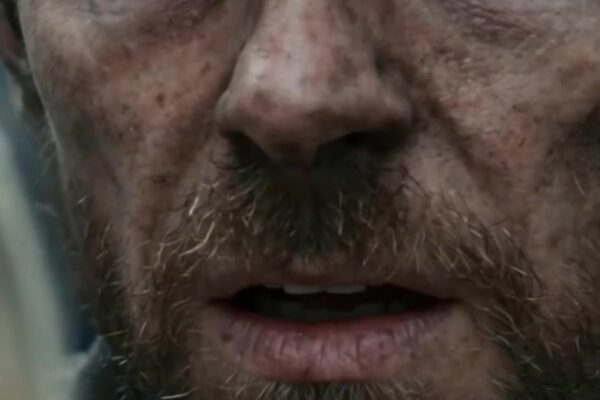
Not a scream or a crash, but the tearing rush of feet through gravel, the frantic slap of soles on stone. Heads turned as if guided by a single string. A skinny boy burst through the hedge opening that led to the service path. His shirt hung off him like a secondhand apology. Dirt painted his knees. He carried something in his fist as if it were the last piece of a sinking boat.
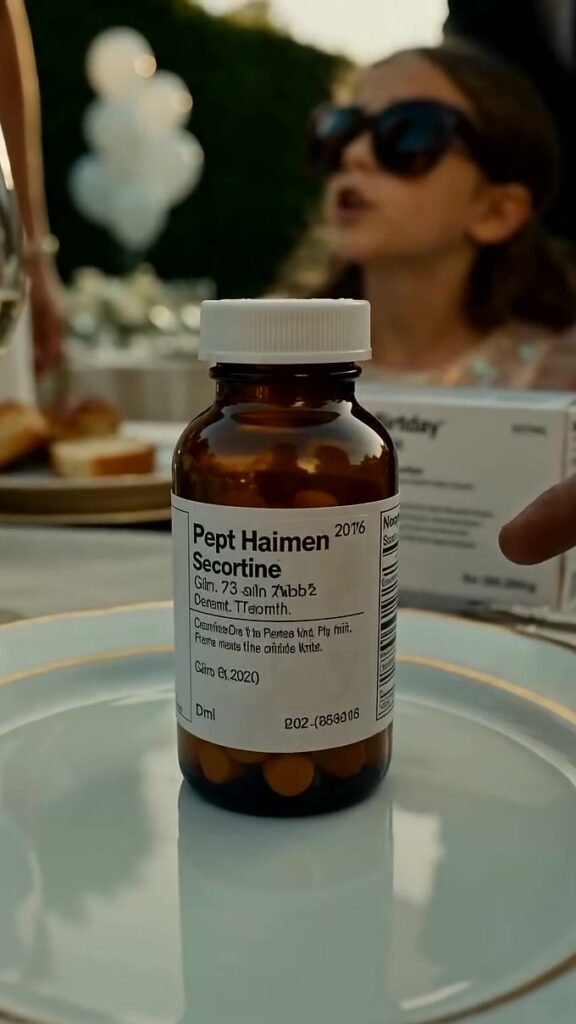
He ran straight to the birthday table and slammed a small brown bottle down hard enough to make the porcelain shiver. The clink of crystal went sharp. A few balloons bobbed violently, as if startled.
The children stopped mid-game. The adults stopped mid-breath.
For a heartbeat, nobody moved, because the party had not been designed to include a boy like him. He stood there shaking, chest heaving, eyes wild with a fear that was not of embarrassment but of consequence.
Serena arrived first, heels silent on the grass, fury polished to a shine. “Who let him in?” Her smile had vanished, leaving only a face that looked carved from pale stone.
The boy swallowed like it hurt. His gaze jumped to Amelia. “She’s not blind,” he said, voice raw and too loud in the manicured air.
The sentence landed wrong—like a bird hitting glass. Guests glanced at each other, confused, then looked back to Amelia, who stood motionless behind her sunglasses.
Hugh’s brows knit. He leaned over the table, eyes dropping to the bottle the boy had thrown down. His hand hovered above it but didn’t touch. Beside Amelia’s plate sat a second bottle, set neatly near the cake knife, as if it were party décor. Identical shape. Identical label. The same sterile block letters, the same pharmacy logo.
Hugh’s jaw tightened. “What is that?” he asked, and the question wasn’t for the boy alone.
The boy’s fingers flexed around nothing now, as if still clutching the courage it had taken to come. “My mom cleaned your house,” he said. “Sometimes. When people stopped calling.”
A ripple moved through the guests—an uncomfortable shift, like people adjusting in seats they realized were borrowed. Serena’s eyes cooled further, losing even the pretense of anger. What surfaced was calculation. “Say another word,” she murmured, “and you’ll regret it.”
The boy’s eyes filled, but he didn’t run. “She saw you,” he said. “She saw you crush it. Into her food. Into her juice. That stuff—” He nodded at the bottle. “That’s what you’ve been giving her.”
Someone made a sound that could have been a gasp or a laugh strangled early. A plate trembled in a guest’s hand.
Hugh turned slowly toward Serena, as if his body were moving through thick water. For the first time all afternoon, his face forgot to perform. “Serena,” he said quietly, “what did you do?”
Serena’s gaze flicked to the ring of onlookers, then back to the boy. “He’s lying,” she said. But her voice had lost the effortless charm it wore like perfume. “He’s filthy. He wants money. He wants attention.”
The boy shook his head hard, tears spilling despite him. “My mom said if your daughter ever stopped pretending—” His words snagged on his own panic. “She said you were scared she’d tell him. Tell everyone.”
Amelia’s fingers rose, slow and uncertain, hovering near the edge of her glasses. The gesture was so small it might have been missed, but in that garden it was thunder. Hugh noticed. His breath hitched. His eyes flicked from Amelia’s hand to the two bottles, then to Serena, and for a second he looked like a man watching the floor disappear beneath him.
Serena moved then—too fast for elegance, too sharp for grace. She lunged toward the bottle the boy had brought, as if she could swallow it back into secrecy. Her bracelets flashed like knives. The boy jerked away, shielding it with his body.
“Don’t touch it!” he cried. “It’s the same. Same number. Same—” He fumbled, pulling from his pocket a folded paper damp with sweat. A pharmacy receipt. A date. A signature that, in Serena’s looping script, pretended to be ordinary.
Hugh snatched the paper before Serena could. His thumb smeared the ink, and he stared as if the letters were crawling. “This is our account,” he whispered.
“You don’t understand,” Serena hissed, and the hiss revealed the animal beneath the silk. “You don’t know what it takes to keep a family safe. To keep a child—” She stopped herself, eyes darting to the guests, the staff, the children. “To keep everything stable.”
Amelia’s hand found the frame of her glasses. It trembled. She drew in a breath that sounded like someone tasting air after years underground. And then, with a decisive, frightening calm, she lifted them off.
Her eyes were wide, clear, and painfully awake. Not the glazed stare of blindness, not the unfocused drift Serena had coached her into. She looked at the world with the sharpness of a child who has been forced to memorize darkness.
She stared directly at Serena.
“Mom,” she said, voice small but cutting, “I hate the way it makes my head feel.”
The garden seemed to tilt. Guests stared as if they were witnessing a magic trick gone wrong. A woman pressed a hand to her mouth. A man took a step back, bumping a chair. Somewhere, a balloon popped with a gunshot snap.
Serena’s face didn’t fall apart. It hardened, the way water turns to ice midstream. “Put those back on,” she ordered, low and urgent, as if Amelia’s uncovered eyes were an indecency.
Hugh’s hand closed around the bottle beside Amelia’s plate. He held it up, and sunlight shone through the amber plastic like a warning. “This,” he said, voice breaking, “is why she’s been dizzy. Why she’s been sleeping. Why she’s been… fading.”
Serena’s gaze flicked to the gate, to the staff, to the guests whose phones were already half-raised. “You’ll ruin her,” she said, and the words weren’t a threat—they were an accusation, as if truth itself were violence. “You’ll ruin all of us.”
The boy stood trembling, as if his body might collapse now that the message had landed. “My mom said you’d try to make it disappear,” he whispered. “She said people like you always do.”
Amelia stepped away from the cake. It was the first time she had moved without permission all day. She reached for Hugh’s hand, small fingers closing around his. She didn’t look at the boy, not yet. She looked at her father like she was seeing him without a costume for the first time.
“I can see,” she said softly, and the confession sounded like freedom and betrayal at once.
In the distance, beyond the hedges, a siren began to rise—thin at first, then swelling, as if the world outside the garden had finally noticed the noise. Serena turned her head toward it, the perfect party unraveling around her in real time. The roses still clung to the arch. The crystal still glittered. The balloons still floated.
But the scene, so carefully arranged, could no longer hold.
Because now everyone was watching the birthday girl, standing bare-eyed in the sun, and the only thing more dramatic than the lie was the moment it ended.