The black SUV didn’t slow down. It cut through the rain like a blade that didn’t believe in consequences, tires hissing on slick asphalt as if the street belonged to it alone. A gutter had clogged at the corner of Grant and Larch, and the puddle there had grown into something ugly—an opaque, churned-up mirror the color of old coffee.
Maris Vale saw the vehicle a heartbeat before it reached the water. She was already too close to the curb, boxed in by scaffolding to her left and a line of impatient umbrellas to her right. She took a half-step back, heel slipping on the wet concrete.
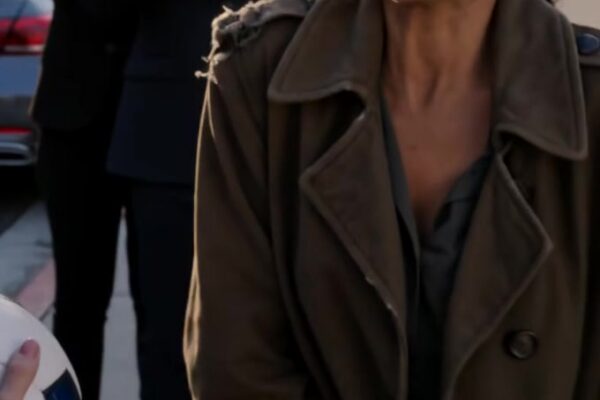
The SUV hit the puddle at full speed. The wave rose, heavy and brown, a curtain thrown with intent. It struck her from the knees up and then, insultingly, kept going—mud plastering her tan trench coat, speckling the pale blue of her dress, streaking across her cheeks and lenses. The world turned into smeared streetlights and the sharp taste of grit.
A hot sound tore from her throat—more shock than a cry. People on the sidewalk inhaled and looked away as if her humiliation might splash onto them too. The rain kept falling, steady as judgment.
The SUV braked just enough for the driver to angle toward the half-open window. He didn’t roll it down all the way. He didn’t offer a gesture that even resembled apology. The interior smelled faintly of expensive leather and impatience.
“What is wrong with you?” Maris called, voice shaking because her body was cold and because rage has to fight for air when you’ve been made small in public.
The man behind the wheel flicked his eyes over her, uninterested in the mud on her glasses, in the tremor of her fingers as she wiped at her face. He looked like someone who practiced not noticing things. “I’m in a hurry,” he said, as though that explained the physics of cruelty.
Then he accelerated again. The rear tires flung a second spray behind him—an afterthought of dirt thrown like a shrug. The SUV slid into traffic and disappeared among taillights.
For a moment Maris didn’t move. The rain tapped on her shoulders. Mud dripped from her sleeve to the concrete in slow, deliberate drops. Around her, the city went on pretending it hadn’t seen anything worth remembering.
Her first instinct was to laugh, a bitter sound that would have made it easier. Her second instinct was to cry, which would have made it easier for everyone else. She did neither. She simply stood there, swallowing the taste of public embarrassment until it settled, heavy and familiar, somewhere behind her ribs.
She reached into her coat pocket and pulled out a handkerchief—white linen, monogrammed with a single stitched V. She cleaned her glasses carefully, as if clarity were a decision. Then she lifted her chin and began walking.
The lobby of Halcyon Tower was marble and quiet, scented with citrus and expensive air filtration. The revolving doors accepted her with mechanical indifference. Two security guards glanced up.
One of them started to stand, then hesitated when he saw the mud. The other’s gaze flicked to Maris’s face and settled, uncertain, on her eyes. Recognition came late, like dawn behind thick clouds.
“Ms. Vale,” he said, too softly, as if volume could make the scene improper.
She didn’t pause. “Morning,” she replied, and the word carried the same steadiness as her stride. The guard reached for his radio, then stopped. A private elevator waited at the end of the hall, bronze doors polished to the point of vanity. It opened as she approached, as though the building itself had been holding its breath for her.
Inside, she removed the trench coat and folded it over her arm. The fabric was ruined, heavy with city grime, but her hands were precise. A small garment bag hung on a hook—placed there earlier by her assistant, who believed in contingencies the way some people believed in prayer.
When the elevator began its silent ascent, Maris unzipped the bag and changed with the practiced calm of someone who had been forced to become a lighthouse in storms. A clean dress—light blue, unwrinkled, impossible—replaced the soiled one. A second pair of glasses slid onto her nose, lenses spotless. She dabbed rain from her hair and twisted it into a low knot. Her lipstick was a shade called Quiet Authority.
The elevator chimed at the top floor. The doors opened to a hallway lined with framed photographs of men smiling beside ribbon cuttings. Their faces were the history Halcyon liked to display. Maris walked past them without looking.
Outside the executive boardroom, her assistant, Tamsin, waited with the anxious composure of someone holding a dam back with her palms. “Are you—” she began, then stopped herself. She saw what she needed to see: Maris’s shoulders level, her gaze unbroken.
“I’m fine,” Maris said. She took the brown leather folder from Tamsin’s hands. Its edges were worn, not from neglect but from use. Inside were numbers that could make empires kneel.
The glass doors opened, and bright white light spilled over her like a stage cue. A long conference table stretched across the room, its surface gleaming, a reflection of the faces already seated: senior executives, counsel, two board members, and a visiting banker with an expression that said he’d never been told no in his life.
Conversations cut off mid-breath. Heads turned. Spines straightened. The room’s air changed as if someone had adjusted the pressure.
Maris stepped in. Her heels clicked once, crisp and final. She didn’t raise her voice. She didn’t have to. She offered a polite nod to the table, the kind given to equals whether or not they deserved it.
One executive—dark suit, red tie, hands that had signed layoffs and called it strategy—stood immediately. He smiled with the practiced warmth of a man who feared power more than he respected it. He moved aside from the head of the table, as if the chair had always been waiting for her to arrive and make it real.
Maris placed her folder in front of the seat. The nameplate there was brushed metal, simple, undeniable: MARIS VALE — CHIEF EXECUTIVE OFFICER.
She was about to sit when the boardroom doors opened again behind her.
“Sorry I’m late,” a man said, still talking as he entered, words tumbling ahead of his awareness. “Traffic was—”
He stopped as if his throat had shut.
Maris didn’t turn right away. She let the silence thicken, felt it settle into the corners of the room. The executives glanced between the newcomer and the woman at the head of the table, confusion sharpening into curiosity.
The man’s hair was dry, his overcoat expensive, his expression that peculiar mix of irritation and entitlement. He held a sleek umbrella in one hand and a phone in the other. Maris recognized his face immediately—not just from the curb, not just from the moment his SUV had made her a spectacle, but from the acquisition file tucked in her folder. This was Gideon Rusk, founder and CEO of Rusk Logistics, the company Halcyon intended to buy by noon.
Gideon’s eyes fixed on her. Something in his face tried to form a story that would make this impossible. It failed. Color drained from his cheeks as if someone had opened a valve.
His mouth opened, then closed. He tried again. “You—”
Maris turned slowly. Her expression held no anger, which was the sharpest thing she could offer. Anger would have been proof he mattered. She gave him instead a small, professional smile—the kind that could be pinned to a lapel like a warning.
“Good morning, Mr. Rusk,” she said. Her tone didn’t accuse. It didn’t soothe. It simply placed him, precisely, in the room he had just entered.
Gideon’s gaze dropped, finally noticing the nameplate. His throat bobbed. The red-tie executive looked from him to Maris and back again, understanding beginning to dawn with a delicious slowness.
Maris opened her folder. The sound of leather and paper was ordinary, and that was what made it terrifying. Ordinary actions carried out by someone with the ability to decide outcomes were never really ordinary.
She looked at Gideon as if he were simply another figure on a spreadsheet. “Shall we begin?”
The room went so quiet the rain against the glass sounded like applause. Gideon stood at the door, suddenly unsure whether to step forward or retreat, his hurry evaporated into something smaller: fear.
Maris took her seat at the head of the table. Her hands rested lightly on the folder, steady as if mud and rain and public humiliation were things that happened to other people. She met each executive’s eyes, then returned her gaze to Gideon.
“Before we discuss terms,” she continued, voice measured, “I’d like to revisit a question of culture.”
The red-tie executive swallowed, sensing that the agenda had shifted without a single line on the printed packet changing. The banker leaned back, suddenly interested in the ceiling.
Gideon tried to smile, but it cracked at the corners. “Of course,” he managed.
Maris nodded once. “Excellent. Then let’s talk about the kind of person who believes being in a hurry grants them the right to drench someone else and keep driving.”
She paused—not for drama, but for precision. Her gaze never left him.
“Because Halcyon,” she said softly, “has no intention of buying that.”
Outside, the black SUV sat somewhere far below, parked beneath the tower like a guilty thought. Inside, Gideon Rusk realized that in a city full of moving vehicles, the only thing he hadn’t seen coming was the woman he’d tried to erase with a puddle.
Maris Vale turned a page in her folder. The meeting began. And for the first time all morning, he felt the full speed of consequence—without a chance to slow down.