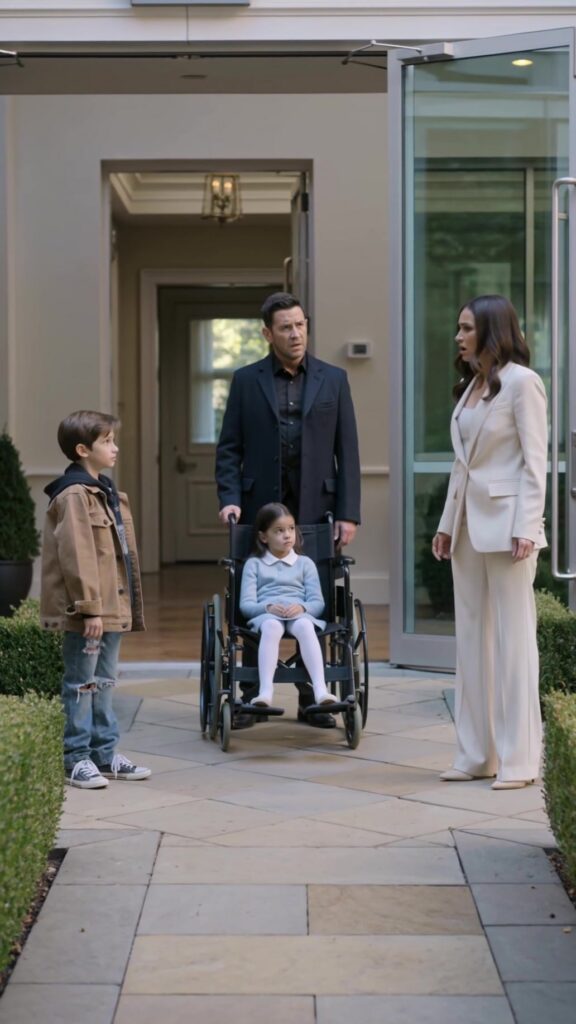
The first thing Noah noticed was how quiet the clinic garden was. Not quiet like a library—quiet like someone had asked the world to hold its breath. The hedges had been clipped into careful rectangles, the fountain made a soft looping noise, and even the pigeons seemed polite. Noah sat on the low stone wall by the lavender, legs swinging, watching his dad pretend not to be nervous.
Dad—Dr. Aaron Vale, according to the shiny sign inside—kept adjusting the cuff of his shirt like it was strangling him. He was supposed to be off today. Supposed to be just a man in a garden, not the director of a rehabilitation clinic with a board meeting in an hour and a fiancée with perfect hair.
Vivian stood near the glass doors, angled so the sunlight turned her engagement ring into a little flare. She’d chosen a cream dress and a smile that didn’t quite reach her eyes. She always looked like she belonged in magazine photos—candid but somehow rehearsed.
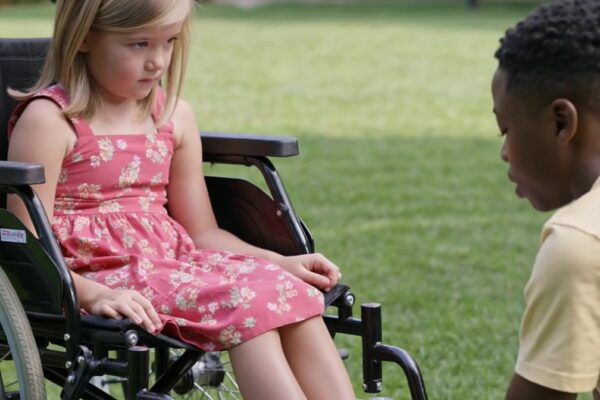
In the center of the garden, Iris sat in her wheelchair with a pale blanket tucked around her knees even though it wasn’t cold. Iris was seven, Noah was ten, and Iris used to run faster than anyone. Before the accident. Before all the words like “neurological” and “prognosis” entered their house and stayed like guests who forgot to leave.
Today had been framed as good news. Vivian had insisted on bringing the kids to “see the progress.” Dad had said it might be uplifting. Noah hadn’t argued, because arguing felt like wasting oxygen. He’d spent months learning the shape of this place—its minty hallways and encouraging posters—and he knew what “progress” usually meant: adults describing tiny changes like miracles, so everyone could keep moving forward without stopping to admit they were stuck.
Iris tilted her head, staring at the fountain like she was trying to remember how water sounded when you didn’t have to listen for hidden meanings. She didn’t look frightened. Just… spaced out, the way she had been lately, like someone had dimmed her from the inside.
Noah had been collecting clues the way some kids collected trading cards. Iris falling asleep too quickly. Iris forgetting Noah’s favorite cereal. Vivian “helpfully” offering to handle Iris’s meds, because Dad was “so busy” and the nurses “might confuse the schedule.” A little orange notebook Vivian kept in her purse, always turned away when Noah leaned too close.
And then, last night, the bottle Noah found.
He’d been searching for his charger in the guest room drawer. The drawer got stuck, and when he tugged, it popped open hard enough to rattle everything. A small glass bottle rolled out, stopped against his shoe. Clear, with a white cap. No label. Just a faint chemical smell, sharp like the time Noah spilled nail polish remover on the bathroom counter.
He’d stared at it too long. Not scared yet. More like his brain was trying to choose which story made sense. Vivian had plenty of skincare stuff. Maybe it was some fancy serum. Maybe it belonged to the clinic. Maybe he was being paranoid because his life felt like it had too many trapdoors.
But then he’d seen Vivian’s notebook. One page had a neat list of times and checkmarks. Another had Iris’s name underlined with numbers beside it—half numbers, really, like someone adjusting a dial.
Noah didn’t sleep much after that.
Now, in the garden, Vivian’s hand was tucked near her hip, fingers curled like she was holding something small and fragile. She laughed at something Dad said, but the laugh came a second late, like it had to travel farther than it should.
Noah watched her, then watched Iris. Iris blinked slowly, like her eyelids were heavier than they used to be.
Dad leaned down toward Iris, his voice warm. “Hey, bug. How’re we feeling today?”
Iris smiled, small and sleepy. “Tired.”
Vivian’s smile tightened, just for a second. “She’s been tired because healing takes energy,” she said, too quick, too polished. “And she’s had such a big week.”
Noah’s stomach did that slow sinking thing it did before a math test. His dad turned slightly, like he was about to reply, but his eyes were still on Iris, still trying to find the version of her that existed before.
Noah realized something then: if he said anything, it had to land. It had to be clear. And it couldn’t sound like a kid throwing a tantrum, because adults had a magical ability to turn a child’s anger into proof that the child was wrong.
So Noah didn’t let himself sound angry.
He slid off the stone wall and walked a few steps forward, not rushing, not dramatic. He stopped at a distance that felt respectful, the way you’d stop if you were asking for directions, not accusing someone of something that could break a family in half.
“Dad,” he said, and his own voice surprised him. It sounded steady. “She isn’t stuck like this on her own.”
Vivian’s head turned slightly. Dad’s brows lifted, the cuff-adjusting finally stopping.
Noah pointed with his chin toward Iris, because pointing with a finger felt too childish, too easy to dismiss. “That woman is keeping her that way.”
The words crossed the garden without rising. No yell. No shaking. Just a sentence placed carefully on the ground between them like a stone you couldn’t step around.
Dad’s whole body turned at once. “Noah,” he said, half warning, half disbelief, the way his voice sounded when Noah claimed he’d seen a coyote in the backyard.
Noah didn’t back down. He looked at his father, not at Vivian, because he needed Dad to stay with him for this. “Is he lying?” Dad asked, and it came out directed at Vivian like he couldn’t stop it.
Vivian didn’t answer. For a second she didn’t move at all, frozen by the fact that the script had changed. Then her face drained of color, the way milk looks when it’s poured into a dark cup—suddenly obvious. Her body began to shift backward before her expression caught up. One step. Then another. Controlled, but too fast to look innocent.
Iris’s head turned slowly, like her neck was moving through syrup. She stared at Vivian with confusion, not fear, because fear required energy she didn’t have. “Vivi?” she said, soft, like a question that didn’t know it was important.
Dad stepped closer to Iris, not far—just enough to put himself between her and anything else. His hand went to the back of the chair, protective without being possessive. He didn’t touch Vivian. He didn’t chase her. He anchored himself to what mattered first.
Noah stayed still on the left side of the garden. He didn’t rush forward to prove courage. He didn’t cry to prove sincerity. He just watched, because watching was what he’d been doing for months, and it was why he knew.
Vivian’s hand lifted slightly as she backed toward the glass doors. That’s when the sun hit what she was holding.
A tiny bottle, the kind that fit inside a palm. Glass, clear enough to catch daylight and throw it back like a signal. Almost hidden. Almost invisible. But glass always betrays itself when it wants to be seen.
Dad saw it. Noah watched the moment Dad’s mind connected a hundred small worries into one solid shape. The change on Dad’s face was so complete it felt like the garden’s air tightened. Suspicion didn’t live there anymore.
Recognition did.
“Vivian,” Dad said, and his voice wasn’t loud. It didn’t need to be. It had weight now, the kind it carried in operating rooms and emergencies. “What is that?”
Vivian’s mouth opened, then closed. Her eyes darted—toward the doors, toward the building, toward the place where people in uniforms could be summoned, where explanations could be spun into something neat. She swallowed. “Aaron, you’re letting him—”
“What is that,” Dad repeated, slower.
Noah felt his heartbeat in his ears, but he kept his face calm. If he broke into tears now, Vivian would grab it and twist it into “emotional kid.” Noah didn’t want to be emotional kid. He wanted to be accurate.
Iris frowned faintly, trying to follow. “Dad?” she murmured, and the word was both comfort and confusion.
Vivian began to turn, as if leaving quickly enough might rewrite the last thirty seconds. She shifted the bottle behind her thigh, like hiding it could make it un-exist.
Dad’s hand tightened on the wheelchair handle. He didn’t run after Vivian. He didn’t lunge. He did something worse for her—something grown-up and final. He pulled his phone from his pocket with the same steady motion he used to check vitals.
“Stay with Iris,” he said to Noah, without taking his eyes off Vivian. It wasn’t a request. It was trust, handed over in one sentence.
Noah moved to Iris’s side and took her hand. Her fingers were cool and slack, but they curled around his anyway, like she remembered the shape of safety.
Vivian stopped with her back half-turned, as if she’d hit an invisible wall. “You’re making a mistake,” she said, and her voice finally cracked. “You don’t understand—”
Dad’s gaze didn’t blink. “I understand my daughter,” he said. “And I understand that you didn’t answer.”
Noah stared at the bottle glinting near Vivian’s hand. He thought about the orange notebook. The checkmarks. The way Vivian always insisted Iris was “too fragile” for excitement, for school, for friends, for anything that might make her brighter and harder to control.
In the garden, the fountain kept looping its little song. Somewhere beyond the hedges, a car horn blared and faded. The world didn’t stop for revelations. It just kept going, leaving you to decide whether you’d keep up honestly or keep up pretending.
Noah squeezed Iris’s hand. “It’s okay,” he told her, not because everything was okay, but because she deserved a voice that didn’t lie to her. “Dad’s here.”
And for the first time in a long time, Noah believed it in a new way—not as a hope, but as a fact that could hold weight.
Vivian’s shoulders sank, just slightly. Dad’s phone was already at his ear. Noah didn’t know what would happen next—police, nurses, courtrooms, the messy after of truth. He only knew this: he had said it without anger, and somehow that had made it sharper. Like a knife you didn’t see until it was already through the lie.
The boy did not sound angry.
That was what made the accusation impossible to survive.