The hospital garden was supposed to be the calm part of the day, the little pocket of green where parents tried to breathe like regular people instead of walking question marks. It smelled like wet mulch and that lemony disinfectant that always floated out through automatic doors. A few azalea bushes tried their best. A fountain did an okay imitation of peace.
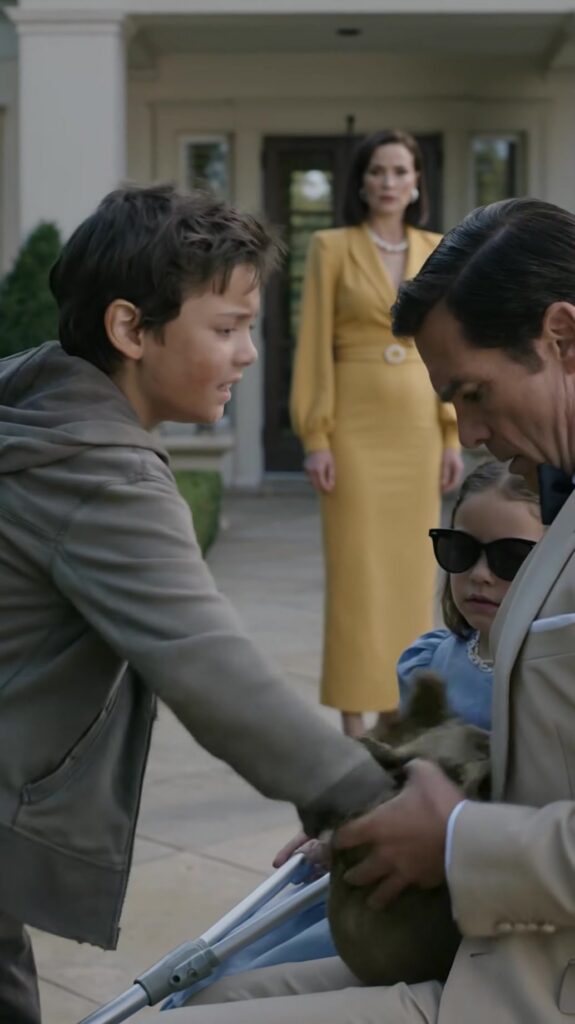
Daniel sat on a bench that was still slick from the morning rain. He kept one hand on the wooden slat behind his daughter’s shoulders, like if he let go she’d float away into the mess of the last three months. Mina sat perfectly upright in her blue dress, dark sunglasses covering half her face, a small crutch laid carefully across her lap as if it belonged to someone else.
“Do you want the apple juice or the chocolate milk?” Daniel asked for the third time.
Mina’s lips moved, then stopped. She turned her head slightly toward the fountain, listening more than looking. “Chocolate,” she said, and it was so soft it barely made it out of her throat.
Daniel stood to go back inside. He’d barely shifted his weight when the garden gate banged open hard enough to make a flock of pigeons explode off the path.
A boy—maybe twelve, maybe fourteen, hard to tell under the grime—ran in like he’d been shot out of a bad dream. His shoes slapped wet pavement. A filthy sack was clutched to his chest. His hair stuck to his forehead in damp ropes, and his chest heaved as if each breath had to be earned.
He didn’t scan the garden. He didn’t hesitate. He made a straight line to Daniel like he’d memorized the bench and the angle of the fountain.
“Your wife made her sick!” the boy shouted, voice cracking on the last word.
The sentence landed like a thrown brick. Daniel froze halfway between standing and sitting, one hand flying back to Mina automatically. He looked around, half expecting someone to laugh and point, like this was a prank show and he’d walked into the wrong scene.
At the hospital doors behind them, a woman in a yellow cardigan stopped so suddenly her tote bag swung forward and smacked her hip. Alicia. Daniel’s wife. She’d been inside “talking to billing,” which had become her favorite vague task lately. She stared at the boy as if he’d pulled her name out of her mouth.
The boy swallowed, then steadied himself as if he’d used up his panic and now had to spend courage. “She’s not blind,” he said, pointing toward Mina with a shaking finger. “Not really.”
Daniel turned slowly to his daughter. “Mina?” he asked, careful, gentle, like he was stepping onto thin ice. “Honey, look at me.”
Mina didn’t lift her face to him.
Instead, her chin angled toward the boy’s voice with a precision that made Daniel’s stomach drop. It wasn’t the vague head-turn of someone hearing a sound. It was exact—like she’d found him with her eyes, sunglasses or not.
Alicia’s mouth opened. No sound came out.
The boy shoved his hand into the sack and rummaged. His fingers came out with a tiny bottle—one of those travel-size things, plastic, no label, the kind you’d pour shampoo into for a weekend. There was a little liquid left in the bottom, cloudy and pale.
“He—he gave me this,” the boy said, then corrected himself fast, like he didn’t want to waste a syllable. “She gave me this to throw away. Told me it was dirty. Told me I’d get five bucks if I tossed it and never mentioned it. But I heard what they said.”
Daniel snatched the bottle without thinking. It felt too light, too innocent. His fingers started to tremble the moment it touched his skin.
“Daniel, don’t—” Alicia took a step forward, then stopped. Her face had gone paper-white, like the color had been erased.
Mina’s voice slipped out from behind her sunglasses, a whisper that almost blended into the distant ambulance siren. “She said don’t tell Daddy…”
Daniel’s throat tightened so hard he tasted metal. “Mina,” he said, and his voice broke, which hadn’t happened even when he’d watched her learn to use the crutch. “What did she give you?”
Mina’s fingers tightened around the crutch, knuckles pale. “It’s drops,” she whispered. “Bitter. She said it helps my eyes rest. She said the doctors don’t understand.”
Alicia backed up a step like she’d been pushed. “That’s not—Daniel, it’s not like—”
The boy cut in, blunt and shaking. “I heard the nurse ask why she was still giving it after the tests.”
Silence swallowed the garden. The fountain kept burbling, rude and cheerful. A nurse walked by at the far end with a clipboard and didn’t look over, because who expects a family to unravel in the tulips?
Daniel stared at Alicia. This was the woman who labeled leftovers with dates, who cried at animal rescue videos, who once drove back three miles because she thought she’d hit a squirrel. The idea that she’d hurt Mina didn’t fit in his mind. It didn’t fit in the world.
“After the tests?” Daniel repeated. “What tests?”
Alicia’s eyes darted to Mina, then to the boy, then to the bottle like it was a live grenade. “She was… she was faking,” Alicia blurted suddenly, and the words tumbled out wrong, panicked. “Not faking. I mean—she wasn’t blind, Daniel. The doctors said there was no damage. You remember. They said it didn’t make sense.”
Daniel did remember. The specialists. The scans. The careful phrases: We’re not seeing a physical cause. The way people said it when they meant We don’t know or Maybe it’s psychological and didn’t want to offend.
“So you—what?” Daniel asked, and his voice went very quiet. “You decided to make it make sense?”
Alicia’s hands rose to her temples. “She kept saying she couldn’t see. And then she would walk straight to her toys when she thought nobody was watching. I caught her once looking at her tablet. She got scared when I walked in. She—she was lying, Daniel. I thought if she stopped getting attention for it, she’d stop.”
“Attention?” The word came out sharp. Daniel looked down at Mina, at the way she held herself like a fragile statue. “Mina, sweetie… can you see right now?”
Mina’s shoulders trembled once. “Sometimes,” she admitted, barely audible. “Sometimes it goes fuzzy. Sometimes it’s fine.”
The boy took a tiny step closer, like he couldn’t help himself. “She told me to dump it in the trash behind the cafeteria,” he said. “But I didn’t. I heard the nurse talk. I was waiting by the vending machines ‘cause it’s warm in there. She said, ‘Why is the mom still giving her those drops when the labs came back weird?’ That’s what she said. Weird.”
Daniel looked at the bottle again, suddenly seeing it as a clue instead of a thing. “Where did she get it?” he asked, staring at Alicia.
Alicia’s lips trembled. “Online,” she said. “A forum. Other moms. They said it helped with… with—”
“With what?” Daniel pressed.
Alicia’s voice collapsed into a confession. “With getting kids to stop pretending. They called it ‘resetting.’ They said it was harmless in small doses. They said doctors just don’t like alternative stuff.”
Mina’s head dipped. “It makes my stomach hurt,” she whispered. “And sometimes I hear buzzing.”
Daniel’s heart slammed so hard it felt like it might crack his ribs. He pulled out his phone with the same hand holding the bottle. His thumb hovered over the call button, then shook so much he almost dropped it.
“No,” Alicia said quickly, stepping forward. “Daniel, please. Don’t call. We can talk. We can fix it. I’ll stop. I already stopped. That’s why I—”
“You stopped because someone noticed,” Daniel said, and the coldness in his voice startled him. He glanced at the boy. “What’s your name?”
The boy blinked fast, as if he hadn’t expected to be asked anything that gentle. “Eli,” he said. “People call me that.”
“Eli,” Daniel repeated. “Thank you.” He didn’t know what else to say. Thank you for running into my world like a fire alarm. Thank you for being loud when everyone else was polite. Thank you for saving my kid from… whatever this was.
He hit call. “Nurse’s station,” he said when someone answered, keeping his voice steady by force. “I’m in the garden. My daughter needs to be seen right now. And I have a bottle of medication her mother’s been giving her. No label. I need someone to come out.”
Alicia made a small sound, like a wounded animal. She sank onto the edge of the bench, hands covering her mouth, eyes wide and wet. Mina didn’t move, but her fingers found Daniel’s sleeve and held on.
Eli hovered near the path, uncertain now that he’d done the hard part. Daniel looked at him and saw the bruised purple under one eye, the raw red knuckles, the way his jacket was too thin for the season.
“Stay,” Daniel said. “Please. Someone’s going to want to know what you heard.”
Eli nodded once, stiff. “I only came ‘cause I figured if I waited, nobody would believe me,” he muttered. “Grown-ups don’t like listening to kids like me.”
Daniel swallowed, throat burning. “I believe you,” he said, and it felt like the most important sentence he’d spoken in months.
The automatic doors hissed open. Footsteps hurried across the wet stone. A nurse in navy scrubs jogged toward them, eyes sharp, already taking in the bottle, the child, the mother’s crumpled posture, the father’s rigid stance.
Behind the nurse, security followed at a careful distance, as if trying not to spook anything.
The garden, which had been designed to soothe, suddenly felt like the middle of a storm. Daniel tightened his arm around Mina. He didn’t know what the next hour would bring—blood tests, questions, shouting, police, apologies, maybe a kind of grief he hadn’t met yet.
But he did know one thing, clear as the fountain’s endless noise: a boy had run into the hospital garden like someone who knew he would only be believed once, and because of that, the truth had found its way into the light.