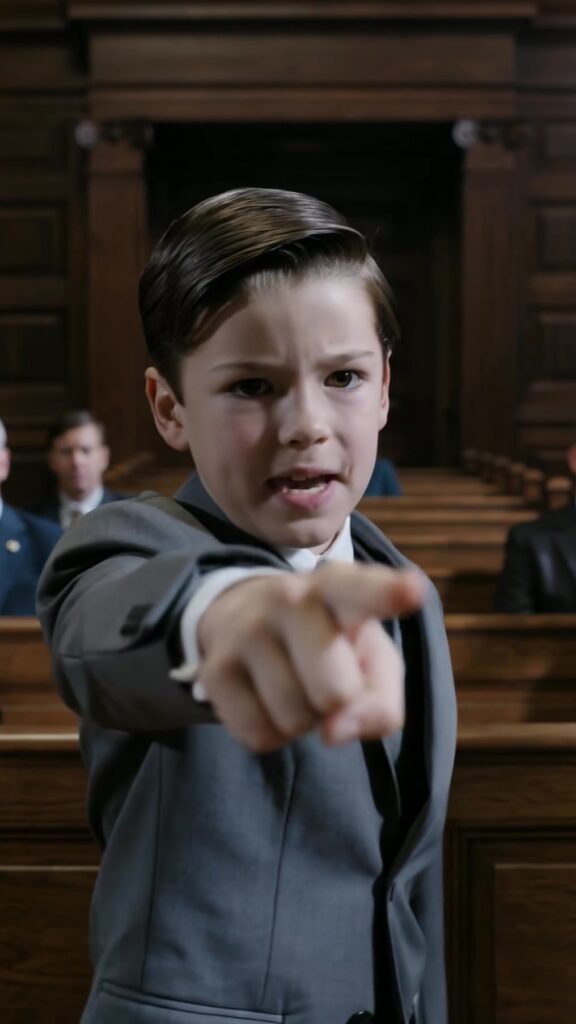
The first time Elliot Ashford broke his silence, it was not in a therapist’s office or a quiet bedroom with the curtains drawn. It was under chandeliers that made the air look expensive, in a courtroom so certain of its verdict that even the benches seemed to lean toward guilt.
Marisol Vega stood alone at the defense table, hands folded so tightly her knuckles shone through the bruised brown of her skin. She was the Ashfords’ maid—no, the Ashfords’ shadow, their stitcher of torn hems and keeper of schedules, their unseen witness for six years. And now she was a murderer in the eyes of the city.
Everyone had heard the same story for months: the Ashford estate burned, Reginald Ashford died in the library, and the maid escaped with the child. The headlines were already written. The prosecution’s narrative had the simple shape the public loved: envy, rage, a flash of violence, and a convenient fire to swallow evidence. Marisol had no history, no family in town, no polished lawyer with an Ashford-smooth name. Just a court-appointed defender with a tie too short and eyes too tired.
Victor Ashford sat in the front row like a monument carved from restraint. He wore mourning the way other men wore cologne—subtle, intentional, meant to be noticed. His hands were clasped, his chin slightly bowed as if he carried the weight of his brother’s loss for the whole room. When the prosecutor spoke of betrayal, Victor’s expression flickered with sorrow at exactly the right moments.
Elliot sat behind Victor, a small figure in a gray suit that fit as if it had been tailored around his quiet. His hair was combed carefully. His face, pale and smooth, held the stillness of a painting. For nearly a year he had not spoken in public—not at school, not at the memorial, not at any of the sessions with specialists who took notes and prescribed patience.
The only person who claimed she had heard his voice at all was Marisol. In the dark hours, when nightmares drove him from bed, he would cling to her sleeve and whisper words that dissolved by morning. In the daylight, he was an obedient ghost. The doctors called it selective mutism. The newspapers called it proof: a child too traumatized to speak because his father’s killer lived on in his memory.
The prosecutor finished her final remarks with a crisp certainty. “She was the last adult seen with Mr. Ashford in the library,” she said, turning slightly so the jurors could see Marisol’s bowed head. “She had access to the entire house. She had opportunity. And she alone escaped without injury.”
The defense rose, stumbled through a short plea for reasonable doubt, and sat down again with an apology in his eyes. The judge adjusted his glasses and looked to the jury as if the only remaining task was to choose how long Marisol should disappear from the world.
Then the chair scraped.
The sound cut through the room like a blade. Every head turned as Elliot Ashford stood. He did it slowly, as if lifting himself from a pool of cold water. His small hands gripped the back of the bench. His gaze, sharp with a kind of old fear, fixed on the front row.
“It wasn’t her,” he said.
The words landed wrong—too clear, too steady. There was a breath of disbelief, and then the room seemed to hold its lungs. Marisol’s head snapped up. Her lips parted, but she made no sound. Tears sprang instantly, as if the syllables had struck a bell inside her.
The judge raised his gavel. “Sit down, young man.”
Elliot did not.
“She was protecting me!” His voice rose, raw at the edge. “She didn’t do it!”
A murmur turned to gasps. Reporters leaned forward so quickly their pens clattered. The prosecutor’s composure cracked; her eyes flicked to Victor, then back to the child with professional alarm.
Victor half-turned, his face tight. “Elliot,” he said, low but urgent. “That’s enough.”
Elliot pointed, his arm trembling with the effort. Not at the judge. Not at Marisol. Not at the lawyers. He pointed at Victor as if the gesture itself was a confession waiting to be understood.
Victor’s hand shot back and clamped around the boy’s wrist. His grip looked, for a moment, like a father’s correction—until Elliot flinched and a ripple of something unmistakable went through the courtroom.
It wasn’t concern that moved Victor’s face. It was panic. Clean, sudden fear, wearing the mask of authority.
“He’s confused,” Victor said loudly, for the benefit of jurors and microphones. “He was a child. He saw smoke and chaos. He doesn’t know what he’s saying.”
Elliot’s eyes did not move. “Yes,” he answered, and his voice cracked with the weight of it, “I do.”
The judge leaned forward. “Elliot Ashford, do you understand you are interrupting court proceedings?”
“I understand,” Elliot said. His breathing was fast now. His fingers flexed where Victor’s hand held him, as if testing the possibility of escape. “I understand why I wasn’t supposed to speak.”
The last sentence slid into the room like a cold draft. Even the bailiff shifted.
Marisol whispered, barely audible. “No… please…” Her eyes begged him to stop, not because she feared his truth, but because she feared what truth would cost him.
Elliot swallowed hard. “The maid didn’t lock the library door that night,” he said, each word pried loose with effort. “You did.”
He turned his chin slightly, and the motion felt like a door opening on a memory no one wanted aired. “Uncle Victor.”
The room erupted—shouts, gavel strikes, people rising from their seats. The judge banged his gavel until his arm shook. “Order! Order!”
Victor released Elliot’s wrist as if burned, then immediately reached again to take the boy by the shoulder, guiding him down with a gesture meant to look gentle. Elliot resisted. A small bruise was already blooming where the grip had been.
“This is outrageous,” the prosecutor stammered, but she sounded uncertain, because the child’s accusation had landed on something in the room that had always been there: the convenient solidity of Victor’s grief, the way he had shepherded the investigation, the way he had insisted the child not be questioned too harshly, too often, too soon.
The judge’s eyes narrowed behind his glasses. “Mr. Ashford,” he said to Victor, voice suddenly careful, “step back.”
Victor’s smile appeared like a switch flipped on. “Your Honor,” he began, palms open. “My nephew is unwell. This is traumatic for him. He needs—”
“He needs to be heard,” Elliot said, cutting through. His small voice did not carry the authority of adulthood, but it carried something more dangerous: specificity. “The library door was usually stuck. Marisol kept a little bottle of oil in the pantry for the hinge.”
Marisol’s eyes widened. That detail had never been in any report. It was intimate, domestic truth.
“That night,” Elliot continued, his words rushing now, “Marisol tried the handle and it wouldn’t move. She told me to stay behind her. She called for my father. She told him to come out. He didn’t answer.”
Elliot squeezed his eyes shut once, hard, then opened them and stared at Victor. “You were there. I saw your ring.”
Victor’s hand went, involuntarily, to his right hand—where a signet ring sat, dark stone set in silver. The gesture betrayed him more than any stutter could have.
“He doesn’t know,” Victor said again, but his voice thinned. “He’s mixing things up.”
“I’m not,” Elliot said. “You told me not to talk about it. You said Marisol would go away forever if I did. You said no one would believe a boy who stopped speaking.”
Somewhere in the audience, someone made a strangled sound. A reporter’s pen scratched frantically.
The judge signaled to the bailiff. “Remove the jury,” he ordered. “Now.”
As the jurors were ushered out, the room turned from theater to something rawer. The attorneys huddled, whispering fast. The judge leaned down to speak into the microphone, his tone suddenly less ceremonial and more human. “Elliot,” he said, “can you tell the court what you saw in the library?”
Elliot’s throat bobbed. He glanced at Marisol as if asking permission and forgiveness at once. Marisol’s tears fell silently, but she nodded, shaking, hands still clenched as if prayer were a muscle.
“I saw my father and Uncle Victor arguing,” Elliot said. “My father was holding papers. He said Uncle Victor couldn’t sell something that didn’t belong to him. Then Uncle Victor shut the door. He told me to go to my room.”
Victor’s face went pale beneath its polish. “This is insane,” he whispered, but his eyes darted toward the exit like a man counting steps.
“I didn’t go,” Elliot said. “I hid behind the curtain in the hallway. I heard a crash. I heard my father shout. Then smoke came under the door. I smelled… not just burning wood. Something sharp. Like when the gardener cleaned the tools.” He frowned, searching his memory for the name. “Solvent.”
The judge’s gaze sharpened. “Accelerant,” he murmured, and the word hung like a verdict waiting to be earned.
Marisol pressed both hands to her mouth. She had told detectives she had smelled chemicals, and they had written it down and then ignored it, because chemicals did not fit their story as neatly as her foreign name did.
Elliot’s shoulders shook once. “Marisol broke a window with a chair. She cut her arm. She picked me up anyway. She carried me. I was coughing, and she covered my face with her apron. She kept saying, ‘Look at me, look at me,’ so I wouldn’t look back.”
Victor took a step backward. The bailiff moved between him and the aisle as if anticipating flight.
The judge straightened in his chair, older suddenly, heavier with responsibility. “Mr. Ashford,” he said, voice hardening, “you are instructed to remain seated.”
Victor’s mask cracked at the edges. “I have no idea what poison she put in that boy’s head,” he said, pointing at Marisol with a tremor of rage. “She’s been with him constantly—of course he would say whatever—”
“She never told me your name,” Elliot said, and the quietness of his tone made it sharper than shouting. “I remembered it myself.”
Silence, thick as smoke. In it, everyone seemed to realize the same thing: the case had never been about evidence. It had been about controlling the only witness who mattered. A boy who was never supposed to speak.
The judge’s gavel came down once—not the performative strike of earlier, but a final, decisive sound. “Court is in recess,” he announced. “The witness will be protected. The defendant will be held pending further investigation. And the court requests immediate review of the fire report and all interviews conducted with the minor.”
As deputies moved toward Victor, he lifted his chin with a desperate imitation of dignity. But his eyes betrayed him again—flicking to Elliot with something like hatred, and beneath it, an old calculation reawakening.
Marisol sagged as if her bones had been unhooked. Her defender steadied her elbow, stunned into competence. Elliot remained standing, shaking, his fingers finally lowering. He looked suddenly like a child again, and the cost of his courage was visible in the way he pressed his lips together, trying not to break.
When the judge ordered Elliot escorted to a private room, Marisol stepped forward before anyone could stop her. She did not touch him—touch might have been too much, too public, too dangerous—but she leaned close enough for him to hear over the noise.
“You are safe,” she whispered, voice hoarse. “Whatever happens next, you did the right thing.”
Elliot’s eyes filled. For a year his silence had been a cage built by fear and held together by threats disguised as family love. Now, in the ruins of that cage, he managed a small nod. His voice, when it came, was barely more than air.
“I was scared,” he admitted.
Marisol’s tears slid down without shame. “So was I,” she said. “But we are here.”
Outside, thunder rolled, as if the sky itself had been waiting. Inside, the courtroom buzzed with the first real uncertainty it had known in months. The story the city thought it understood was burning away, and in the clearing smoke, a different truth began to take shape—one spoken, at last, by the boy who had been trained by terror to keep his mouth shut.