The garden luncheon was the kind of thing people attended for the photos and tolerated for the food. Everything was aggressively lovely: white linen that looked too clean to belong outdoors, glassware that threw sunbeams onto cheeks like little spotlights, and centerpieces that smelled like money—roses, peonies, and something exotic no one could name without checking a card.
A string quartet played near the fountain, their music doing that polite background thing where it sounded expensive but never demanding. Servers in gloves moved with the careful speed of people balancing rent on their trays. The guests—investors, charity board members, lifestyle reporters, and neighbors who liked to be seen being neighbors—laughed in voices tuned to the right volume.
At the center table sat Calvin Harroway, the reason the whole event existed. Calvin had built a tech company that promised to “simplify living,” which meant it made a lot of people rich while confusing everyone else. He had the tailored suit, the confident hands, and the smile that made strangers think he had already forgiven them for something. Beside him sat his wife, Maris, a woman who wore diamonds like punctuation marks. Next to them were two investors and a journalist who kept saying “vision” like it was a flavor.
Calvin lifted his glass. “To the Greenbridge Children’s Fund,” he said, and everyone lifted theirs too, grateful for something easy to clap for. Someone called him inspiring. Someone else said he was a family man. Maris touched his wrist like she’d placed her claim on him years ago and didn’t intend to renew it; it simply existed.
Then the boy appeared.
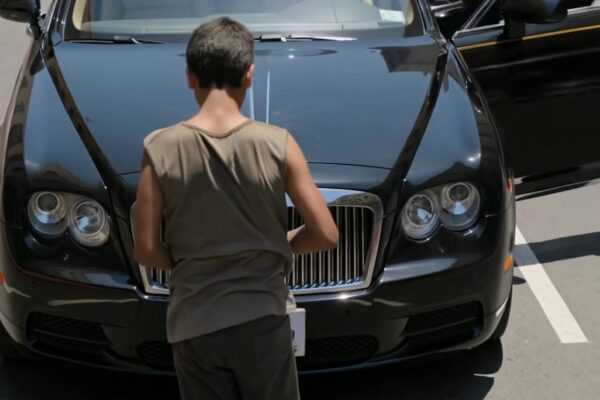
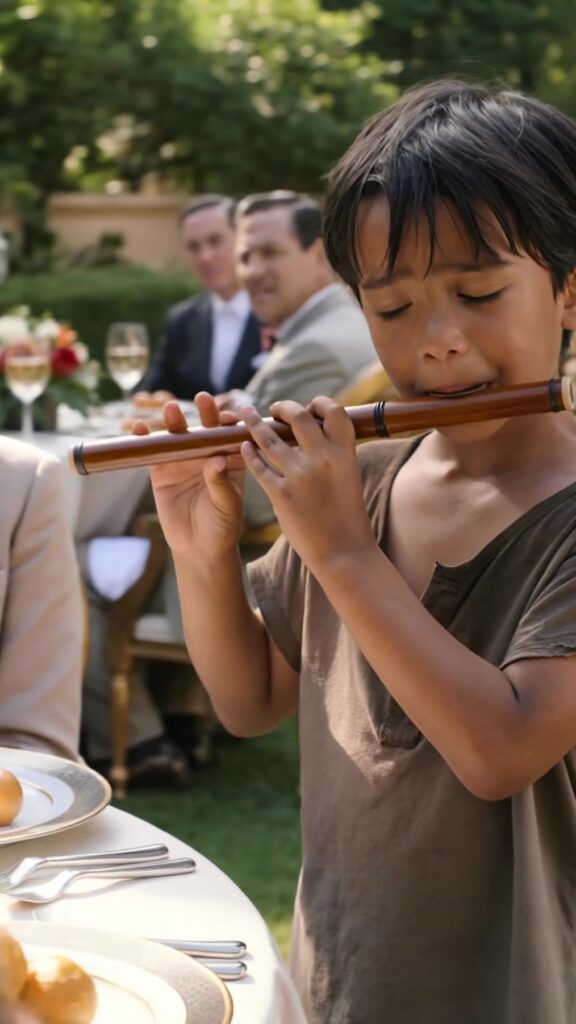
At first people thought he was a staff member’s kid who’d wandered in, because kids did that sometimes when adults were busy congratulating themselves. But this wasn’t a kid in a pressed shirt looking bored. This was a boy thin enough that the wind seemed to choose him first, with knees poking through dusty jeans and a shirt that had lost its argument with time. His face was smudged like he’d been handling coal or crawling under something. In one hand he carried a small wooden flute, held carefully, almost formally, like it mattered more than his own comfort.
He walked straight toward the center table.
Conversation softened into awkward gaps. A couple of guests pretended they hadn’t noticed; they stared too hard at their plates. Someone’s laugh ended mid-syllable. The quartet wobbled through a measure and then, sensing the shift, grew quieter.
Calvin looked up. The expression on his face wasn’t pity. It was the irritation of someone who’d paid for an illusion and was watching it tear.
“Hey,” Calvin snapped, a little too loud for crystal-and-linen manners. “Who let him in? Can someone get him out of here?”
Two servers glanced at each other, unsure if they were supposed to handle it or if doing so would count as a scene. The journalist’s eyes glittered, pen hovering like it had been hoping for this.
The boy stopped at the edge of the table, close enough to smell the lemon on the water glasses and the buttery warmth rising from the bread basket. He held the flute with both hands now, knuckles pale.
“Please,” he said, voice small but steady. “I need money. My mom is sick.”
Maris’s mouth twitched, not quite a smile but something like it, the way people react when they think they’re about to witness a performance. One investor shifted and muttered, “Is this part of the program?” as if a starving kid might be entertainment between courses.
Calvin leaned back, arranging himself in his chair like a king bored by a peasant. “Then earn it,” he said, and his smile sharpened. “Play.”
A few people chuckled, relieved to be told what kind of moment this was supposed to be. A poor boy. A rich man. A little cruelty dressed up as wit. Someone murmured, “How charming,” as if hunger could be quaint.
The boy glanced down at the flute. His shoulders rose once, like he had to pull air from somewhere deep, and then he lifted it to his lips.
The first note was soft enough that the fountain nearly swallowed it. Then the melody formed—only a handful of notes, simple, almost childish. Not impressive in a technical way. Not the kind of thing you’d pay a quartet for.
But it did something strange to the air.
Calvin’s smile faltered so quickly it looked like a glitch. His eyes narrowed, not in suspicion at first, but in recognition—the kind that hits you in the stomach before your brain catches up.
The tune wasn’t famous. It wasn’t trendy. It was the kind of little melody someone would make up in a cheap apartment while a baby slept in a drawer because there wasn’t a crib. The kind of tune that belonged to a life Calvin no longer admitted existed.
The boy stopped after a few bars. He lowered the flute, hands steadier now, and reached into his pocket.
People leaned in without meaning to. Even the journalist stopped pretending it was casual.
The boy pulled out a photograph, old enough that the corners were bent and the image had gone slightly yellow. He held it up toward Calvin.
Calvin snatched it fast, a reflex as sharp as a slap. “What is that?” he demanded, annoyed, as if the boy had stolen something from him instead of offering it.
Then his face drained.
Maris’s gaze snapped to the photo. The investors watched Calvin instead, like traders monitoring a market dip.
In the photograph, Calvin was younger—no perfect suit, no curated smile. He stood in the doorway of a cramped apartment, arm around a woman with tired eyes and a brave expression. His other hand rested on a bundled baby, the baby’s face half-hidden by cloth. It wasn’t a posed charity photo. It was intimate. Real. The kind of proof you couldn’t spin into a keynote speech.
Calvin’s fingers tightened until the edge of the picture bent. “Where did you get this?” he whispered, and the whisper somehow carried farther than his shout had.
The boy didn’t flinch. His chin lifted, and something in his expression shifted—less pleading, more certain, as if the years had been leading him to this table and this exact sunlight.
“My mother gave it to me,” he said. “She said you’d know your son.”
Silence landed like a heavy cloth over the luncheon.
Maris’s face went still, like a mask set down on a counter. The smile she’d worn for cameras evaporated, leaving only a tightness around her mouth. “Calvin,” she said, not loud, not soft, just his name with a question sharpened inside it.
Calvin stared at the boy, then at the photo, then back at the boy. His throat moved. His perfect composure looked suddenly like an outfit one size too small.
The boy stepped closer, close enough that Calvin could see the faint bruise on his cheekbone and the dryness on his lips. He didn’t ask for money again. He didn’t have to.
“She said you left her pregnant,” the boy continued, his voice not trembling now at all, “the same week you got engaged.”
Someone inhaled too loudly. A glass clinked against a plate. The quartet, uncertain what to do with scandal, stopped playing altogether.
Maris’s hand slid off Calvin’s wrist like it had touched something hot. “Is that true?” she asked, still calm in a way that felt practiced, but her eyes were wide and bright.
Calvin opened his mouth. Nothing came out. The journalist’s pen began moving like it had been waiting its whole career for this.
The boy looked around at the flower arrangements, the crystal, the linen, the people who had been laughing about generosity while sipping sparkling water. “She didn’t want anything from you,” he said, directing the words not just at Calvin but at the whole polished world around him. “She wanted you to look at me once. That’s it.”
Calvin’s fingers trembled as he held the photo. “This is—” he started, but there was no ending that could make it better. Denial would be a lie too loud to believe. Admission would crack the table in half.
Maris stood abruptly, chair scraping. Her diamonds flashed like warning lights. “How long have you known?” she asked him, and the question wasn’t about the boy; it was about the man she’d been sitting beside for years.
Calvin didn’t answer. He couldn’t seem to take his eyes off the boy, as if he was looking at a ghost that had decided to stop haunting quietly.
The boy set the flute down gently on the tablecloth, right beside the bread basket, like a strange offering. “I didn’t come to ruin anything,” he said. “But I’m tired of being the part of your life you hide.”
He turned away then, not running, not begging, just walking back through the garden as the guests watched, unsure whether to be outraged, sympathetic, or relieved it wasn’t them. A server took a step as if to stop him, then hesitated, caught between loyalty and decency.
Calvin finally pushed back his chair, the movement jerky. He looked at Maris, at the investors, at the journalist, at the pristine luncheon now stained by a truth no napkin could wipe. His voice came out rough. “I need—”
Maris cut him off with a single look. “You need a different life than the one you sold me,” she said, and it wasn’t dramatic; it was final.
The boy reached the gate. For a moment he paused, one hand on the iron, and glanced back. Not with triumph. Not with spite. Just with a quiet, stubborn hope that someone—anyone—would follow him out of the perfect garden and into the real world where sick mothers waited and songs were played without an audience.
Calvin stood frozen, photo still in his hand, as if the paper weighed more than his entire company. Around him, the luncheon tried to restart—someone cleared their throat, someone asked for the salad course, someone laughed too loudly to prove they were fine.
But it was over. Not because the plates weren’t full. Not because the sun had shifted.
Because a boy with a wooden flute had walked into a curated paradise and reminded everyone that you can decorate a lie with flowers, but you can’t make it smell like anything else.