The yard behind Rust & Ritual was the kind of place that usually swallowed noise whole. A chain-link fence hugged the back lot. A few sad patio chairs leaned against a wall. Motorcycles sat in a neat line beside the fence, their chrome muted under a thin layer of dust and road grit. Even when the guys laughed, it felt like the sound stayed low, like it knew better than to echo.
That afternoon, the whole place was calm enough that even the wind seemed to idle.
Then a kid screamed.
It didn’t sound like a scraped knee. It sounded like the kind of crying that comes after you’ve been brave too long and the bravery finally runs out. Heads turned. A couple of bikers paused mid-conversation, looking around like they expected to see a dog with a paw caught in something.
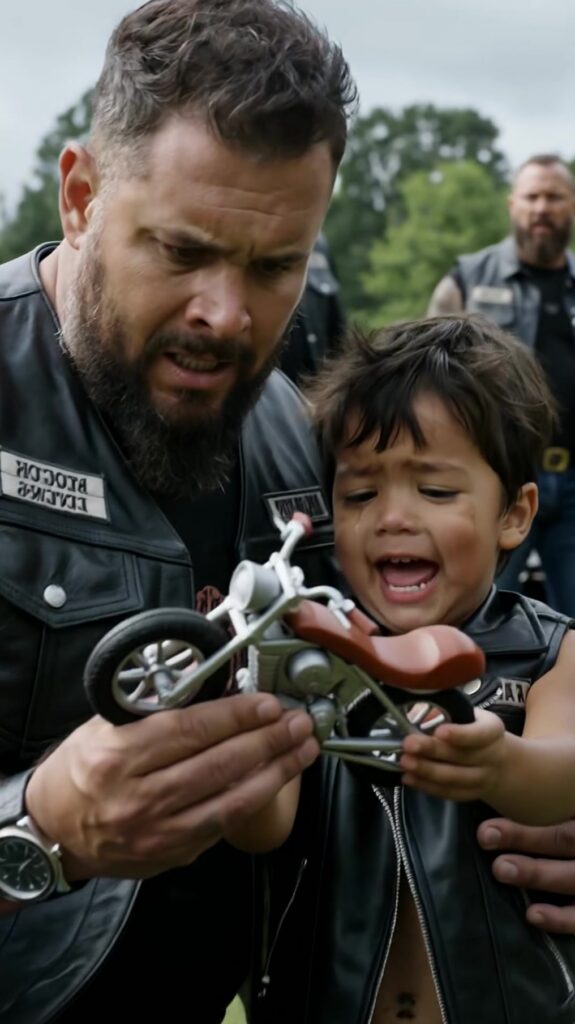
Instead, a little boy came running through the side gate like he’d been launched. He wore shorts, sneakers that were one size too big, and a tiny black leather vest over a faded T-shirt. The vest looked like it had been made with care but out of leftovers—stitching a little crooked, the edges a bit raw, the way a father might do it at a kitchen table with a needle and determination.
The boy clutched a toy motorcycle in both hands so tightly his knuckles were pale. He was sobbing so hard he could barely breathe, like his ribs didn’t know how to make room for air anymore. He darted across the grass, eyes wide and frantic, scanning faces the way someone scans a crowd for an exit.
“Hey—” someone started, but the kid didn’t slow.
He tripped over a hump in the yard—an old root pushing up through the dirt. He went down hard. His knees hit first, then his elbows. The toy motorcycle smacked the ground too, a sharp plastic clack that made a few of the men flinch.
But the kid didn’t let go. He curled around it like it was fragile glass. Still crying, he dragged himself upright, smeared grass on his cheek, and stumbled forward again.
He stopped in front of the biggest biker in the yard—Duke “Gravel” Grady—who was leaning against his bike with a paper cup of coffee like it was holding him together. Duke had a thick gray-black beard, arms like a pair of tree trunks, and a face that looked carved out of every bad decision he’d ever survived. He was the kind of man strangers crossed the street to avoid.
The kid held the toy motorcycle out with both hands, offering it like a peace treaty.
“Please,” he said, voice cracking. “Mister. Buy it.”
Duke blinked once, slow. The yard behind him—half a dozen men, boots planted, leather vests, patches—quieted in a way that felt heavy. Duke set his coffee on the seat of his bike and crouched down until he was eye-level with the child.
“That yours?” Duke asked. His voice was rough, but he didn’t bark it. He kept it low, like he was trying not to scare the kid any more than the world already had.
The boy sniffed, nodded, then shook his head like he couldn’t decide which answer fit. “It’s mine now,” he said. “My dad made it. He said I gotta sell it if… if stuff happens.”
Duke reached out slowly, not to grab, just to ask permission. The kid’s hands trembled as he let the toy go.
Up close, it didn’t look like a toy from a store. It was handmade, sure, but not in a clumsy way. The shape was right. The proportions were right. Even the tiny scuffs along the “tank” looked intentional, like someone understood where real bikes wore down. The handlebars were curved with that particular bend Duke always liked. The little stripe down the side was painted black, straight as a promise.
Duke’s face changed in a fraction of a second—like someone had unplugged the hard mask and left the man underneath exposed.
Because Duke knew it. Not the idea of it. The actual work. The tiny file marks he used to leave when he got impatient. The way he always exaggerated the rear fender. The little groove he carved near the seat for no reason other than he liked how it looked.
His throat tightened so suddenly it felt like he’d swallowed a stone.
“Who’s your dad?” Duke asked, and the words came out different than he meant—too careful, too scared.
The boy wiped his face with the heel of his hand and tried to breathe like he’d practiced it. “His name’s Eli,” he said. “Eli Carter. He… he’s not here.”
“Not here,” Duke repeated, because sometimes you make people say things twice when you don’t want them to be true.
The kid’s eyes went wet again, fresh tears spilling like his face didn’t have an off switch. “He got sick,” he whispered. “He tried to be okay. He told me not to tell anybody because… because people get weird.”
Behind Duke, one of the men shifted his weight. Someone cleared their throat. Nobody made a joke. Nobody reached for a cigarette. The usual noise was gone.
Duke forced himself to look back down at the boy. “You came here alone?”
The kid nodded, then fumbled with the inside of his vest, fingers working at the lining like he’d done it a hundred times in secret. He pulled out a folded photo, creased and softened from being carried around. He held it out with shaky hands.
“He said if he died,” the boy said, voice wobbling, “I should find the biker who is my father.”
The words fell into the yard like a wrench dropped on concrete. Hard. Final. Loud in a way that didn’t require volume.
Duke didn’t move for a full breath. Then he took the photo gently, like touching it too hard might change what was on it.
He unfolded it.
A young woman stared back at him from twenty years ago, smiling like the world hadn’t taught her caution yet. Her hair was a mess of curls, and her eyes had that bright, stubborn warmth Duke had once mistaken for something that would never burn out. He knew her face immediately, in the same way you know an old scar—familiar even if you pretend not to look at it.
Marin.
And beside her, wrapped in a blanket that had once been deep black but had faded into charcoal, was a newborn baby. The blanket had a patch stitched onto it—hand-sewn, uneven around the edges, but unmistakable. Duke’s old club emblem. The one he’d ripped off his vest the night he walked away and told himself it was freedom.
Duke’s fingers tightened around the photo without meaning to.
He looked back at the boy. The kid had Marin’s eyes. Eli’s name meant nothing to Duke, but those eyes—those were a punch to the ribs from the past.
“What’s your name?” Duke asked, and his voice cracked on the last word like a man who hadn’t said anything gentle in years.
“Rowan,” the boy whispered. “Rowan Carter. But… Dad said my other last name is Grady. He said you’d know.”
The yard stayed silent, but it wasn’t empty silence. It was the kind that presses in on you, waiting to see what you do next.
Duke stared at the toy motorcycle in his big, scarred hands, then at the photo, then at the boy’s scraped knees. There were a dozen things he could’ve done. He could’ve denied it. He could’ve asked questions like a lawyer. He could’ve stood up and walked away and told himself it was too late, too messy, too dangerous.
Instead, he did something that surprised even him.
He took off his own vest.
The leather was worn soft in places and stiff in others, heavy with years. The patch on the back marked him as someone you didn’t mess with. It should’ve looked ridiculous draped over a child, like dressing a sparrow in armor.
Duke held it open. “Come here,” he said.
Rowan hesitated, looking over Duke’s shoulder at the other bikers. They weren’t smiling, but their faces had shifted into something else—something like caution mixed with respect. Like they all understood a line had been crossed and there was no un-crossing it.
Rowan stepped forward.
Duke wrapped the vest around him anyway, settling it over the tiny shoulders like a promise that actually weighed something. Then he lifted the boy—easy, like Rowan was nothing but air—and stood up with him on his hip.
“You don’t have to sell that,” Duke said, nodding at the toy bike. His eyes stayed on Rowan’s face like he was trying to memorize it in case the world stole it again. “Keep it. We’ll fix the scratches. And you’re not walking anywhere alone anymore. Not today.”
Rowan’s mouth opened like he wanted to say something brave, but a sob came out instead. He pressed his face into Duke’s shoulder, clutching the toy motorcycle between them. Duke stood there, huge and still, like a mountain deciding to move for the first time.
He looked at the men around him. “Clear the office,” he said, voice back to gravel but different now—steadier. “And call Doc. And somebody get this kid some water and a bandage.”
As the yard snapped into motion, Duke stared past the fence toward the road, like he could see twenty years ago coming at him fast.
He didn’t know who Eli Carter really was. He didn’t know why Marin had stayed away. He didn’t know how a child ended up running into a biker yard with a toy motorcycle like a lifeline.
But he knew one thing with a certainty that made his chest ache.
Whatever he’d been before, whatever he’d run from, it had finally caught him.
And this time, he wasn’t going to leave.