The yard behind the clubhouse held its breath in the late afternoon heat. Gravel and grass met in a ragged seam where boots and tires had chewed the ground bare. A dozen motorcycles stood angled in a neat line beside the fence—matte black, chrome scabbed with sun, their shadows long and sharp like blades laid down to rest.
Inside, the men were loud with the ordinary noise of survival: laughter that didn’t quite mean joy, arguments that didn’t quite mean anger. It was a sound that kept the silence from crawling in.
Then a child cried.
The sound cut through the yard the way a bell cuts through fog. Men turned their heads as if someone had fired a shot. A couple of prospect kids—barely old enough to shave—looked at each other, unsure whether they’d imagined it.
The crying came again. Closer. Raw and ragged, as if it had already been going for miles.
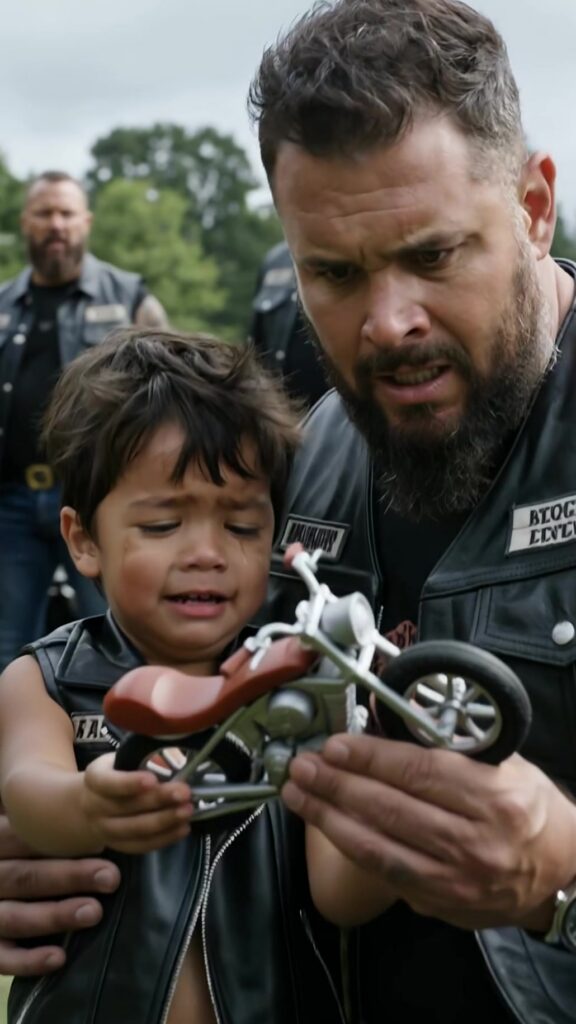
Out from the side gate, a boy burst into view. He couldn’t have been more than six or seven, small enough that the grass swallowed his shins as he ran. He wore a tiny leather vest that seemed to have been cut from someone else’s past—black, worn soft, with a faint outline where a patch had once been. His cheeks were streaked, his nose red, his mouth trembling open on each sob.
Clutched in both hands, held to his chest like a lifeline, was a toy motorcycle.
He sprinted straight into the open yard and stumbled almost immediately. His toe caught a hidden root and he went down hard, the air knocked clean out of him. A few bikers flinched as if the ground had hit them instead.
The boy lay there for a second, shaking, then rolled up to his knees. His hands never loosened. Even as he cried, he checked the toy for damage with frantic, careful fingers.
Across the yard, the biggest man there stepped forward. His beard was iron-gray at the edges, his arms thick as fence posts, his vest heavy with patches that made strangers swallow their courage. The others called him Boone. No one used his first name anymore. It had been worn away like a coin.
Boone’s shadow swallowed the boy when he approached. The child looked up at him, eyes wide with the kind of fear that doesn’t come from monsters in closets, but from real men and real hunger.
The boy held the toy out with both hands, arms shaking. “Please, sir,” he managed. His voice was thin, scraped raw. “Buy it.”
Boone’s brow tightened. His eyes were pale and steady, but something behind them shifted, like a lock turning. He knelt slowly, lowering his bulk until he was closer to the boy’s height. The men behind him stopped talking. Even the wind seemed to pause at the fence line.
Boone nodded toward the toy. “Who made that?”
The child wiped his face with the back of his hand, smearing tears into his hairline. He tried to take a breath and failed, then tried again. “My dad.”
Boone reached out. He did it like someone approaching a wild animal—slow, careful, with the assumption that any sudden move could send the whole thing shattering. His fingers closed around the toy.
It wasn’t store-bought. It wasn’t glossy, perfect plastic. It was carved wood, smoothed until it looked almost alive. The handlebars curved with a deliberate bend. The gas tank had a faint dent carved into one side, as if it had survived a story. A narrow stripe—painted black over darker black—ran along the frame, not for decoration, but because whoever made it could not stop himself from adding a signature.
Boone stared at that stripe.
The yard sharpened around him: the smell of gasoline, the grit beneath his knee, the distant hum of a highway. His throat tightened so suddenly he had to swallow hard.
He’d made toys like this once. A lifetime ago, when he still had a small set of tools in a shoebox and the ridiculous belief that the world could be softened with careful hands. He’d made them for one woman, hidden away from the club, from the rules, from the blood.
Only one.
Boone’s voice lowered. “What’s your dad’s name?”
The boy’s lip quivered. Tears spilled again, faster now, as if the question had loosened something in him. He stared straight into Boone’s face, searching it for something he didn’t know how to name. “He… he said if he died,” the boy whispered, “I should find the biker who is my father.”
Silence slammed into the yard. Boots stopped shifting. A man near the fence let his cigarette burn down to the filter without noticing.
Boone didn’t move. The toy sat in his hands like a weight that could break bone. His knuckles went white around the carved frame.
“He died?” Boone asked, and it came out rough, as if the word had thorns.
The boy nodded hard. “At the hospital. Mom—” He choked on the word, trying to swallow it. “Mom’s gone too. Long time. Grandma said I should sell this to buy food, but Dad said no. He said this is how I’ll find you.”
Boone blinked once, slow. His eyes—those unflinching eyes that had stared down guns and courts and rivals—looked suddenly unarmored.
The boy’s hand went to the inside of his tiny vest, fingers fumbling at the lining like he’d practiced the motion in the dark. He pulled out a folded photograph, creased soft at the corners from being opened too many times. He held it up as if it might bite him, or save him. “He said show you,” the boy whispered.
Boone took the photo. The paper was warm from the child’s body.
One look, and the blood drained from Boone’s face so fast it made him sway.
In the photograph, a young woman stood against a sunlit wall, her hair wind-tangled, her smile stubborn and bright. Her eyes were the kind that dared the world to do its worst. Boone had known that smile. He’d kissed it. He’d left it.
And in her arms, a newborn baby slept, wrapped in a blanket. The blanket wasn’t just any scrap of cloth. It carried a stitched emblem—faded now in the photo, but unmistakable. The patch Boone had ripped off his own back twenty years ago and thrown onto a barroom floor when he told the club he was done being owned by anything.
His patch. Sewn into a child’s blanket like a prayer.
Boone’s mouth opened, but no sound came. He looked up at the boy again, and the boy looked back with the desperate patience of someone who had been told to wait for a miracle and had no other option.
Behind Boone, the clubhouse felt suddenly farther away, like another life. All that remained was the photograph, the toy, and the small trembling boy who had run into a yard full of hardened men as if it were the only safe place left on earth.
Boone’s voice finally worked, cracked at the edges. “What’s your name, kid?”
The boy sniffed hard. “Eli.”
Boone repeated it under his breath, as if tasting it for truth. He looked down at the toy motorcycle again, at the careful stripe, the tiny carved dent, the work that could only have come from his own hands or from someone who had watched him closely enough to learn the language of his fingers.
He’d left a woman with a smile like sunlight. He’d left a patch. He’d left tenderness behind because it was easier to be feared than to be needed.
And now need stood before him, crying, holding out the past as proof.
Boone reached out, not for the toy this time, but for the boy’s shoulder. Eli flinched at first—trained to expect pain—but Boone’s hand was steady, and he did not squeeze. He simply rested his palm there like a promise that weighed more than any gun.
“You don’t have to sell it,” Boone said. The words were plain, but they shook, betraying the storm underneath. “You hear me? You don’t have to sell anything.”
Eli’s eyes searched Boone’s face. “Are… are you him?”
Boone stared at the photograph once more, then folded it carefully, as if folding a flag. When he looked back at Eli, there was something fierce in his expression—an anger at himself, at time, at every choice that had built a wall between them. And under that anger, something softer that had survived all those years in hiding.
“Yeah,” Boone said, voice low and final. “I’m him.”
In the stunned quiet, one of the older bikers took a step forward as if to speak, then stopped. Nobody knew what to do with a moment like this. They were men who understood debts, not destiny. Consequences, not second chances.
Boone rose, scooping the boy up with surprising gentleness. Eli clung to him automatically, arms wrapping around Boone’s neck as if his body recognized the answer before his mind dared accept it. Boone held the toy motorcycle in one hand, his son in the other, and turned toward the clubhouse.
As he walked, the line of motorcycles beside the fence remained still and dark. But the yard no longer felt like a place of silent witnesses.
It felt like a courtroom where Boone was finally being judged by the one person whose verdict mattered.
And inside the clubhouse, beyond the door, whatever life Boone had built without tenderness was about to be put on trial—because a boy with a toy motorcycle had come running through the grass, carrying the last handmade proof of a love Boone had tried to abandon, and refusing to let go when the world knocked him down.