The café was glowing with golden light when the little boy stepped between the tables, and for an instant the room didn’t know what to do with him. Sunlight poured through tall panes and caught on the rims of crystal glasses, turning conversation into a soft, expensive shimmer. A pianist in the corner kept his hands moving because he had learned that silence drew attention, and attention meant questions.
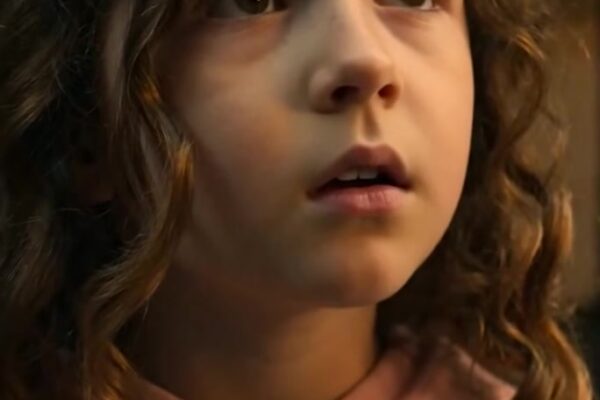
The boy was all questions. Bare torso streaked with grime, knees scraped raw, ribs lifting too quickly as if each breath had to be stolen. He moved as if the chairs were a forest and he had been chased into it. Heads turned. Linen napkins paused halfway to mouths. A woman in pearls frowned as though the child had tracked mud straight across her thoughts.
At a table near the window sat a woman who looked as if she belonged to the light. Her dress was pale, her posture composed, and her hair—thick and glossy, the color of dark honey—fell over one shoulder in a practiced sweep. She had the stillness of someone who had paid a great deal to be left alone.
The boy’s gaze latched onto her hair with the hunger of recognition. He threaded between tables without asking permission, the sound of his bare feet too loud against the stone. He lifted one hand, trembling, and before anyone could stop him, his fingers brushed the smooth curtain of her hair.
She snapped back as if the touch were heat. Her chair scraped the floor, sharp as a reprimand.
“Hey—don’t touch me.”
The nearest table fell quiet. Even the pianist hesitated, a wrong note swallowed in time.
The boy pulled his hand back slowly, as if he’d reached for a flame and discovered it was real. But he didn’t bolt. He didn’t apologize. He stared at her with the stunned intensity of someone who had been taught that finding a thing mattered more than the consequences of holding it.
His eyes filled, the tears coming fast and unpracticed. “She has the same hair,” he whispered.
The woman’s mouth tightened. Annoyance tried to reassert itself, but something in the boy’s voice made it fail. “What are you talking about?” she demanded, though it landed less like an order than a defense.
He took a half step closer. His whole body quivered as if the café’s warmth couldn’t reach the cold inside him. “My mom said I’d find you here.”
Her expression changed not into belief but into something sharper and older—fear with the edges sanded down by etiquette. She seemed to scan him, as though searching for a trick, a camera, a planted witness. When she spoke again, her voice had dropped into a register meant for private disasters.
“Who is your mother?”
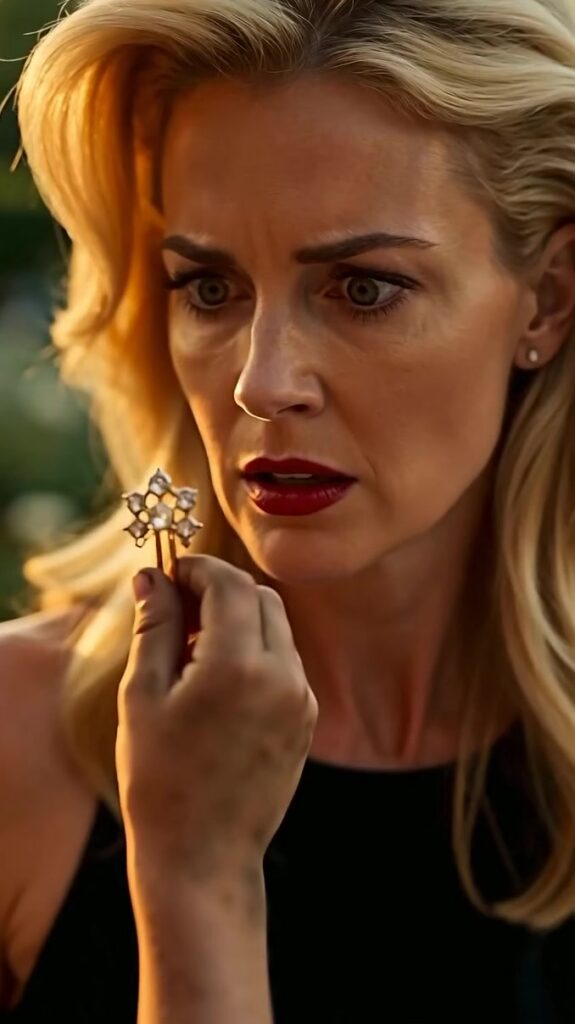
The boy didn’t answer with a name. Instead, he thrust his shaking hand into his pocket and fumbled with something small. He brought it out like an offering. A jeweled hair clip, ornate and old-fashioned, studded with tiny stones arranged like petals around a central sapphire. Dust clung to it, but the sunlight caught the facets and lit them with a clean, merciless glint.
The woman’s face drained of color so quickly it looked as if the light had been sucked out of her skin. Her hands hovered above the table, not touching anything, as if she didn’t trust herself not to knock the world over.
“That’s impossible,” she whispered.
A tear slid down the boy’s cheek and traced a clean line through the dirt. “She said you’d say that.”
The woman stood so abruptly her chair clattered backward. Several patrons recoiled. One man began to rise, perhaps ready to intervene, but something in the woman’s eyes froze him where he was. Her composure had cracked, and beneath it was a frantic, focused urgency.
“Where is she?” she asked, and the question sounded like it had been waiting years in her throat.
The boy turned his head slowly toward the garden path behind the café, where a narrow corridor of trimmed hedges led to the street. Golden leaves trembled on their branches in the breeze. For a moment, it seemed empty.
Then the woman saw her.
Half-hidden between the trees, standing where shadow stitched itself into sunlight, was another woman in a gray suit. Her hair was pinned back with severe precision. She was too still, too controlled, as if movement would be a confession. Her gaze stayed fixed on the table, on the boy, on the jeweled clip like a blade held up to the light.
The hair clip shook in the boy’s hand. The elegant woman took one step forward, her face unraveling—shock, grief, anger, all crowding to the surface. “Mara,” she breathed, and the name seemed to puncture the air.
The woman in gray didn’t flinch, but her eyes flickered, just once, toward the café’s exit, gauging distance and witnesses. Then she began to turn away.
“Don’t,” the elegant woman said, and it came out rougher than she intended. Heads swiveled. The pianist stopped playing entirely now, surrendering to the silence.
The woman in gray walked, measured and calm, as if she had every right to leave. The boy’s small body tensed, panic rising. He looked between them, torn like cloth. “She said you’d try to go,” he whispered, not accusing, just terrified.
The elegant woman—Claudine, the boy would learn her name later—didn’t chase. She knew better than to run into a trap in public. Instead, she lifted her voice just enough to carry past the hedges. “If you leave now, I’ll call the police. I’ll tell them you’re alive.”
The woman in gray stopped. The garden held its breath. “Alive,” she repeated softly, as if tasting the word for poison. She turned back, not fully, just enough that her profile showed. “You promised you would never say that.”
Claudine’s hands curled into fists at her sides. “I promised a lot of things when I thought you were dead.” Her gaze snapped to the boy. “Is he—” She couldn’t finish the sentence. The possibility was too heavy to speak aloud in a room full of strangers and clinking plates.
The woman in gray’s eyes softened, and that softness was more frightening than hardness; it meant she still felt. “No,” she said. “He isn’t yours. He’s only the message.”
The boy swallowed, his voice cracking with the weight of being used. “My mom said you were the only one who could stop him,” he blurted. “She said if you saw the clip you’d remember.”
Claudine’s gaze returned to the jeweled hair clip, and memory struck her like a slap: a dressing room thick with perfume; laughter too loud; Mara pinning the clip into Claudine’s hair with hands that trembled because she was always nervous around people who smiled for cameras. “For luck,” Mara had said. “So you don’t forget who you are when they make you pretend.”
And later—blood on tile, the clip missing, the official reports filed, the city’s story written without room for the truth.
Claudine stepped around the table, and this time she did move toward the garden. Not running, not pleading, but walking with the quiet certainty of someone who had finally stopped protecting herself. The guests watched, their annoyance dissolved into curiosity and then into discomfort, because whatever was happening was not entertainment. It was consequence.
At the hedge’s edge, Claudine stopped at a respectful distance. The boy hovered behind her like a shadow that had learned to speak. “Mara,” Claudine said again, and it was a question now: Why? How? What did you do to survive?
Mara’s jaw tightened. “You should go back inside,” she said, as if manners could still save them. “Let this be a misunderstanding. Let the boy be a lost child. Let me disappear.”
“I can’t,” Claudine replied. “Because you sent him.”
Mara’s eyes flicked to the boy. The smallest of smiles touched her mouth—pained, proud. “I sent him because I couldn’t come,” she admitted. “Not without bringing someone with me.”
At that, Claudine’s stomach dropped. She glanced past the trees to the street beyond the garden, to the parked cars gleaming in sunlight. She noticed, too late, the man leaning near the gate, pretending to check his phone, his gaze too intent, his posture too still.
“He followed you,” Claudine said.
Mara didn’t deny it. “He always does.”
The boy clutched the hair clip to his chest as if it could shield him. “My mom said you’d know what to do,” he whispered, voice desperate with hope.
Claudine stared at Mara—at the gray suit, the controlled hands, the eyes that begged her to understand without asking for forgiveness. Claudine felt the café behind her like a stage, felt the weight of every gaze, and realized none of it mattered. The only light that mattered now was the one falling through leaves, striping the path between them like bars.
Claudine reached out, palm open, not for Mara’s hair, not for the past, but for the future that was trying to run away. “Give me the clip,” she told the boy gently. “And take my hand.”
The boy hesitated, then placed the jeweled clip into her palm. It was colder than it should have been. Claudine closed her fingers around it, feeling the sharp edges bite. She offered her other hand to the child.
Mara’s breath hitched. “Claudine,” she warned, and there was terror in it now, raw and unhidden. “If you do this, there’s no going back.”
Claudine looked past Mara to the man by the gate, then back to the woman who had once pinned luck into her hair. “Good,” Claudine said, and her voice steadied into something dangerous. “I’m tired of going back.”
She took the boy’s hand. Together they stepped into the garden’s narrow path, toward Mara—and toward whoever waited beyond the hedges—while the café’s golden light spilled after them like a blessing that couldn’t stop what was coming.