The cemetery was soaked with cold autumn rain from the night before, the kind that doesn’t fall loudly but seeps into everything it touches. The soil had turned to a slick, dark paste. Wet brown leaves lay flattened like old letters no one dared to read, and the bare trees leaned in over the rows of stones as if the dead needed shelter.
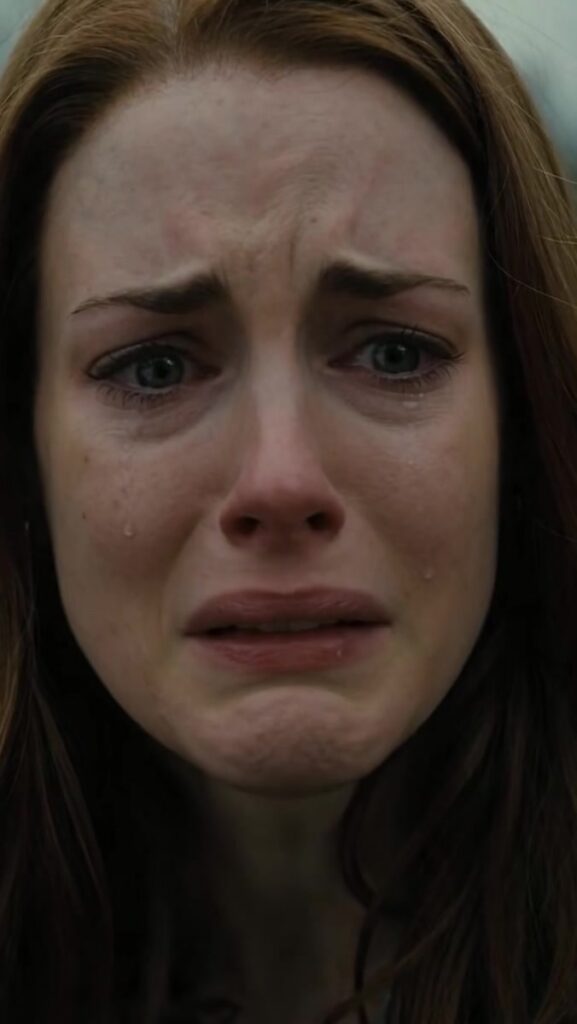
In front of one weathered marker, Mara Halloway knelt so still she looked carved from grief. Her black coat was saturated, clinging to her arms and shoulders; rain had darkened her hair into ropes against her cheeks. She hid her face in her hands, and her sobs were soundless—only the violent tremor of her shoulders gave them away.
Beside her, her husband, Thomas, crouched in a suit too thin for the cold. His eyes stared past the engraved names and dates and the small oval photograph set into the stone—a black-and-white image of two boys with identical dimples and bright mischief in their smiles. Adam and Levi. Their sons. Their twins. Their whole world, sealed into granite by a verdict everyone had insisted was final.
“They said it was quick,” Mara had whispered on the day of the fire. “They said they didn’t suffer.”
Now, at the grave, Thomas couldn’t remember who had said it. A policeman with gentle hands? A coroner who wouldn’t meet their eyes? A social worker with a clipboard that never seemed to close? All he remembered was the word they kept repeating as if it could substitute for truth: identified.
Mara’s fingers dug into her own palms until she felt pain, because pain was something she could understand. Grief was an ocean with no bottom.
Then she felt it—an interruption in the air. Not wind. Not a falling leaf. The sense of being watched, as sharp and intimate as someone standing too close.
Mara lowered her hands, expecting perhaps a groundskeeper or a stranger who couldn’t read a room. What she saw stole the breath from her lungs.
A little girl stood on the far side of the headstone, barefoot in the mud as if the cold had forgotten her. She was tiny, no older than six or seven, her pale hair a storm-tossed tangle. Dirt smudged her cheeks and chin, and her thin smock hung in strips, soaked and heavy.
She did not look lost. She did not look frightened. She looked certain, as if she had been given a direction and would walk through fire to obey it.
Her small hand rose and pointed at the photograph embedded in the stone.
“The boys in that picture,” she said, her voice quiet but oddly steady in the damp hush, “they stay with me at the East Side orphanage.”
The cemetery seemed to hold its breath. Even the trees stopped their complaining creak. Mara stared at the girl, unable to connect the words to meaning.
Thomas lurched forward, his knees cracking against the wet ground. “What did you say?” His voice sounded like it belonged to someone else.
The girl didn’t blink. Her finger remained fixed on the boys’ smiling faces. “They sleep next to me.”
Mara’s mouth opened; no sound came. A thin, animal noise tried to rise and died in her throat. Thomas stood halfway, swaying, his face losing color as if the rain had washed it away.
“That’s not possible,” he said, but the words were only a habit. His heart had already begun to believe, because his heart had never accepted the grave.
The child lowered her hand. A leaf scraped along the stone with a soft, wet hiss. She looked from the photograph to Mara, then to Thomas, measuring them with eyes too tired to be a child’s.
Then she took one small step closer. Mud sucked at her feet. She didn’t flinch.
“One of them cries at night,” she murmured. “He tries not to. But he does.”
Mara made a broken sound and covered her mouth. Tears flooded her eyes so quickly her vision blurred. Thomas’s hands began to shake; he pressed them against his thighs as if he could force them still.
The girl tilted her head slightly. “He says your name when he wakes up,” she added, speaking to Mara now. “He says, ‘Mama,’ and then he says, ‘Mara,’ like he’s afraid you won’t know it’s him.”
Mara grabbed Thomas’s sleeve with both hands, not to steady herself but to anchor him, to keep him from collapsing into the grave. Thomas turned to the headstone, then back to the child, as if his mind kept skipping like a scratched record.
“Who are you?” Thomas whispered.
The little girl hesitated, as if names were something that could be taken. “I’m Elsie,” she said finally. “They told me to find you.”
“Who told you?” Mara rasped.
Elsie’s eyes flicked toward the cemetery gate, where the iron bars stood open onto the gray road. “The lady with the keys,” she said. “She said if I wanted the boys to stop hurting, I had to bring you.”
Thomas’s stomach turned. “The lady with the keys?”
Elsie nodded. “She keeps the doors locked at night. She says it’s for our safety. But it’s not.”
The rain began again, not in sheets but in needles, tapping against stone and coat and skin. Mara forced herself to stand, her legs trembling. She shrugged off her scarf and wrapped it around the girl’s shoulders. Elsie didn’t protest. She accepted it like a soldier accepting a blanket.
“Show us,” Thomas said, voice low and urgent. “Take us there.”
Elsie looked up at the headstone one more time. Her gaze lingered on the photograph, and her face tightened with something that wasn’t fear but resolve. “They’re not dead,” she said, almost matter-of-fact, as if the obvious needed saying. “They’re just… kept.”
Mara’s breath came in sharp bursts. “Kept by who?”
Elsie’s lips pressed together. “By people who like quiet children,” she said. “People who don’t want anyone to ask questions.”
Thomas felt something ancient and violent rise in him—rage braided with hope, a dangerous rope. He looked down at the stone, at the carved names that suddenly felt like an accusation. Someone had taken his boys and buried a lie in their place.
He stepped away from the grave, then stopped. His hands hovered as if unsure where to go. Finally he reached out and touched the cold photograph with two fingers, a farewell and a promise at once.
“We’re coming,” he whispered to the smiling faces trapped behind the glass.
Elsie started walking, barefoot through the mud, as if she knew the shortest path out of the cemetery. Mara and Thomas followed, slipping on wet leaves, hearts pounding like fists against locked doors. Behind them, the stones stood in their rows, gray and patient, holding secrets that did not belong to the dead.
At the gate, Elsie paused and pointed down the road where the town thinned and the river cut through the industrial district. “East Side,” she said. “Big brick building. Tall windows. The lady says nobody hears you if you cry there because the trains are loud.”
Thomas swallowed hard. “We’re going to bring them home,” he said, and his voice finally sounded like his own.
Mara took Elsie’s small, cold hand in hers. It was bony, trembling now that the moment had shifted from mission to motion. “And you,” Mara said, forcing gentleness through the storm in her chest, “you’re coming too.”
Elsie looked up, and for the first time her certainty cracked enough to show the child beneath. “I’m not supposed to,” she whispered.
“Then let them be angry,” Thomas said, eyes fixed on the road ahead. “Let them try to stop us.”
They left the cemetery behind, trailing mud and rain and an impossible hope that burned hotter than grief. And as they walked toward the orphanage, the wind rose again among the bare trees, not a sigh this time, but a warning—like the world itself knew that a grave was about to be emptied of its lie.