The city moved around them like they were invisible—an uncaring tide of shoes and exhaust and impatient voices. At the curb, cars slid past with the smooth certainty of things that never had to stop. Inside the café, forks clicked against porcelain, laughter rose and fell, and the glass windows held it all like warmth behind a barrier. Out here, on the narrow strip of sidewalk where winter light couldn’t decide whether to stay or leave, the world kept its pace.
August Wren sat at a small round table that had been set too close to the street, as if the staff had wanted his wheelchair out of the way but not wholly gone. His suit was dark and expensive, the fabric draping with practiced authority over a body that had forgotten its own strength. A half-eaten meal cooled in front of him. He stared at it like it had personally offended him.
Once, people had moved when he entered a room. Once, doors opened before his hand reached them. Even after the accident—after the broken spine and the weeks of doctors explaining what could not be unbroken—he’d grown used to being obeyed. His money still drew attention. His name still clipped conversations short.
But out here, on the street, with the wheelchair wheels catching in cracks and the wind pushing the smell of frying oil into his face, there were moments when he felt the city’s indifference pressing in. It had no need for him. It didn’t look at him twice.
He was deciding whether to send his driver back for him when a shadow fell across the table. Not the solid shadow of a passerby, but a hesitating presence that didn’t have a destination.
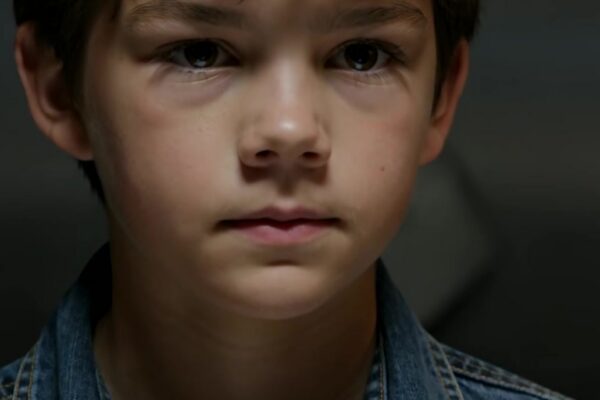
A boy dropped to his knees on the concrete beside the wheelchair. Thin as a question mark. Dirt streaked his cheekbones. His hair was too long, as if scissors had been a luxury for years. In his arms, wrapped in a blanket that might once have been a towel, he held an infant so carefully it looked like the only thing he trusted himself not to ruin.
“Sir,” the boy said, and the word came out like it hurt. His breath shook. “Please listen. Just one minute.”
August’s hand tightened on the armrest. “Get up,” he snapped, because people kneeling in public made him feel watched. “What is this?”
The boy didn’t rise. He shifted the bundle closer, shielding the baby’s face with the blanket’s frayed edge, as if the wind itself might steal it. “This baby,” he said, voice cracking, “can heal your legs.”
For one stunned heartbeat, August only stared. It wasn’t the claim that shocked him—he’d heard every desperate pitch a city could invent. Miracle pills, prayer chains, cursed gemstones, an old woman who read palms and promised second chances. It was the boy’s certainty. The trembling conviction of someone who had nothing left except belief.
Then August laughed. The sound came out loud and cruel, echoing too brightly in the narrow space between café window and street. “A baby?” he said, head tipping back. “You want food so badly you’ve written yourself a fairy tale?”
The boy flinched like a struck animal, but he stayed where he was. His knees pressed into the concrete. He didn’t beg with his hands; he held the infant as if the child might shatter if he loosened his grip.
A smaller figure hovered behind him—a second homeless child, younger, with chapped lips and fearful eyes. “Please don’t laugh,” the younger one whispered, voice barely audible under traffic. “Please.”
August’s laughter faded into a smile sharpened by habit. “And you think the right person is me?” he asked, the words heavy with contempt. “Why? Because my suit is nicer than yours?”
The kneeling boy’s eyes shone wetly. He swallowed, once, like he was forcing down fear. “My mother said,” he whispered, “if he touched the right person… they would stand.”
August’s smile tightened. The word mother landed oddly, like a stone dropped into still water. “Where is she now?” he demanded, and immediately hated that the question sounded less like mockery and more like curiosity.
The boy’s gaze flicked away, somewhere to the curb, to the storm drain, to anything that wasn’t August’s face. “Gone,” he said. “She made me promise.”
August leaned back, preparing the next cruel line. He had learned to protect himself with disdain. Pity was a soft thing; it made a man vulnerable. And vulnerability had been what the accident stole last—after his legs stopped working, after his friends stopped calling, after his son stopped answering messages.
He opened his mouth.
The infant’s tiny hand slipped free of the blanket’s fold. A small fist uncurling like a flower that had no right to bloom in cold air. The hand brushed August’s wrist where it rested against the wheelchair arm.
Everything inside him locked.
It wasn’t warmth. It wasn’t electricity. It was a sensation so deep it didn’t belong to skin at all—a sudden pressure behind the eyes, a rush of memory that wasn’t his, a brief, brutal impression of falling through water while voices screamed his name.
August’s breath cut off. His fingers dug into the wheelchair armrest as if he could anchor himself to metal. His smile vanished so completely it seemed to have been erased. He stared at his own hand, then at the baby’s, as though he couldn’t believe either existed.
“What…” he whispered, the word breaking apart. “What was that?”
The kneeling boy didn’t move. The younger child’s mouth fell open.
August’s right foot twitched.
Once—small, unmistakable, a muscle remembering it had a job.
His heart slammed against his ribs. In the café window, his reflection looked unfamiliar, like a stranger wearing his suit. He tried to move his foot again. Nothing. He tried to will it, to command it, the way he commanded boardrooms and men.
Nothing.
But that single twitch remained, burning through him like a match struck in darkness.
Then something slipped from the blanket with a soft clink and landed on the metal table. A small object, silver and dulled by time. A charm on a broken chain.
August’s eyes dropped to it—and the world narrowed to a point. The engraving was shallow but precise: a crest he had seen on stationary, cufflinks, signet rings. A family mark older than the city’s glass towers. A mark he’d sworn would belong to his son someday.
His throat went dry. “Where did you get this?” he demanded, and his voice no longer held mockery. It held fear.
The kneeling boy lifted his face. Tears made clean lines through the dirt on his cheeks. “My mother said it belonged to your son,” he whispered. “She said you would know.”
August’s pulse throbbed in his wrists. His mind raced backward through months and headlines and unanswered calls. His son, Elias, vanishing after a charity gala. The police telling him to be patient. The city telling him, in a hundred polite ways, that missing men were common and tragedies were routine.
He stared at the baby again, at the too-small fingers curled now around the blanket’s edge. The infant blinked slowly, as if unbothered by the storm it had awakened.
“Who is this child?” August asked, and his voice shook, betraying him. “Tell me the truth.”
The boy’s lips trembled. “His name is Jonah,” he said. “My mother called him a promise. She said… he’s what your family lost. And what we did too.” He hesitated, as if the next sentence might collapse the sky. “She said your son didn’t run away. She said he tried to save us.”
August felt the city’s noise retreat, like a curtain drawn. The clinking dishes, the humming cars, the indifferent footsteps—they all continued, but they no longer seemed real. Something else had stepped into the space between him and the street, something with teeth.
“Where is your mother buried?” he asked softly, shocking himself with the gentleness. “And where did she meet my son?”
The boy swallowed hard. “She’s not buried,” he said. “They took her. The night she told me to find you. The same night she gave me the charm.” He looked down at the baby, then back up with desperate resolve. “Sir… if you can stand, you can help us. You can help him. You can help find your son.”
August’s hand hovered over the charm, as if touching it might burn him. He imagined Elias’s laughter, his stubbornness, the way he’d once said, Father, you don’t see people until they’re useful to you. August had scoffed then. Now, with a homeless boy on his knees and a baby in a threadbare blanket holding a key to his ruined body, the accusation turned into prophecy.
August closed his fingers around the silver crest. Cold bit his palm. He drew in a shaky breath and looked past the café window, past the city that had never slowed for suffering, and for the first time in years he felt something like purpose lifting its head.
“Get in the car with me,” he said, voice low and final. “All of you.”
The boy’s eyes widened. “You believe me?”
August glanced down at his foot and commanded it to move again, not with arrogance but with pleading. It didn’t. Yet the memory of that twitch pulsed like a heartbeat. “I don’t know what I believe,” he admitted, and the honesty tasted strange. “But I know this charm. And I know the way my life just changed.”
He lifted his gaze to the infant. “If my son is alive,” he said, each word a vow, “then the city will stop ignoring you. I will make it look.”
The city continued to flow around them, indifferent as ever. But at the small table by the curb, something had cracked—an old man’s certainty, a boy’s despair, the invisible wall between those who were seen and those who weren’t. And in that thin fracture, a miracle—or a reckoning—began to breathe.