The cobblestone street was cool and quiet, lined with old stone buildings and the smell of warm pastry drifting through the air. Morning light lay in thin ribbons between rooftops, catching on windows that had watched centuries go by. Somewhere a bell chimed the half hour, muffled as if even time had learned to speak softly here.
Adrian Kessler moved through it like a man who had forgotten how to notice. His navy suit was too sharp for the hour, his shoes too polished for the uneven stones. His phone sat heavy in his palm, the screen briefly lighting his face with urgent messages he didn’t have time to answer properly. A town car waited at the far end of the street. A meeting waited beyond that. A life he’d built without asking what it was made of waited, too.
He checked his watch, distracted, already halfway somewhere else.
The small pastry cart sat in a pocket of shadow near the corner, its metal sides dulled by use, its canvas awning patched where wind had worried it thin. The vendor behind it was an older woman bundled against the cool, her hair silver and pinned back, her hands bare despite the chill. She watched Adrian approach as if she’d been watching that stretch of street all her life.
He barely slowed. He was already deciding he would not stop, would not be delayed by the quaintness of a town he had come to only because his firm’s client insisted on a face-to-face signing in the old municipal hall.
Then, as he passed, the woman lifted a pastry—something crescent-shaped and glazed, steam still faintly rising—and held it out on a white napkin.
“Try it,” she said. Not loudly. Not like a salesperson. Like a request carried on a private thread.
Adrian’s first instinct was refusal. He started to wave his hand and step on. But the word had landed oddly in him, tugging at a place he kept sealed. He heard, under her accent, a tremor he didn’t recognize as pity or need. It sounded like longing disciplined into two syllables.
He stopped.
The pause was so slight it felt ridiculous, but the street seemed to widen around it. He took the pastry more out of politeness than interest. The napkin was warm through the paper. Butter and sugar scented his fingers.
He bit quickly, preparing to chew and move on. The crust shattered delicately, and a filling—almond? orange?—bloomed on his tongue in a way that made his throat tighten for no logical reason. He swallowed too soon. He could not decide whether he liked it or not because what he felt had nothing to do with taste.
The woman watched him with wet, searching eyes.
Beside Adrian, his assistant Mara—tan coat, hair in a clipped bob, eyes always scanning for obstacles—had slowed when he did. She looked from the vendor to Adrian, confused by the unplanned stop, ready to intervene, ready to apologize, ready to hurry him along.
For one second Adrian stayed distracted, reaching for his phone, already calculating the delay.
Then the vendor spoke again, so quietly the words seemed meant for his bones rather than his ears.
“She made these for you every morning.”
Adrian froze mid-chew.
Mara’s head snapped up. She hadn’t understood the sentence, not fully, but she heard something in Adrian’s silence that wasn’t business. The air changed the way it does before a storm breaks.
Adrian swallowed hard and turned back to the woman as if he had been called by name from a long distance.
“What did you say?” His voice cracked on the last word, betraying him.
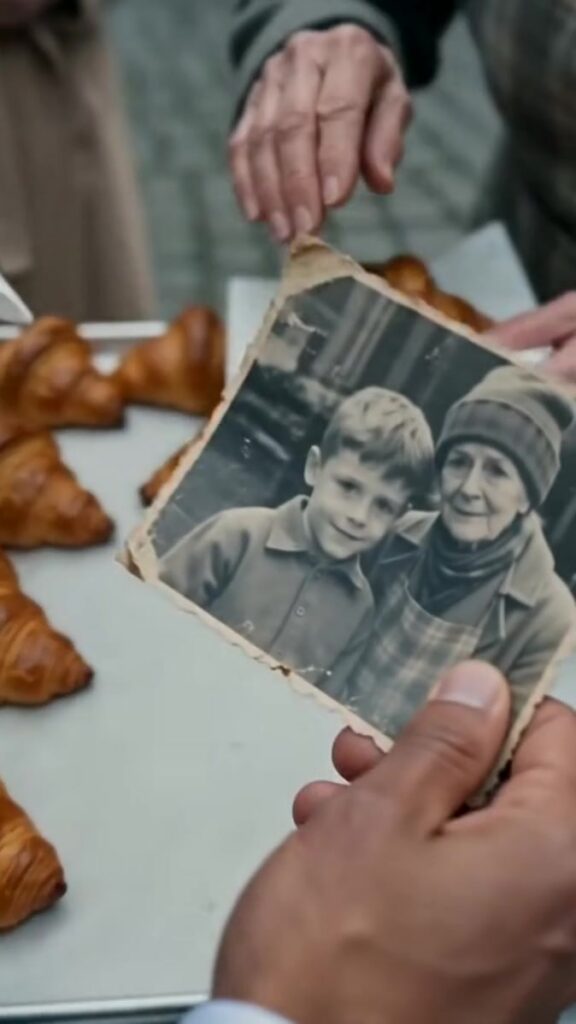
The older woman’s hands trembled as she set the tray down. She moved one pastry aside with the careful deliberation of someone performing a ritual. Beneath it, hidden under the paper lining, was a worn black-and-white photograph—creased at the corners, softened by the oil of many fingers, nearly translucent where it had been folded and unfolded too often.
She slid it toward him across the metal, and the scrape sounded impossibly loud.
“You stood right here,” she said. “Every day.”
Adrian’s fingers shook as he picked the photo up. The paper felt thin as dried leaf, yet it had the weight of something that could break a man.
In the picture, a small boy stood beside a much younger version of the vendor. The boy’s hair was too long, his knees scabbed, his smile missing a tooth. The boy held something in his hands—another pastry on a napkin—and he looked up at the camera with a trust so open it hurt to witness.
The boy’s face.
His face.
Air left Adrian’s body as if someone had struck him. The street tilted. The voices of the town—distant footsteps, a door opening, a cart wheel—pulled away like tidewater. He could only hear his own heartbeat, sudden and panicked, like a child’s.
“No…” he whispered, because denial arrived before thought. “No, this can’t be.”
Mara reached a hand toward his elbow, uncertain whether to steady him or stop him from falling. “Adrian?” she asked, and his name sounded foreign, as if it belonged to the man in the suit and not to the boy in the photograph.
He looked up at the vendor. Her face was older now, lined by years and weather and whatever grief can do when it has nowhere to go. But beneath that, something familiar pressed through: the slope of her cheekbones, the set of her mouth when she tried not to cry, the way her eyes searched him as if he were a doorway she’d been afraid to open.
His posture—always controlled, always composed—broke. His breath came ragged, pulling at his throat like a rope. His eyes stung, then blurred.
“Who are you?” he managed, and the question sounded like betrayal. Because part of him already knew, and part of him could not bear it.
The woman stepped closer. The scent of flour and yeast clung to her coat. Her voice shook now too, the restraint in it finally fracturing.
“The one who waited,” she said.
Adrian’s lips parted. His gaze crawled over her features, desperate, comparing memory to reality. There had been a woman once, in an apartment above a bakery, who sang while she kneaded dough, who kissed his forehead when he was sick, who promised that no matter what happened, she would find him again. There had been a night of sirens and shouting, a hand yanking him away, his own screams swallowed by the dark. There had been years after that when he learned to stop asking questions because questions made adults angry.
Recognition hit him with the force of a collision. It did not arrive gently. It arrived like a door flung open onto a room he’d locked and bricked and painted over.
“Mom…?” The word broke apart as it left him. He hadn’t spoken it in decades. He hadn’t let himself.
The older woman’s eyes filled, and for a moment she looked exactly like the woman from the boy’s memories—young enough to believe love could undo anything. She lifted her hand, stopping just short of touching his face, as if she feared he might vanish, as if permission mattered even now.
“Adri,” she whispered, using a nickname he had not heard since he was small. “My Adri.”
Mara took a step back, stunned into silence. Around them, the street continued its morning, indifferent and ancient. A man with a bicycle passed without noticing. A shutter opened above. Life did what it always did: moved on around the rupture.
Adrian clutched the photograph so tightly it bent. His mind raced through explanations—mistake, coincidence, fraud—because logic was a shield he’d carried for years. But the pastry’s flavor still sat on his tongue like an oath. And the napkin, warm from her hands, was the kind of warmth you don’t manufacture.
“I—” he began, but language failed. What could he say? Where had you been? Why didn’t you come? Why did you let me go? Why did I stop looking? Each question was a knife with two edges.
The woman’s chin trembled. “They told me you were gone,” she said. “They told me so many things. And I… I kept making them anyway.” She glanced at the tray as if it were an altar. “Every morning. Because it was the only way I knew to keep you near. Because if I stopped, it would mean I accepted it.”
Adrian stared at the pastries—golden, ordinary, impossible. The cart suddenly felt like the center of the world, like the place where all his years of ambition and distance and carefully curated success had been walking in circles, unknowingly, toward this corner of stone and scent.
He looked at his watch again without meaning to. The hands had not stopped. Time hadn’t paused for his grief or his miracle. The meeting waited. The car waited. But the boy in the photograph stood still, holding his breakfast and looking up with faith.
Adrian lowered his wrist. He let the watch hang heavy and useless, like a shackle he was finally willing to loosen.
“I don’t know how to do this,” he confessed, voice raw. “I don’t know what to say.”
The woman’s smile was small and broken and brave. “Then don’t say anything,” she replied. “Just… stay. Just for a moment.”
Adrian nodded once, barely. He reached for another pastry with hands that still shook, as if by repeating the simple act he could prove the world was real. He held it but did not bite yet. Instead, he looked at her—at his mother, if that word could be true again—and let the silence stretch between them, not empty now, but full of everything that had been lost and everything that, against reason, might still be found.
Behind him, Mara quietly sent a message to the driver and canceled the schedule without being asked. She watched Adrian’s shoulders soften as though he’d been carrying a weight all his life and had just set it down on a metal tray lined with paper.
The cobblestones stayed cool beneath their feet. The street stayed quiet. And in the warm pastry drifting through the air, the past and present met, not gently, but with the kind of force that changes a man’s name back into a child’s—one trembling syllable at a time.